When Harm Becomes Evidence: Recursive Cascade, Institutional Records, and Repair
An institutional wrong can shape a record that later returns as evidence against the person already harmed. This paper examines that recursive cascade and the obligations of provenance, correction, and repair.
Revised preprint — 3 September 2026
Abstract
Institutions rely on records because records travel. A screening report compresses a history into a decision-ready signal that later actors can use without reconstructing its causes. Compression becomes normatively dangerous when it strips information material to an adverse inference and leaves the person or relation described to bear the cost. A tenant who misses an eviction hearing because of defective notice may acquire a default judgment later treated as evidence of unreliability; a parent whose access to required services was materially impaired may later appear as noncompliant. In each case, harm acquires a portable evidentiary form.
This Article calls that mechanism recursive cascade: an independently grounded breach damages a load-bearing condition of a protected relation; the breach produces or materially shapes an institutional artifact, or renders its later use misleading; and the artifact travels into a later forum as adverse proof. The Article develops a four-domain theory of protected conditions, a selective trigger requiring specific, articulable facts supporting a plausible material nexus, and a role-sensitive cause-tracing allocation among affected subjects, originators, intermediaries, and downstream decision-makers. It also explains when recurring provenance failures justify safeguards at generation, circulation, or reliance rather than repeated case-by-case reconstruction.
The framework does not determine wrongfulness or protected status; those predicates remain independently grounded. It distinguishes correction, reopening, contextualization, and recomposition, and develops the argument through eviction and tenant screening, family separation, Indigenous and collective claims, and an external criminal-record test. Its central claim is limited: when a portable artifact's adverse meaning materially depends on conditions of production, the later inference must answer to that provenance. A breach should not be allowed to govern through an artifact that travels apart from its cause.
Keywords: protected conditions; recursive cascade; institutional records; evidentiary harm; cause-tracing; repair; administrative decision-making; philosophy of law.
Contents
I. Introduction
II. Protected Conditions Model
III. Underlying Breach, Protected-Condition Activation, and Cascade
IV. Recursive Cascade
V. Institutional Pathways: Records, Compliance, Status, Measures, and Proof
VI. Family Separation, Termination, and the Decomposed Bond
VII. Repair: Correction, Reopening, Contextualization, and Recomposition
VIII. Extended Empirical Demonstration: Eviction and the Model Against the Record
IX. Objections and Boundary Conditions
X. Conclusion
Appendix. Relation to Existing Work
References
Legal Authorities
Scope and Status
This Article offers a theoretical and diagnostic framework. It does not itself determine which relations warrant protection or which acts, omissions, classifications, or institutional practices are wrongful; those predicates must be supplied by governing law, institutional duty, legitimate authority, or an independently defended normative account. The framework is citation-supported as a proof of concept but is not an externally validated empirical instrument, predictive model, self-executing legal test, source of jurisdiction, or substitute for context-specific legal analysis.
I. Introduction
A tenant misses an eviction hearing after defective notice. The court enters default. The default becomes a record. The record appears in a tenant-screening report.1 A future landlord reads the record as evidence that the tenant is unreliable. The tenant’s loss of housing has become evidence against future housing. The harm has not ended; it has learned to travel.
That sequence is familiar because modern institutions act through artifacts. Files, notices, dockets, scores, classifications, measures, compliance entries, and status records allow institutions to coordinate judgment across time. They also allow harm to move. An independently cognizable breach can materially produce or shape an institutional artifact, or render the artifact’s later use misleading; that artifact can detach from enough of its production context to travel; and later it can return as proof against the person or relation affected by the original wrong.
That mechanism is recursive cascade.
Recursive cascade is not simply downstream harm. It is not merely bad recordkeeping, procedural error, or administrative burden. It is the evidentiary return by which a breach-shaped artifact becomes adverse proof. A missed hearing becomes unreliability. A missing document becomes nonexistence. A service failure becomes incapacity. A possession record becomes authority. A compliance entry becomes character. In each case, an institution may mistake the residue of breach for neutral evidence.
The record may be accurate yet still mislead when its production conditions fall out of view.
The central rule is simple: do not let a breach govern through its own artifact.
The Article develops this claim through a broader theory of protected conditions. Persons and peoples do not act in the abstract. Meaningful agency is sustained through protected relations whose practical reality depends on load-bearing conditions: interior conditions of memory, dignity, attention, and meaning; bodily and near-body conditions of safety, mobility, health, and contact; sustaining fields of home, land, work, infrastructure, care, language, culture, and material support; and recognized conditions of status, record, standing, title, membership, and legal legibility.2 These conditions are not all property in the same way. Some are not property at all if property means only alienable object-ownership. Property nevertheless supplies one legal grammar of standing, boundary, dependence, exclusion of interference, recognition, inalienability, and repair in settings where law already mediates relations through possession, title, access, records, status, or control.34
The contribution is an integrated account of how an independently cognizable wrong can become institutionally durable. The four-domain Protected Conditions architecture locates the load-bearing support that was impaired; recursive cascade identifies when that impairment acquires a portable evidentiary form; the selective trigger determines when cause-tracing is required; and the repair architecture directs intervention to the point where the breach continues to exert force.
The framework is forensic rather than foundational. Protection and wrongfulness remain independently grounded in law, institutional duty, legitimate authority, or an independently defended normative account. Once an underlying breach is supplied, the Protected-Condition Activation Test asks whether it damaged a condition on which the protected relation depends deeply enough to leave the relation hollow, coerced, unstable, falsified, or practically unavailable. Activation identifies a load-bearing injury; it does not manufacture wrongfulness.
A breach-shaped artifact is an institutionally stabilized trace or proxy whose existence, form, valence, completeness, timing, or proposed interpretation was materially affected by an underlying breach. “Breach-produced” is the narrower existence-caused case. The broader category matters because an accurate artifact may still mislead when detached from the conditions that shaped it.
The Recursive-Cascade Trigger is selective. When a later institution proposes to rely on a possibly breach-shaped artifact, a particularized predicate plus portability, adverse-inference, and material-effect conditions can require cause-tracing. The trigger opens inquiry; it does not decide the merits.
Repair follows the form in which breach continues to act: correction addresses the artifact, reopening procedural posture, contextualization inference, and recomposition a represented relation or authority. Part VII develops their functions and limits.
The governing intuition has a familiar legal ancestry. Prevention doctrine, equitable estoppel and tolling, unclean hands, spoliation, forfeiture by wrongdoing, and related doctrines already refuse in bounded settings to let misconduct generate a legal or evidentiary advantage.5 This Article does not claim to have discovered that principle. Its claimed contribution is narrower and structural: recursive cascade identifies a cross-forum mechanism in which an underlying breach materially produces or shapes a portable artifact, or renders its later use misleading, and that artifact subsequently governs through an institution that may not have committed the original breach, known that it occurred, or understood itself as conferring an advantage on the original wrongdoer.
Recursive cascade also sits beside, rather than displaces, neighboring accounts of due process, administrative burden, epistemic injustice, and algorithmic or proxy governance.6 Those frameworks identify related problems. Recursive cascade isolates a more specific sequence that may operate through any of them: an underlying breach leaves or shapes an institutionally portable artifact, and the artifact later returns as adverse evidence.
The argument proceeds from architecture to mechanism, application, and objection. Parts II-IV develop protected conditions, activation, recursive cascade, and the trigger; Parts V-VIII trace pathways, family separation, repair, and eviction; Part IX tests objections and an external criminal-record case; Part X concludes.
II. Protected Conditions Model
A. The standpoint of the framework
Begin not with a dispute but with a person moving through an ordinary morning. She wakes with her memories, her intentions for the day, her sense of who she is. She takes her medication, pockets her keys, phone, and identification. She leaves a home, crosses a neighborhood she knows, and enters a workplace where she has standing to be. She clocks in; behind the gesture stand a wage record, a lease, a benefits file, a credential — systems that recognize her and authorize the day she is having. Nothing has gone wrong. No one has been harmed.
The model’s first claim is that this — not the auction block, not the courtroom — is where a theory of property should begin: with the structure of agency-in-the-world. A person is constituted and sustained through relations to things across distinguishable domains, ordered from the agent outward. The standpoint is deliberately first-personal. The model maps how the world shows up as mine, as me, as what holds me, as what stands behind me — not how an appraiser would inventory the same scene. This is an old observation wearing new clothes: William James described the self as extending through the body, its clothes and immediate possessions, the home and works, and outward into reputation and accounts — a self with layers, thinning as it extends.7 The model takes that seriously as structure rather than metaphor.
Two consequences follow. First, property here is not a pile of objects but a standpoint-relative field of relations: the organized way an agent holds, depends on, inhabits, and is recognized through the world. Second, because that field has structure, care, investment, inheritance, and harm occur somewhere within it and can travel. The structure comes first; the traffic comes after. This Part builds the structure. Harm enters only in section E, as one kind of traffic through it.
B. The four domains
The four-domain structure sorts the field by proximity to the agent.
In the terms used throughout this Article, the domain may contain both a protected relation and the protected condition that sustains it. The relation is what is at stake; the condition is the threshold support that keeps it meaningful.
Interior conditions. Memory, conscience, meaning, self-trust, intention, and authority over one’s own understanding of one’s life. These are not merely valuable to the agent; they are partly constitutive of her. They cannot be handed over, priced, or substituted. In records-based adjudication they are often available only through testimony, observation, expert interpretation, or another representational step; the condition itself is not the record through which it later becomes legible. They are nonetheless hers in the most exacting sense the word has: she holds them, lives from them, and has standing against their invasion.
Bodily and near-body conditions. The body itself, and the small set of objects functionally fused to immediate agency: medication, identification, the phone that carries access and contact, keys, glasses, a mobility device, tools in hand. The defining feature of this domain is not the market value of its objects — most are cheap — but their fusion with present capacity. A phone in a drawer is an appliance; a phone seized from a person mid-crisis is an amputation of reach. The same object moves in and out of this domain depending on its relation to the agent’s live functioning.
Sustaining fields. Home, land, workplace, the archive, the digital account — the environments within which agency is sustained over time. A field is inhabited rather than carried. It holds routines, stores the near-body objects, anchors the relationships, and gives the agent a place from which to act. Fields are replaceable in principle and ruinously costly to replace in fact, because what is lost with a field is not square footage but the accumulated organization of a life.
Recognized conditions. Records, wages, benefits, memberships, credentials, legal status, classifications, and other forms of standing conferred by systems. These conditions are already organized in institutionally consultable forms and can therefore possess unusual portability and decision-readiness. That does not make them uniformly less constitutive than conditions in other domains: legal standing, membership, or recognized status may themselves be load-bearing. Their distinctive feature is institutional form. A record can open or close a home, a wage sustains a body, and a credential admits one to a field; recognized-tier artifacts can therefore exert causal power across the rest of the model.
Read together, the domains form gradients rather than exceptionless rankings. Constitutiveness often tends to fall as one moves outward, while substitutability and decision-readiness in records-based adjudication often tend to rise. Particular conditions may sit athwart those tendencies. Legal standing is highly legible and can also be gravely constitutive. A body may be directly observed in a clinic or courtroom; interior meaning may enter through testimony; relational conditions may become available through witnesses, records, or expert interpretation. The dimension that matters here is comparative institutional accessibility and portability, not exclusive visibility.
One constant remains beneath the gradients: the relation itself is inalienable at every tier. Objects and institutional forms can transfer; relations do not thereby transfer. A house can be sold, but not being-at-home; wages can be assigned, but not the standing of having earned them; a certificate can change hands as paper while the credential it certifies cannot simply move with it. The ordering therefore supplies no automatic substantive priority. It identifies differences in constitutiveness, substitutability, and institutional decision-readiness.
The resulting structural asymmetry is comparative, not exclusive. Records-based institutions may hear testimony, observe bodies, inspect places, receive relational evidence, or otherwise encounter conditions from the other domains. But recognized-tier artifacts have a distinctive advantage of portability and decision-readiness. They can therefore acquire disproportionate influence when the conditions they represent are harder to reconstruct. That asymmetry is an opening, not a prediction. Whether it becomes a pathway for recursive cascade depends on how the institution treats the artifact in the particular setting.
The domains are distinct but plumbed together, and the plumbing is observable in ordinary life. Relations migrate inward: a house, lived in long enough, becomes home; a field acquires interior weight. They migrate outward: a memory becomes a record; a skill becomes a credential; a grandmother's presence settles into an heirloom that is, on paper, a near-body object worth forty dollars. Ordinary functioning also runs on cross-domain assemblies: being paid for a day's work involves the body, the field, and the recognized system at once. These channels of extension and migration are the framework's connective tissue. Part III shows that cascade is this same connectivity operating under breach. Harm travels along the channels by which the person extended herself. Without that topology, “downward,” “upward,” “lateral,” and “recursive” name nothing.
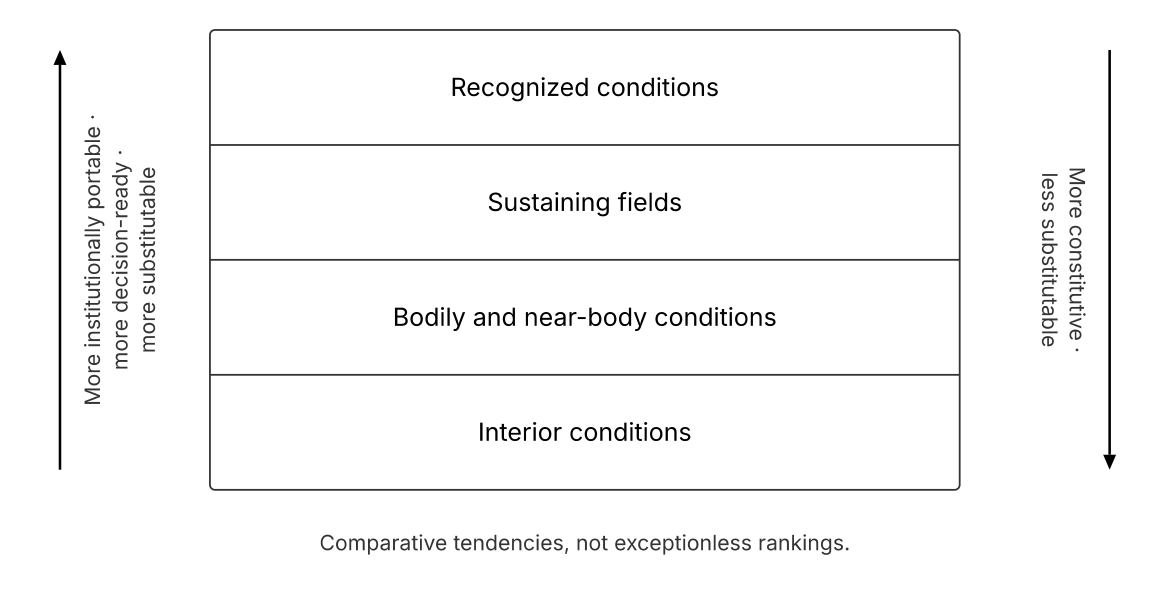
Figure 1. The four domains of protected conditions. Decision-readiness and substitutability tend to increase upward; constitutiveness tends to increase downward.
Two limits govern the sorting. Four domains is a pragmatic resolution, not a claim that exactly four bins are natural or necessary; the commitment is to structured differences in proximity, substitutability, decision-readiness, and connectivity. Person-to-person bonds are not a fifth ring but relations between agents that traverse the domains. The architecture begins from an individual standpoint. Its collective application treats a people as an agent with its own standpoint and carries the translation burden explicitly in Part IX.
C. The framework's concept of property
Property is one legal grammar through which protected conditions become visible; it is not the only possible name for the structure.8
Property is used here in a limited sense. Not every valued condition is an owned object. Property instead functions as a grammar of standing, boundary, dependence, exclusion of interference, and repair where law or institutions already make agency legible through things, records, statuses, titles, possession, recognition, or control.
Hohfeld supplies the relational insight that property organizes relations among persons, while the method here remains the protected relation rather than Hohfeldian decomposition. The question is not which entitlement-box a condition occupies. It is whether a protected relation depends on a condition, whether an independently grounded breach has damaged that condition, and what repair the continuing effects may require.
Singer supplies the same caution from another angle. Property structures social relations; it is not merely a relation between a person and a thing. The framework nevertheless keeps its own trigger vocabulary. Reliance is a backward-looking expectation. Load-bearing dependency is structural and present-tense. A condition matters because this relation depends on it now to remain real, not only because someone once relied on its continuation.
Protected conditions need not be property, and property is not the only grammar through which protected relations can be understood.
Radin enters differently. She is not a reserve source and not the ground of the model. She is credited inheritance at the point where the model treats proximity, inalienability, and anti-commodification pressure as legally intelligible.9 The model shares the insight that some relations to things become bound up with personhood. But it moves from personhood-property to protected conditions: not only which things matter to persons, but which conditions make relations of agency possible and which artifacts can later falsify them.
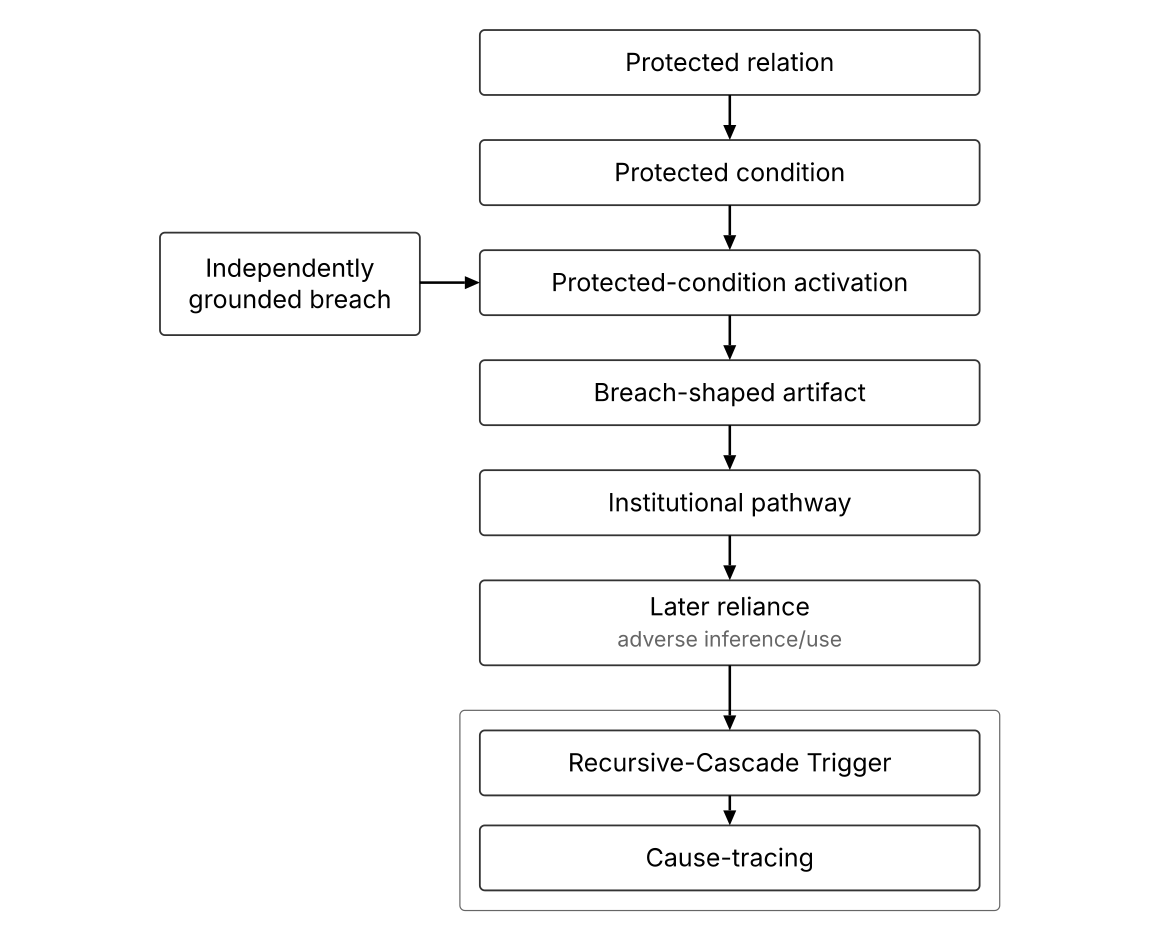
Figure 2. The architecture of recursive cascade. An independently grounded breach enters through protected-condition activation; a breach-shaped artifact then travels through an institutional pathway into later reliance, where the Recursive-Cascade Trigger governs whether cause-tracing is required.
Merrill and Smith mark a boundary for this account. Their formalist and exclusion-centered approaches clarify what a separate treatment of property theory would need to address, but they do not supply the organizing frame here. The argument begins with protected relations and treats property as one bounded institutional grammar.
The contribution is forensic rather than foundational. Wrongfulness must come from governing law, institutional duty, legitimate authority, or an independently defended normative account. Protected Conditions asks what happened after that predicate was supplied: whether the breach damaged a load-bearing condition, how the damage persisted or acquired evidentiary force, and what repair its continuing pathway may require. Adversity, serious impairment, and an adverse artifact cannot by themselves establish breach.
A note on terminology.
The structure is primary; the label is secondary. “Property” remains useful because many applications are administered through property-adjacent institutions, while the framework's operation does not depend on object-ownership or market transfer. Its operative vocabulary remains protected relations, protected conditions, underlying breach, recursive cascade, cause-tracing, and repair.
D. Protected Conditions and the Activation Test
A protected condition is a threshold support that keeps a protected relation real enough to exercise, inhabit, contest, continue, or repair.
Protection remains externally grounded in governing law, institutional duty, legitimate authority, or an independently defended normative account. Once a protected relation is identified, Protected Conditions asks which conditions are load-bearing for its practical reality.
A protected relation is therefore a relation whose claim to protection has an independently grounded legal, institutional, authoritative, or normative basis. A protected condition is the minimum support without which that relation becomes hollow, coerced, unstable, falsified, or practically unavailable: the floor below which the relation loses practical reality.
Calling everything valuable a “Protected Condition” would collapse the category. The Protected-Condition Activation Test therefore has two elements and one remedial implication.
Dependency. The protected relation must depend on the condition to remain meaningful in practice. If the relation remains practically real despite the condition’s loss or impairment, the condition may still matter morally or legally, but it is not doing threshold work within this framework.
Threshold impairment. An underlying breach must damage the condition seriously enough to leave the protected relation hollow, coerced, unstable, falsified, or practically unavailable. Crossing this threshold does not establish the wrongfulness of the underlying conduct; that question has already been answered by the legal, institutional, authoritative, or normative standard that supplies the underlying breach. The Activation Test asks instead whether the wrong has reached a load-bearing condition of the relation.
Remedial implication. When both elements are satisfied, ordinary replacement or compensation may be inadequate because the damage reaches the condition that keeps the relation practically real. This is an implication of activation, not part of the definition of the condition itself.
The Activation Test is counterfactual without making harm conceptually prior to the relation. Asking what would happen if a condition failed identifies a feature of the intact relation, just as asking what collapses without a load-bearing wall identifies a property of the standing building. The test reads the relation under imagined stress to map its real architecture; it uses harm's shadow to find the relation's frame.
E. Neutral structure and what runs through it
Everything to this point describes structure rather than pathology. The domains carry identification and attachment, care, stewardship, labor, inheritance, recognition, and repair as well as injury. That neutrality matters because the architecture must explain ordinary relational life before it explains what breach does to it.
One neutral case shows the structure without wrong. A grandmother wears a ring for fifty years; it carries near-body and interior weight. At her death, probate renders it as a line in an estate inventory—accurate as an object description but thin as a relation. Her granddaughter receives the ring, later wears it, and over time forms a relation of her own. The object transferred; the relation did not. It had to be re-formed. Cross-domain migration, record compression, and relational inalienability are therefore visible before breach enters the framework. Under adversarial conditions, the same structural features matter when a thin institutional rendering is treated as complete.
The same neutral structure carries care, inheritance, recognition, labor, repair, and harm. Part III introduces breach into an architecture that already exists.
When harm enters this structure, two effects matter.
First, the domain structure gives harm a location, direction, depth, and history. Part III's vocabulary of breach and downward, upward, lateral, or recursive movement names what happened to a condition rather than treating injury as undifferentiated loss.
Second, harm can become more than subtraction. In an unstructured picture, harm removes value: something is taken, broken, or lost. In a domain-structured world, harm can also acquire an institutional form.
That conversion depends on a premise about institutional decision-making that the domain structure alone does not supply. Call it the artifact-reliance premise: records-based institutions make decisions through stabilized artifacts — records, statuses, measures, classifications, scores, absences, and other proxies — that can be consulted apart from the full conditions that produced or shaped them. The premise does not assert that institutions invariably accept such artifacts at face value or that cause-tracing is uncommon. It identifies a structural possibility: an artifact can remain institutionally usable even when its conditions of production are not reconstructed in the later forum.
Where that possibility is realized, the legibility asymmetry becomes an active channel. Displacement may become a nonappearance; an inaccessible process may become a default; instability may become a screening score; thinned participation may become a compliance status. The harm has not merely subtracted. It has left an institutionally usable trace with persistence beyond the conditions that produced it.
This is a structural rather than statistical claim. The domains, their connectivity, and institutional artifact reliance identify where recursive cascade can occur; they establish possibility rather than prevalence. Two scope rules follow. The framework still requires an independently grounded underlying breach, including for interior conditions, and ordinary attenuation, development, migration, generational drift, or cultural adaptation counts as breach only when the governing legal, institutional, authoritative, or normative standard makes it one.
Domain placement is not an additional trigger condition. It identifies where the breach entered the protected relation, how the resulting condition became institutionally legible, and whether repair directed only at the portable artifact would leave the underlying condition or relation impaired.
The same eviction artifact shows why domain placement matters. A recognized-condition defect may call principally for correction, sealing, linked disposition, or limits on adverse reliance. If eviction also damaged the sustaining field of home, artifact repair may leave the underlying condition impaired and require restoration or reopening where governing authority permits. A bodily or near-body barrier may require restored accommodation or access as well as record repair. Interior harm can likewise explain why resource replacement alone may not restore the relation without turning every psychological consequence into a separate entitlement.
Domain placement therefore does not determine whether the Recursive-Cascade Trigger is satisfied. It changes the diagnostic account of what the breach damaged and, once cause-tracing establishes the relevant pathway, helps identify what would remain unrepaired if intervention stopped at the portable artifact.
F. Bonds Are Edges, Not Holdings
The four domains describe how an agent holds, inhabits, depends on, and is recognized through the world. They should not be mistaken for a theory that turns every important relation into a thing held by one person. Person-to-person bonds require a different grammar.
A bond between persons is not a holding. It is an edge between agents. A parent-child bond, a kinship bond, a care relation, or a relation of peoplehood may carry interior meaning, bodily presence, shared fields, and recognized records, but none of those is the bond itself. The bond traverses the domains without becoming an object inside one of them.
This distinction matters most where law relies on records. A birth certificate, custody order, visitation log, adoption decree, membership record, school file, archive entry, or benefits record may represent part of a relation. Such records can be necessary. They may protect persons, stabilize expectations, prevent arbitrariness, or preserve memory. But the record is a proxy. It is not the relation itself.
The point is especially important in the parent-child case. A child is not the parent’s property. The parent-child relation is not an object owned by either side. It is a protected relation between persons, one mature and one developing, each with protected conditions of safety, continuity, care, memory, and belonging. Treating a child as a holding of the parent would be the very domination the model is designed to name, not a conclusion the model permits.
Children remain agents within protected relations, never property within the framework. The edge structure explains why.
Part VI returns to this edge structure in family separation. Before that application, Part III identifies when an independently grounded breach reaches a load-bearing condition and how the resulting harm can move.
III. Underlying Breach, Protected-Condition Activation, and Cascade
Part II separated independent wrongfulness from protected-condition activation. This Part develops dependency and threshold impairment, then asks how activated harm can move. A serious loss is not an underlying breach merely because it crosses the Activation Test, and a real breach may fall outside this framework if it does not damage a load-bearing condition of a protected relation. Once activation occurs, cascade names the movement that follows.
A. Dependency
A condition is not protected merely because it is valuable. Within this framework, dependency asks whether an independently protected relation relies on the condition to remain practically real. The inquiry is structural: what relation is being sustained, and what condition keeps that relation exercisable, inhabitable, contestable, continuable, or repairable?
A relation to home may depend on lawful access, stable occupancy, working utilities, record accuracy, and the ability to contest displacement. A relation to work may depend on wages, tools, bodily safety, schedule stability, and recognition of status. A relation to culture or peoplehood may depend on land, language, ceremony, kinship, memory, archives, and authority over meaning. A relation to a child may depend on safety, care, presence, communication, records, time, and non-falsified institutional judgment.
Dependency is not sentimentality. The question is not whether the person cares about the condition, but whether the relation loses practical reality when the condition is removed, damaged, falsified, or governed by someone else. A person may care deeply about many things that are not protected conditions in this sense. The framework activates only when an underlying breach reaches a condition doing load-bearing work for an independently protected relation.
B. Threshold Impairment
Even when dependency exists, not every impairment activates the framework. Threshold impairment occurs when an underlying breach damages the condition seriously enough to leave the protected relation hollow, coerced, unstable, falsified, or practically unavailable.
A relation becomes hollow when its legal or social form remains but the condition that gives it substance is gone. It becomes coerced when continuation depends on pressure or conditions that defeat meaningful choice. It becomes unstable when the supporting condition is made unreliable enough that agency cannot be organized around it. It becomes falsified when a record, category, or public account substitutes an institutional version for the relation itself. It becomes practically unavailable when the protected condition cannot be used, accessed, inhabited, invoked, or repaired in the real world.
The threshold is therefore functional. It asks whether the condition still allows the protected relation to operate as a real condition of meaningful agency. It does not establish that the underlying interference was wrongful; that predicate has already been supplied elsewhere.
C. Modes of Protected-Condition Impairment
Once activation is satisfied, the following categories describe modes of impairment; they do not establish wrongfulness, create causes of action, or rank claims. Their function is diagnostic: to show how a load-bearing condition was damaged and what continuing effects may require attention.
Domination occurs when one actor gains controlling power over another’s basic conditions of agency.10 It appears when institutions or private actors can decide whether a person may remain housed, recognized, safe, present, or heard while the affected person lacks meaningful capacity to contest the decision.
Coercion occurs when acceptance is produced by pressure or the absence of a meaningful alternative. The issue is not merely that the person chose under difficult circumstances. The issue is whether the protected relation was made dependent on accepting terms that damage the condition that makes the relation real.
Erasure occurs when memory, identity, belonging, authority, record, or presence is removed, replaced, or made illegible. Erasure may be physical, as when objects, bodies, or people are removed from the field that gives them meaning. It may also be administrative, as when records omit the conditions that explain the record.
Extraction occurs when value, labor, data, knowledge, culture, land, or relational authority is taken without rightful relation or repair. Extraction is not limited to markets. It can appear where an institution uses a person’s compliance, a people’s knowledge, or a community’s cultural materials while denying the authority that gives the relation meaning.
Destruction occurs when the condition is degraded, consumed, or rendered unusable. It may be obvious, as with destroyed property or environmental damage. It may also be relational, as when a support condition is damaged so severely that restoration cannot return the relation to its prior form.
Disabling interference occurs when a person or people is blocked from action, communication, self-government, contestation, or repair. This mode is especially important because it links breach to cascade. A breach that disables correction can later appear as silence, nonappearance, waiver, weak affiliation, or lack of proof.
These modes overlap. A single breach may dominate, coerce, erase, extract, destroy, and disable at once. The point is not to sort the breach into a single box. The point is to make visible what ordinary categories often compress.
D. Breach, Attenuation, and Internal Transformation
Breach must also be distinguished from attenuation and internal transformation.
Not every loss of continuity is a breach. A family may reorganize. A person may leave a place. A community may change ceremony, membership practice, language use, governance structure, or public presentation. A tradition may evolve through the authority of the people who live it. These changes may be painful, contested, or uneven without becoming protected-condition breach.
Internal transformation occurs when a relation changes through the authority of the persons or people whose relation it is. External interference enters the framework as an underlying breach only when governing law, institutional duty, legitimate authority, or an independently defended normative account supplies wrongfulness. That distinction limits outside authority in collective contexts and also matters in ordinary individual cases: waiver, departure, sale, relocation, or nonparticipation is not automatically breach. The later inquiry is whether the act reflects meaningful agency under the relevant conditions or is the trace of prior disabling interference.
E. Cascade
A breach may remain local and be corrected before it travels. Or it may move across domains and return in altered form. Cascade names that movement.
A downward cascade moves from recognized or institutional conditions into sustaining fields, bodily conditions, or interior conditions. A benefits denial may become food insecurity, then health decline, then loss of planning capacity. A court record may become housing exclusion, then displacement, then school instability, then fear.
An upward cascade moves from bodily, interior, or field conditions into recognized standing. Illness, trauma, displacement, transportation barriers, or caregiving burdens may produce missed appointments, incomplete forms, nonappearance, late filings, or missing documentation. Those artifacts then enter institutional records.
A lateral cascade spreads across adjacent fields. Loss of digital access may disrupt work, school, benefits, medical care, banking, and communication at once. Loss of transportation may affect employment, court attendance, visitation, medical care, and food access simultaneously.
A recursive cascade returns. The harm produces an artifact, absence, status, or compliance failure that later becomes evidence against the person or relation harmed. Part IV gives this form full treatment because it is the central mechanism.
Cascade is not a severity multiplier. It is a movement inquiry. It asks where the breach went, what it became, whether it disabled correction, and whether repair must reach beyond the first visible loss.
F. Contestability
Contestability is the condition that allows a breach to be named, challenged, corrected, and repaired without retaliation.11 It is not only a procedural value. It can itself function as a protected condition where meaningful challenge, correction, or review is load-bearing for an independently protected relation. Whether it does so in a particular setting depends on the governing legal, institutional, or normative order; the framework does not make contestability protected merely by naming it.
In some settings contestability looks like notice, access to records, counsel, hearing, translation, accommodation, review, appeal, and anti-retaliation protection. In other settings it may look like customary process, kinship authority, ceremonial protocol, council deliberation, restorative procedure, or internal governance. The minimum is not procedural sameness. The minimum is that correction remains meaningfully available under the relevant normative order.
A formal opportunity is not meaningful if the conditions needed to use it are missing.
Contestability matters because institutions often read its absence as neutral. Silence becomes acceptance. Nonappearance becomes waiver. Missing documentation becomes nonexistence. Incomplete participation becomes weak belonging. Lack of correction becomes proof that the record was accurate. But if the breach itself impaired the capacity to contest, then absence of contestation cannot be treated as independent proof that no breach occurred.
The resulting inquiry asks who controlled the record, who could create or correct it, what evidence was excluded, what risks attached to objection, and whether reliance on the record alone would leave the relation hollow, coerced, unstable, or falsified.
Most cascades describe movement. Part IV turns to recursive cascade: the breach-shaped artifact returns as evidence against the person or relation affected by the breach.
IV. Recursive Cascade
Recursive cascade is the evidentiary return by which a breach-shaped artifact becomes adverse proof. It is not simply that harm spreads. It is the pattern in which an independently grounded breach damages a protected condition, leaves or shapes an institutionally stabilized artifact, and a later institution uses that artifact to judge the person or relation affected by the original wrong. The sequence is simple: breach → artifact → return.
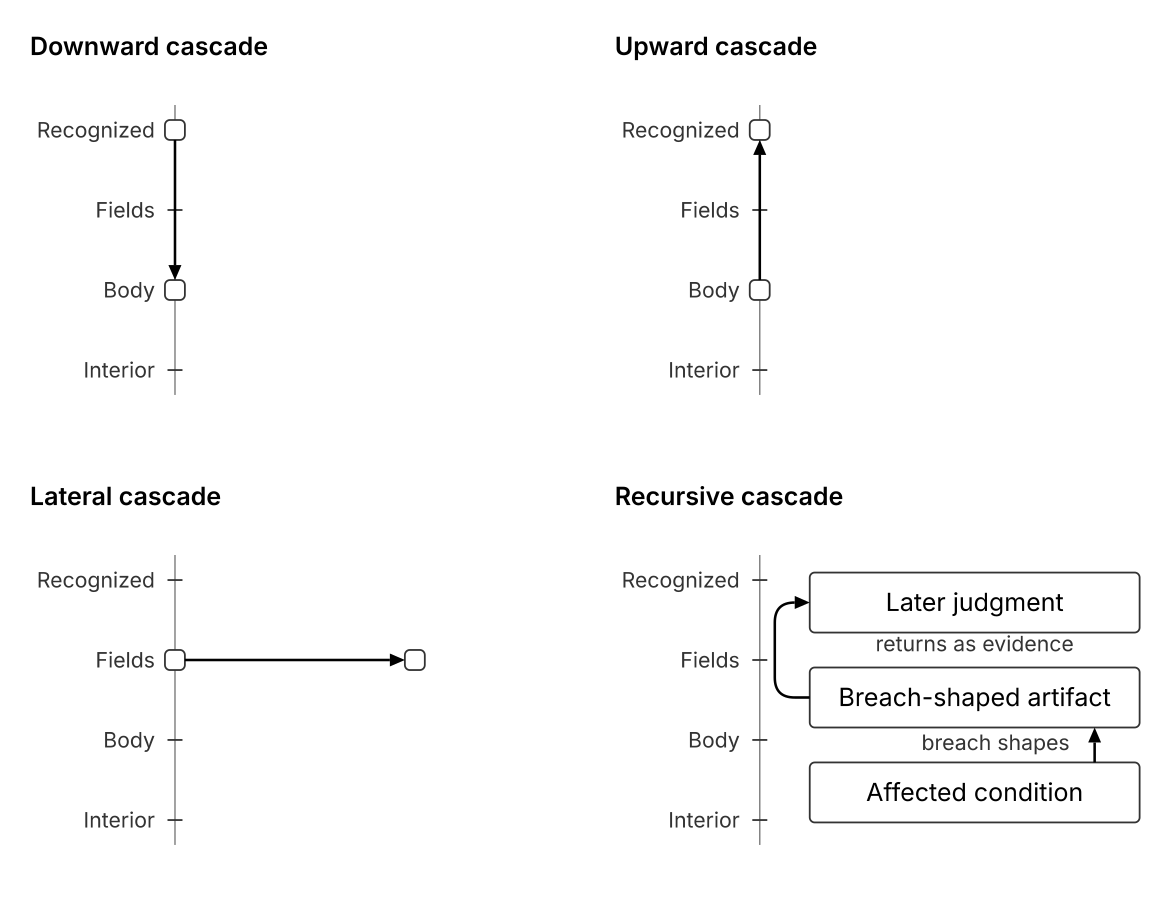
Figure 3. Four forms of cascade movement. Recursion differs from the other three in that a breach-shaped artifact returns as evidence in later judgment about the affected person or relation.
Artifact is a functional rather than merely physical category. It is an institutionally stabilized trace, representation, measure, status, classification, or proxy that can be preserved, counted, transmitted, or invoked in judgment apart from the full conditions that produced or shaped it. A docket entry and a screening score are artifacts, as may be a recorded nonappearance, compliance status, default judgment, classification, or institutionally counted period of elapsed time.
Not every consequence of a breach is therefore an artifact. Fear, displacement, pain, loss of trust, or weakened relation may be consequences without becoming artifacts. They enter the artifact category only when an institution renders some trace or proxy of them sufficiently stable to become an input into later judgment. The distinction matters because recursive cascade concerns not harm in general but harm that acquires an institutional form capable of evidentiary return.
A breach-shaped artifact is an artifact whose creation, content, completeness, timing, status, institutional meaning, or proposed interpretation was materially affected by an underlying breach. Materiality asks whether that effect is substantial enough that treating the artifact the same way without the causal information could alter the later institution's judgment; mere causal background or additional context is insufficient. “Breach-produced” is the narrower case in which the underlying breach generated the artifact itself.
Recursive cascade matters because modern institutions often decide through artifacts. Files, notices, statuses, deadlines, compliance entries, data systems, court dockets, agency notes, scores, classifications, and documentary continuity can be necessary.12 They coordinate decisions, protect persons, preserve memory, and check arbitrary power. The danger arises when a breach-shaped artifact remains institutionally usable after the production conditions that explain it have fallen out of view.
A. The Recursive-Cascade Trigger
The Recursive-Cascade Trigger is separate from the Protected-Condition Activation Test. Activation asks whether an independently grounded breach has damaged a load-bearing condition of a protected relation. The Recursive-Cascade Trigger asks whether an institutional artifact connected to that breach now requires cause-tracing before it may support an adverse inference.
The inquiry begins only where an institution relies, or proposes to rely, on an artifact and there is a reasonable basis to question attribution. A reasonable basis requires specific, articulable facts supporting a plausible material nexus between an independently grounded breach and the artifact's existence, form, valence, completeness, or proposed interpretation. General adversity, the prevalence of institutional barriers, or the artifact's adverse effect is insufficient by itself.
The predicate may be supported by defective notice, inaccessible services, a documented record mismatch, displacement, a disability-related barrier, institutional delay, retaliation, exclusion from records, or comparable facts only insofar as those facts connect the possible breach to the artifact or proposed inference. The completed recursive claim need not be proved in advance; the predicate asks whether there is enough particularized causal information to justify tracing rather than treating the artifact as self-explanatory.
Where that predicate is met, cause-tracing is required only if three additional conditions are present: the artifact can travel apart from its cause; it can support an adverse inference; and that inference materially affects access, standing, recognition, repair, or a protected relation.
If the predicate is absent, the recursive-cascade inquiry does not begin. If any of the three conditions is absent, the inquiry ends. If all are present, the institution must trace the artifact back to its conditions of production before treating it as self-explanatory evidence. The trigger opens inquiry; it does not decide the merits. Cause-tracing may confirm recursive cascade, show that breach only partly shaped the artifact and therefore requires qualification or contextualization, or establish that the proposed inference rests on independent evidence. The requirement is internal to the framework’s diagnostic claim: where the trigger is satisfied, an institution cannot treat the artifact as self-explanatory without resolving the identified attribution problem. Whether governing law independently requires that inquiry, and what legal consequence follows from failure to perform it, remain questions for the applicable legal regime.
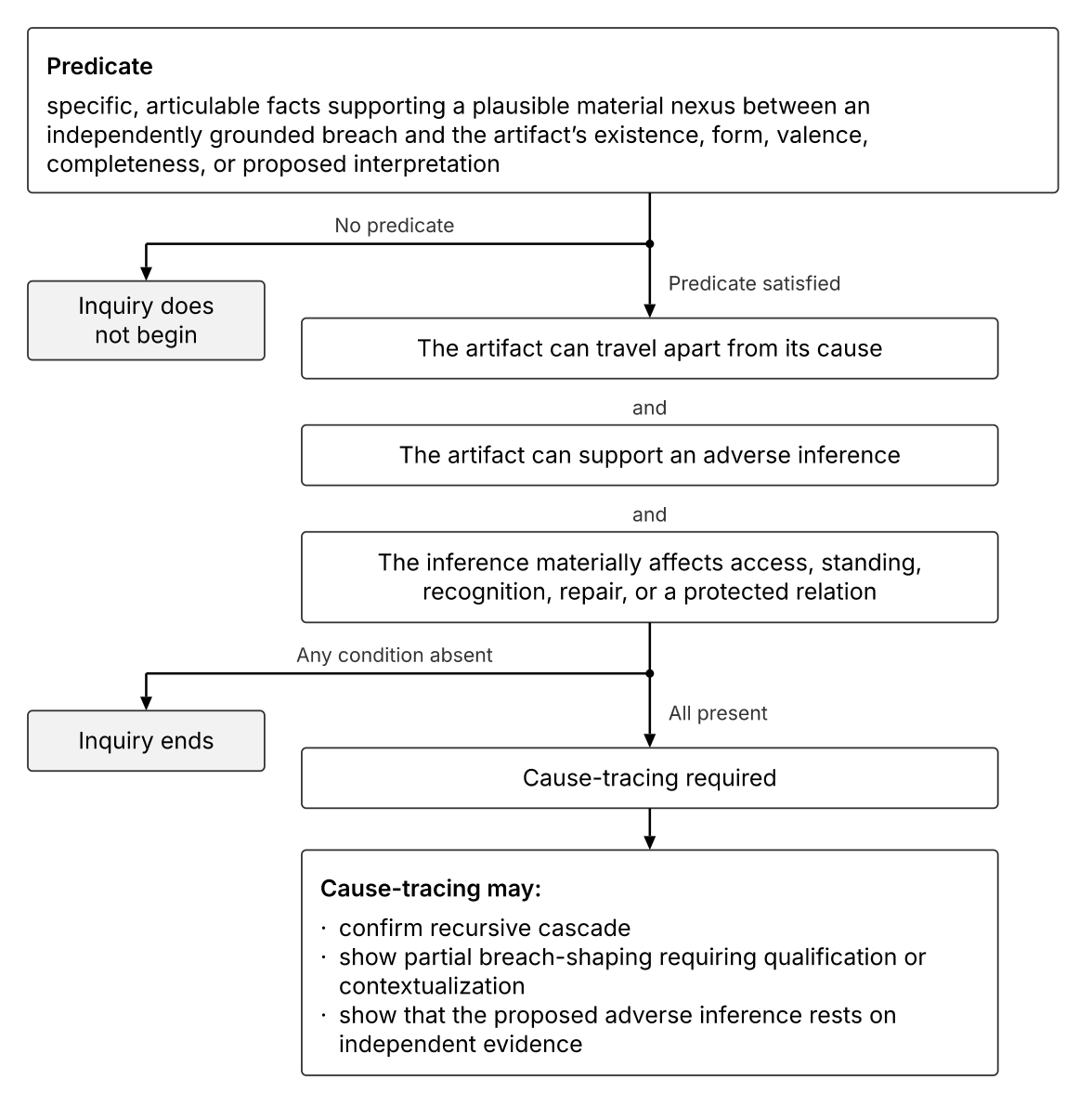
Figure 4. The Recursive-Cascade Trigger. Cause-tracing is required only where the predicate is satisfied and all three conditions are met; otherwise the inquiry ends.
B. Structural Pattern and Individual Claim
The trigger identifies when cause-tracing is required. The framework must then identify the level of response and the actor positioned to trace or interrupt the pathway.
At the structural level, recurring pathways may justify system-level safeguards. Repeated attribution failures do not weaken or strengthen the individual predicate; they change the appropriate level of intervention. Where the same provenance failure recurs, preservation, linked disposition, masking or sealing, transmission limits, or limits on adverse reliance may be more administrable than reconstructing the same causal history case by case.
At the individual level, the connection remains case-specific. The affected subject, the artifact, or information already held by an institution must supply specific facts supporting a plausible material nexus between an independently grounded breach and the artifact or proposed inference. Once the predicate and three trigger conditions are present, cause-tracing determines whether breach produced the artifact, materially shaped it, rendered an accurate artifact misleading, or left the proposed inference independently supported.
The individual claim may therefore fail even within a structurally risky pathway: the artifact may not be breach-shaped, correction may already be sufficient, independent evidence may support the inference, or countervailing protected conditions may require a different result.
C. Allocating Cause-Tracing Across Institutions
Cause-tracing is hardest when provenance and decision authority are divided. Responsibility therefore follows institutional role rather than a generalized duty on the person described by the artifact to reconstruct an institution-controlled history.
The affected subject bears a limited prima facie production burden: an independently grounded breach plus specific facts supporting a plausible material nexus to the artifact or proposed inference. That showing opens tracing; it does not prove the recursive claim or require records controlled elsewhere. What counts as sufficient specificity is calibrated to the information reasonably available to the affected subject, so lack of access to institution-controlled provenance cannot itself defeat the predicate.
The originating institution bears responsibility within the framework for material source information it controls, including notice, disposition, correction history, and known qualifying context. The allocation follows informational control, not an assumption that the originator committed the breach.
An assembler, reporting agency, or screening intermediary is responsible for accurately linking available disposition and qualifying information and maintaining a workable dispute pathway. It need not invent missing context, but it should not discard available provenance and present the compressed artifact as complete.
The downstream decision-maker owns the inference. If the trigger is satisfied and necessary provenance remains unavailable through no fault of the affected subject, the artifact may not function within the framework as self-explanatory adverse proof. The decision-maker may seek more information, discount the inference, or rely on independent evidence.
Tracing costs should presumptively follow control of the missing information or institutional benefit from compression, subject to governing law and reasonable administrability limits. Portability should not make the subject pay the full cost of reconstructing provenance that another institution controls.
These are diagnostic and procedural allocations proposed by the framework, not claims that existing law universally imposes each preservation, production, linkage, dispute, non-inference, or cost rule.
D. What Recursive Cascade Is Not
Recursive cascade differs from ordinary downstream harm. Downstream harm shows that one injury led to another; recursive cascade shows that the later injury returns to the evidentiary field and changes how the original relation is judged.
Recursive cascade also differs from bad recordkeeping, due process failure, or generalized distrust of records. An inaccurate record may be nonrecursive, and a formally adequate procedure may still rely on breach-shaped evidence. Records remain necessary. The narrower question is whether a portable artifact's defect or production conditions become adverse proof without the cause-tracing required by the trigger.
The problem is not always falsity. The problem is decontextualized accuracy. A record may be true in a narrow sense while misleading in the inference it invites.
E. Forms of Breach-Shaped Artifact
Recursive cascade can appear through several artifact forms.
Nonappearance occurs when absence from a hearing, meeting, visitation, appointment, ceremony, school event, or administrative process is later treated as waiver, abandonment, noninterest, or lack of care, even though the absence may have been produced by notice failure, displacement, lack of transport, detention, illness, inaccessible scheduling, or fear of retaliation.
Missing documentation occurs when a person or people cannot produce records because the relevant institution controlled, lost, withheld, misclassified, destroyed, or never created them. The absence is then read as lack of proof.
Compliance failure occurs when a person fails to satisfy an institutional requirement under conditions the institution helped create: inaccessible services, impossible timelines, language barriers, disability barriers, poverty constraints, transportation gaps, or inconsistent instructions. The failure is then read as refusal, incapacity, or lack of commitment.
Status degradation occurs when a temporary or breach-related condition hardens into a durable status: default, eviction record, suspended benefits, noncompliant parent, unreliable tenant, weak member, inactive participant, unauthorized occupant, or nonresponsive claimant.
Proxy scoring occurs when a score, classification, or risk category converts prior instability into future exclusion. The score may look objective while carrying forward breach conditions embedded in the data.
These forms may overlap. A displaced tenant may miss a hearing, lose documents, receive a default, appear in a tenant-screening report, and then be scored as high-risk.13 A separated parent may miss visits, fail services, lose housing, receive negative compliance entries, and later face those entries as proof against the bond. A people whose cultural materials were removed may later face the removal’s effects as proof that relation, continuity, or authority is weak.
F. Neighbor Literatures
Due process addresses notice, hearing, impartial decision-making, and erroneous deprivation; recursive cascade isolates the later evidentiary return of breach-shaped evidence. Administrative burden explains learning, compliance, and psychological costs; recursive cascade adds the return by which burden-produced failure becomes proof against the claimant.14 Epistemic injustice explains wrongs to persons as knowers; recursive cascade adds the institutional life of artifacts that may travel more powerfully than explanation.15 Algorithmic and proxy-governance scholarship shows how data systems carry prior disadvantage into future exclusion; recursive cascade is broader because it also appears in paper records, court files, agency notes, visitation logs, school records, and archive descriptions.16
G. Anti-Recursive Safeguards and Remedial Priority
Anti-recursive safeguards should be selected by the point at which distortion enters or continues through an institutional pathway. Part VII develops the repair families; this section supplies the selection logic. The aim is not to multiply remedies, but to intervene where the failure can most reliably prevent a breach-shaped artifact from becoming adverse proof.
Production failure calls for intervention at the source. The originating institution may need to avoid generating an unnecessary adverse proxy, repair notice or access before the artifact forms, preserve source information, or link the artifact to its disposition and qualifying context. The relevant actor is the institution controlling production, and the relevant moment is before an avoidable distortion stabilizes into a portable record.
Portability failure calls for intervention before or during circulation. An originator, repository, reporting agency, or screening intermediary may need to seal, mask, expunge, restrict access to, or limit transmission of an artifact whose downstream use cannot reliably preserve the information necessary to interpret it. The point is not that every breach-shaped artifact must disappear; it is that portability should not outrun provenance.
Interpretation failure arises when the artifact may properly remain available but cannot fairly do the evidentiary work proposed for it. The downstream decision-maker then owns the safeguard: non-inference, burden shifting, contextualization, corroboration, or a requirement to resolve the attribution problem before adverse reliance. This intervention operates at the moment of judgment rather than at record production.17
Procedural-posture failure calls for action by the forum or institution that controls the affected posture. Reopening, restored time, renewed notice, reconsideration, or review may be necessary when a breach-shaped artifact has hardened into default, waiver, closure, or another procedural position that would otherwise continue to govern.
Representational failure calls for intervention where an institutional representation has displaced the relation or authority it purports to describe. The institution controlling that representation may need correction or recomposition; in collective or Indigenous contexts, the appropriate response may instead be return of authority, deference, or withdrawal from interpretive control. The safeguard must repair representation without converting repair into a new claim of authority.
Priority depends on whether qualifying context can reliably travel with the artifact. Annotation and contextual metadata are weak safeguards when a downstream system routinely strips them, does not transmit them, or does not present them to the later decision-maker. Where context is unlikely to travel, adding a tag at the source leaves the basic portability problem intact. The framework should then prefer intervention at generation, circulation, or adverse reliance: prevent the misleading proxy from forming, limit the conditions under which it travels, or bar the unsupported inference it would otherwise invite.
This is a reliability priority, not an automatic preference for deletion. Some records must remain available for legitimate institutional purposes, and independent evidence may still justify an adverse decision. Where several failures coexist, the preferred safeguard is the earliest feasible intervention that reliably interrupts recurrence while preserving legitimate use and countervailing protected conditions. Upstream safeguards can reduce repeated downstream tracing; they do not decide the merits of any individual case.
Part V turns from artifact form to the institutional pathways that make artifacts portable and consequential.
V. Institutional Pathways: Records, Compliance, Status, Measures, and Proof
Artifact form and institutional pathway are distinct. The artifact is the stabilized institutional output; the pathway is the system, rule, practice, or process through which it remains usable, moves into another forum, or acquires later force. A nonappearance may travel through a court docket, service-compliance system, or eligibility screen. A compliance status may travel through service-plan reporting and later adjudication.
The distinction matters because repair may have to reach both. Correcting an artifact without interrupting the pathway may leave the harm capable of recurring. Altering a pathway without correcting an already portable artifact may leave the existing distortion in circulation.
The problem is institutional detachment, not record use as such: an artifact becomes available for judgment apart from enough of its production context to test the inference it invites.
A. Why Pathways Matter
A breach-shaped artifact becomes recursively consequential because an institutional pathway permits it to persist, travel, enter another decision, or stand in for a fuller history. Pathway analysis asks how the artifact becomes decision-ready beyond its point of production and where repair must interrupt that continued force.
B. The Record-System Pathway
The most direct pathway is the record system through which an entry is created, preserved, transmitted, and later consulted.
A default, eviction filing, missed appointment, agency note, school entry, medical notation, employment entry, or benefits file may later be read as a neutral account of conduct. If the record was produced under conditions of breach, it preserves the breach in portable form.
A record can become more durable than the relation it misdescribes. Later institutions may see the entry without seeing the housing crisis, displacement, family separation, translation failure, inaccessible process, or administrative delay that produced it.
C. The Compliance-System Pathway
A second pathway is the compliance system. Institutions judge through deadlines, service plans, appointments, forms, proof requirements, attendance, and completion entries. These tools can make administration possible and protect against arbitrary decision-making.
Compliance systems can also carry breach. A person may fail to comply because access was blocked, notice failed, services were unavailable, or the relevant condition had already been destabilized. When the later institution treats that failure as neutral proof, the breach returns through compliance.
D. The Status-Classification Pathway
A third pathway is the status-classification process. Status compresses history into a label: evicted, noncompliant, absent, ineligible, unverified, terminated, abandoned, inactive, risky, disqualified. Once status attaches, later institutions may treat it as fact rather than as process.
That compression may be useful, but it can also falsify the relation. If the label was breach-shaped, it can shape housing, work, benefits, care, family contact, membership, or remedy long after the original conditions disappear.
E. The Measurement and Classification Pathway
Some artifacts travel not as narrative records but as compressed measures or classifications. A risk score, eligibility category, time-in-care measure, priority ranking, or other institutional classification can condense a longer history into a decision-ready input.
Compression is not itself wrongful. Institutions often need classifications and measures in order to act consistently. The recursive risk arises when the measure incorporates conditions shaped by an underlying breach and later travels as though the measure were independent of those conditions. A score may encode prior instability without identifying what produced the instability. A statutory clock may count both person-consumed and system-consumed time without distinguishing between them. A classification may preserve an earlier exclusion after the conditions that produced it have disappeared.
The relevant inquiry remains the same: what did the measure stabilize, what conditions shaped it, what inference does it support, and what later decision gives that inference force?
Part VI applies pathway analysis where an artifact can become a proxy for a relation between agents: the parent-child bond.
VI. Family Separation, Termination, and the Decomposed Bond
The preceding Parts identify the recursive mechanism and the pathways through which breach-shaped artifacts acquire later force. This Part tests that architecture in family separation.
Part VI makes a narrower evidentiary claim about separation-produced artifacts in legal severance proceedings; it is not a general theory of child-welfare reform.
As Part II explains, bonds are edges rather than holdings. Family separation is difficult because a reciprocal parent-child relation may be adjudicated through records even though neither the child nor the relation is property held by one side. Both parent and child retain protected conditions of safety, continuity, care, memory, and belonging.
Public authority may have duties to protect a child from danger, neglect, abuse, abandonment, or disabling conditions; that safety premise is internal to the framework. The narrower claim arises when separation-produced artifacts later become adverse evidence about the relation. When the trigger is met, those artifacts require cause-tracing.
The claim does not make every removal wrongful, every missed visit breach-produced, or reunification the proper repair.
A. Legal Seriousness: Severance of a Bond
Termination of parental rights is among the most serious acts a legal system can perform against a family relation.18 It does not merely regulate conduct. It may sever the legal relation between parent and child. That seriousness is why procedural and evidentiary safeguards matter.
The framework adds a relational explanation for the seriousness of termination. Because the child is not property and the bond is not a holding, termination is the legal decomposition of an edge between persons rather than the taking of an object from an owner. The law may sometimes have reason to sever or permanently alter that edge, especially where the child's protected conditions require it. But artifacts materially shaped by the separation itself require cause-tracing before they support severance.
Separation and the institutional conditions surrounding it can coincide with, and in some cases materially shape, signs later made relevant to severance: missed visits, incomplete services, unstable housing, loss of contact, emotional distance, inability to demonstrate care, weakened proof of attachment, or negative compliance records.19 These signs may be real. The question is what produced them and what inference may fairly be drawn from them.
The relational account sharpens legal seriousness. Where the state first alters the conditions of relation and then judges the relation through those altered conditions, the risk is not merely error. It is recursive cascade.
B. Housing as Bond-Specific Artifact
Housing is not only a background resource in family-separation cases. It may become a bond-specific artifact.
A parent without stable housing may be judged unable to provide care. Yet housing instability can have different causes. In re G.S.R. illustrates one legally important distinction: poverty-linked housing conditions cannot simply substitute for parental unfitness.20 Other possible pathways—displacement, domestic violence, discrimination, benefit delay, an eviction record, or conditions associated with separation—require their own case-specific evidentiary support. The resulting record may say lack of suitable housing. It may later return as evidence that reunification is unsafe, impractical, or contrary to the child’s interest.
This can be legitimate in some cases. Children need safe and stable housing. A court or agency cannot ignore dangerous housing conditions. But the inference is different when housing instability is treated as an uncaused fact. The question is whether the housing condition reflects danger to the child, lack of parental capacity, poverty without neglect, institutional delay, or a breach-related barrier.
If the system requires a parent to demonstrate housing while also producing or worsening the conditions that make housing unavailable, housing becomes recursive. The absence of housing is no longer a simple fact about the parent. It is also a record of the field in which the parent is being judged. D.N. is the individual-level exemplar because the court itself performed the attribution inquiry. The opinion treated the father’s lack of housing as a poverty-linked barrier rather than proof of parental unwillingness or incapacity, reversed the detriment finding, and expressly warned that the premature finding “could affect father in future dependency proceedings.” The case matters here because the artifact remained real, but the inference drawn from it could not stand until its cause was traced.21
C. Compliance as Institution-Controlled Artifact
Service plans, visitation schedules, treatment requirements, classes, evaluations, and reporting obligations can become central evidence in family-separation proceedings. They are designed to measure participation, effort, capacity, and risk. They can be necessary. They can also become institution-controlled artifacts.
Compliance is not a natural fact. It depends on notice, access, transportation, language, disability accommodation22, scheduling, childcare, service availability, safety, trust, and the coherence of instructions. When those conditions are absent, noncompletion may reflect the system’s design as much as the parent’s will.
Noncompliance remains relevant. A parent may refuse services, avoid contact, remain dangerous, or fail to act when action is possible. But inaccessible, delayed, culturally inappropriate, poorly explained, internally inconsistent, or impossible services change what the compliance record can fairly prove.
The recursive risk is direct: the institution sets the service pathway, controls participation records, and later offers noncompletion as evidence against the bond. The same institution may become record-maker, evaluator, and petitioner. That structure requires cause-tracing; it does not by itself prove error.
Service compliance, visitation, and family contact may be relevant to reunification and permanency analysis. The conditional question is whether institutionally damaged access conditions produced the missed visit, incomplete service, or weakened contact before that record is treated as an adverse inference.
D. Elapsed Time as an Institutional Measure
Time itself is not an institutional artifact. But an institution can convert elapsed time into one by measuring, recording, and assigning legal or evidentiary significance to it. Family-separation proceedings provide the limiting case. A statutory time-in-care period does not represent new parental conduct in the way that a missed visit, nonappearance, incomplete service entry, or compliance failure does. It is an institutional measure: elapsed time counted under a rule and made capable of producing legal consequence.
That distinction makes the permanency clock important to the model without treating time itself as a record. The formal claim is statutory: federal law can make time in foster care relevant to a petition-filing requirement, subject to exceptions.23 The analytic claim is narrower: where an institution converts elapsed time into an adverse input, the conditions that consumed that time may matter to the inference drawn from it. If the institution materially consumed part of the period through service delay, inaccessible visitation, continuances, or comparable barriers, the resulting time measure may become breach-shaped. The question is not whether time passed. It is what institutional meaning may properly be assigned to the measured passage of time.
Permanency timelines answer a real harm: foster-care drift. A child suspended indefinitely in temporariness may suffer injury to stability, care, continuity, and future planning, and the child's relation to permanency can itself be independently protected. The inquiry therefore concerns how evidence is produced when the parent-child bond and the child's need for stability collide, not whether permanency timelines are inherently objectionable.
The problem arises when the clock cannot distinguish parent-consumed time from system-consumed time. A parent and child separated for many months may lose ordinary rhythms of care. The child may bond with other caregivers. The parent may struggle to maintain presence through supervised visits, limited communication, distance, poverty, service waitlists, agency delay, continuances, caseworker turnover, or inaccessible scheduling. Some of that time may reflect parental refusal or incapacity. Some may reflect the system’s own pace. The legal risk is that the measure will count both the same. Program evaluations, conformity reviews, and related sources document circumstances in which service delay, nonprovision, workforce instability, continuances, or other system-side barriers can consume reunification time.24
ASFA contains a bounded statutory foothold for the same attribution problem. Its petition-filing mandate includes exceptions, including where the State has not provided services it deems necessary for the safe return of the child when the specified reasonable-efforts requirement applies.25 Read structurally, that exception recognizes that a system should not invoke time it materially consumed as though the passage of time were self-explanatory.
The same two-level discipline applies here that applies to nonappearance and compliance failure. Structurally, a time measure deserves scrutiny where the institution can materially consume the period it later counts. Individually, however, a parent must supply case-specific facts connecting system conduct to the measured period: agency continuances, documented service waitlists, inaccessible visitation, failure to provide required services, or comparable evidence. Without that showing, elapsed time may still matter.
The claim is therefore precise: not that clocks are bad, and not that permanency should yield to parental claims. The claim is that a clock that cannot distinguish system-consumed time from parent-consumed time may convert the system’s own pace into evidence on one side of a relation it is supposed to adjudicate. The time measure then becomes recursive: the institution may convert time it materially consumed into evidence on one side of the relation it must judge.26
E. The Child Does Not Disappear
A parent-centered theory would be defective. The child is not the object through which the adult’s claim is vindicated. The child is a developing agent with protected conditions of safety, care, continuity, bodily security, emotional stability, memory, belonging, and future agency.
For that reason, recomposition cannot mean automatic reunification. If return would expose the child to danger, serious instability, abuse, or disabling conditions, the model does not require return. The child’s protected conditions may require continued separation, guardianship, adoption, kinship placement, or another arrangement.
But the child’s standpoint also does not authorize evidentiary shortcuts.
A system cannot protect the child by falsifying the relation being judged. Nor can it treat separation-produced artifacts as neutral proof while ignoring how those artifacts were produced. The child’s interest is not served by a record that cannot distinguish danger from poverty, refusal from inaccessibility, abandonment from exclusion, or lack of bond from state-produced attenuation.
Child safety is not an exception to the model. It is part of the model.
F. Public Authority as Record-Maker and Petitioner
Recursive cascade is especially dangerous where the same public system helps create the record and later relies on that record to seek severance.
An agency may control visitation schedules, service referrals, case notes, housing assessments, safety plans, transportation supports, documentation requests, and reports to the court. It may also decide what counts as compliance, which barriers are recorded, how parent explanations are framed, and which facts become durable file entries. Later, those entries may be presented as evidence that the parent failed to participate, failed to bond, failed to provide, or failed to benefit from services.
This structure may be unavoidable in part. Child-welfare systems need records. Courts need evidence. Agencies must report. But where the agency’s own decisions shape the conditions of participation, the resulting records cannot be treated as if they arose from a neutral field.
Role-awareness follows. A record produced inside the separation system must be read with attention to who controlled the conditions that made it possible. Where the state altered the relation, controlled the evidence of that relation, and then seeks severance through that evidence, recursive-cascade safeguards are at their highest.
There is also a reason the Article does not build this Part around a single completed termination that it declares wrongful. A completed recursion may leave a record that says only what the artifacts said, and on appeal that record may be indistinguishable from a justified severance. Contestation itself may be under-resourced: due process does not categorically guarantee appointed counsel in every termination proceeding, and access to appellate review may turn on the ability to obtain the record. The reversals are visible instances in which the attribution problem reached appellate review; they show correction doctrine operating where a tribunal could see the attribution problem.27
G. Bond-Specific Recomposition
The repair problem in family separation is not solved by correcting a single entry. A wrong date, missing service note, or inaccurate housing description may need correction. A missed hearing may need reopening. A misleading compliance history may need contextualization. But where the artifact stands in for the parent-child relation, repair must also be bond-specific.
Recomposition is not a command to reunify. It is a command not to sever through untraced proxies.
Bond-specific recomposition asks whether the evidentiary picture of the relation has been distorted by the conditions of separation. It asks whether visitation records, service plans, housing entries, time-in-care timelines, bonding assessments, and compliance histories have been read as if they were the relation itself. It asks whether the child and parent have been given a meaningful opportunity, consistent with safety, to demonstrate the relation under conditions that do not falsify it.
This may require more than one remedy. It may require correction of records, reopening of procedural posture, contextualization of noncompliance, additional services, adjusted visitation, kinship or cultural supports, delay where delay protects accuracy without harming the child, or a changed permanency path where recomposition would endanger the child. The remedy depends on the condition breached and the pathway through which the breach continues to act.
The central rule is modest but demanding: do not let separation-produced artifacts do the work of proving that the bond deserved separation.
Family separation shows why repair may have to reach records, posture, inference, and relation rather than the initial loss alone.
VII. Repair: Correction, Reopening, Contextualization, and Recomposition
Repair must therefore reach the condition breached and the pathway through which the breach continues to act.
This Part translates that rule into four repair families: correction, reopening, contextualization, and recomposition. They are functions, not fixed remedy labels. A court, agency, archive, school, landlord, employer, museum, or other institution may perform them through different legal forms. The question is what work repair must do.
A legal remedy is an authorized institutional response available under a particular legal regime. Repair, as used here, means a response that reaches the damaged condition and interrupts the continuing pathway of harm. The framework may help identify when a legal remedy is insufficient to repair the damaged condition, but it does not itself create legal entitlement, jurisdiction, liability, or remedial authority.
A. Why Compensation Is Not Enough
Compensation is often necessary. It may repair loss, restore access, support transition, or recognize injury. But compensation alone is incomplete when the breach continues through an artifact or institutional pathway.
Payment does not correct a circulating inaccurate record. Damages do not reopen a default produced by defective notice. Compensation does not supply context for a true but misleading statement. Money does not recompose a relation decomposed through proxies.
The repair inquiry begins by asking what condition was damaged and how that damage still operates.
But compensation may be insufficient when the artifact, procedural posture, inference, or relation remains unrepaired.
B. Repair Must Be Condition-Matched and Pathway-Matched
A repair is condition-matched when it addresses the load-bearing condition damaged by the underlying breach. It is pathway-matched when it intervenes at the system, rule, practice, or process through which the resulting artifact, posture, inference, or representation continues to exert institutional force.
The categories must remain distinct. The artifact is the stabilized institutional output. Procedural posture is the position into which the person or relation has been placed. Inference is the evidentiary meaning assigned to the artifact. The represented relation or authority is what the proxy purports to describe. The institutional pathway is the route through which any of those targets persists, travels, or acquires later force.
Both dimensions of repair may be necessary. A housing subsidy may stabilize shelter while an eviction record continues to block later housing through tenant-screening systems. A service referral may help a parent while old noncompliance entries continue through the case-record pathway. A museum may preserve an object while an accession record and cataloguing practice continue to claim interpretive authority. Conversely, record correction may address the artifact while leaving the underlying sustaining condition unrepaired.
The governing rule is therefore: repair must reach the condition damaged and the pathway through which the breach continues to act.
C. Correction: Repairing the Artifact
Correction repairs the artifact.
It is appropriate when the record, file, status, score, entry, description, or classification is inaccurate, incomplete, outdated, mismatched, or attributed to the wrong cause. Correction may require deletion, amendment, annotation, dispute notation, reclassification, replacement, or creation of a missing record.
Correction is most familiar in record systems: tenant-screening reports, benefits files, school records, service plans, archive descriptions, and museum records.28 It is not merely clerical. In recursive cascade, the artifact may be the vehicle through which harm continues. If the artifact is wrong, repair must stop the wrongness from traveling.
Correction has limits. Some artifacts are accurate but misleading: a missed visit, unattended hearing, passed deadline, or possession record may be true. In such cases the problem may be posture, inference, or relation.
D. Reopening: Repairing Procedural Posture
Reopening repairs procedural posture.
It is appropriate when a breach-shaped artifact caused loss of procedural position: default, waiver, missed deadline, closed file, lapsed appeal, completed removal, denied benefit, terminated eligibility, or final order. If the posture was produced by conditions that disabled meaningful participation or contestation, repair may require reopening rather than explanation. Finality serves real values: stability, reliance, efficiency, and protection from endless relitigation.29 But finality should not protect a posture produced by defective notice, inaccessible process, institutional delay, retaliation, disability barrier, language exclusion, or other breach condition.
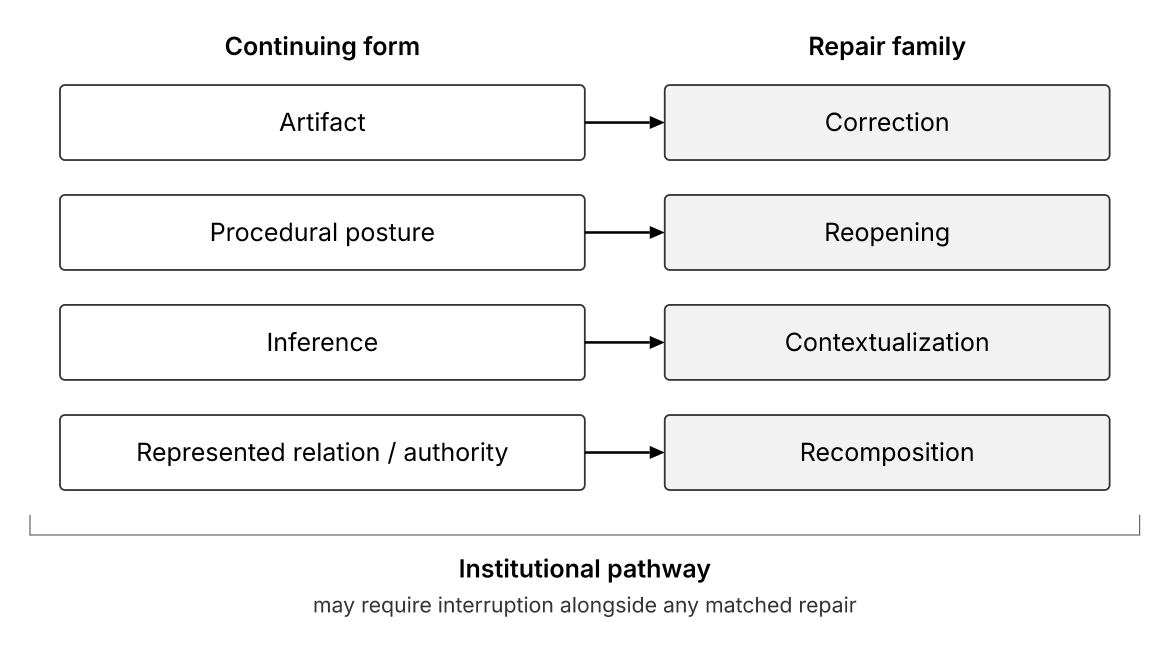
Figure 5. Repair matched to continuing form. Each continuing form identifies a primary matched repair family; interruption of the institutional pathway may be required alongside any of them.
Reopening does not decide the merits. A tenant may still lose. A claimant may still be ineligible. A parent may still fail to show safe reunification. But the decision should not rest on a posture the breach created.
E. Contextualization: Repairing the Inference
Contextualization repairs inference.
It is appropriate when the artifact is accurate as far as it goes but misleading without its conditions of production. The question is not whether the artifact occurred. The question is what it means.
A missed appointment, service failure, low participation record, documentation gap, or possession record may be true but misleading if notice was defective, services were inaccessible, participation was conditioned by fear, distance, disability, poverty, or exclusion, the institution controlled the archive, or possession is mistaken for authority.
Contextualization does not erase facts. It prevents unsupported inferences from them. It may require explanation, notation, burden shifting, evidentiary limits, source disclosure, decision-maker instruction, or a rule against adverse inference unless cause has been traced.
The artifact need not be false to be dangerous. It need only travel apart from the conditions that explain it.
F. Recomposition: Repairing the Relation as Represented
Recomposition repairs the relation as represented.
It is appropriate when an artifact or pathway does not merely affect an object, benefit, or procedure, but stands in for a relation: a parent-child bond, kinship relation, community membership, peoplehood, cultural authority, relation to ancestors, relation to land, or relation to an object whose meaning exceeds possession.
Recomposition asks whether records, categories, possession files, compliance histories, timelines, or proxy measures have been treated as if they exhausted the relation. If so, repair must recompose the relation’s representation before it is judged.
In family separation, recomposition may require the court or agency to reconstruct the evidentiary picture of the parent-child relation in light of separation conditions, service access, visitation constraints, housing barriers, child safety, kinship supports, and time under altered conditions. Recomposition is not a command to reunify. It is a command not to sever through untraced proxies.
In collective or Indigenous contexts, recomposition means returning authority over relation where outside records have displaced it; it does not mean external reconstruction of the relation’s meaning. A museum, court, agency, archive, or scholar may identify that an external record has distorted a relation. That does not authorize the outsider to define the relation. Repair may require correction, consultation, repatriation, deference, return of authority, or withdrawal from interpretive control.30
Recomposition is demanding because it reaches the point where record, relation, and authority meet. It must therefore be controlled by non-domination. The institution repairing the breach must not seize the authority of the relation it claims to protect.
G. Matching Repair to Continuing Form and Pathway
The repair families correspond to different cascade problems: wrong artifact, locked posture, misleading truth, or proxy relation.
Many cases require more than one.
A tenant-screening case may require correction, reopening, and contextualization. A family-separation case may require correction of case notes, reopening of a missed-hearing posture, contextualization of noncompliance, and recomposition of the parent-child bond. A collective-authority case may require record correction, access or display limits, and recomposition through return of authority rather than outsider reconstruction.
The key is not to multiply remedies. The key is to match repair to the way harm continues.
H. Limits on Repair
Repair has limits.
First, repair must not endanger another protected condition: a child’s safety, a victim’s bodily security, a community’s internal authority, or a person’s freedom from coercion.
Second, repair must not presume that return is always possible or desirable. Some relations cannot be restored to their prior form. Some objects cannot be returned. Some time cannot be undone. Some injuries require substitute arrangements, acknowledgment, support, or future-facing safeguards.
Third, repair must not become domination. In collective and Indigenous contexts, correcting records, returning materials, deferring to internal authority, or withdrawing from interpretive control may be required. But repair cannot become a new basis for defining the relation itself.
Fourth, repair must respect finality where finality was not breach-shaped and reopening would impose unjustified harm on others. The framework authorizes inquiry into a posture that may itself be breach-produced, not endless relitigation.
Fifth, repair must remain administrable. The model does not require maximal investigation in every case. It requires cause-tracing where a portable artifact supports an adverse inference and there is reason to believe the artifact may have been breach-shaped.
These limits do not weaken repair. They make repair answerable.
Repair cannot become institutional self-absolution. A response that leaves the breached condition or pathway intact may become remediation theater.
I. From Repair to Demonstration
With the constructive architecture stated, Part VIII tests it against the eviction record and Part IX tests it against its principal objections and boundary conditions.
VIII. Extended Empirical Demonstration: Eviction and the Model Against the Record
The preceding Parts build an architecture: a graded field of relations, a mechanism by which breach becomes traveling evidence, a selective trigger for when cause-tracing is required, and a repair matched to the pathway. This Part examines that architecture in eviction, drawing on Matthew Desmond’s ethnography of displacement in Milwaukee and the quantitative work surrounding it.31
Eviction is an extended empirical demonstration, not an independent validation domain. The case helped generate and organize the theory from the beginning: it opens the Article, supplies its running example, and makes the artifact-reliance problem unusually visible. Success here therefore cannot establish that the framework travels unchanged to every other institution. It can show three more limited things.
First is explanatory fit: whether the four-domain architecture organizes harms that otherwise appear as separate consequences and whether cascade accurately describes their movement.
Second is diagnostic yield: whether the reasonable-basis predicate and three conditions identify when a consequential record requires cause-tracing without treating every adverse record as suspect. Third is remedial surplus: whether the framework identifies a continuing artifact, procedural posture, inference, or represented relation that the leading resource remedy leaves unrepaired.
Family separation in Part VI remains the Article’s principal cross-domain stress test because it moves the mechanism into another institutional setting, another artifact structure, and another conflict among protected conditions. Its evidentiary register is thinner and more doctrinal—statutes, cases, and institutional design rather than a comparable empirical literature. The Article does not present either domain as external validation. Eviction supplies the extended empirical demonstration; family separation tests whether the architecture remains intelligible when the institution, relation, and protected interests change.
This Part asks what the framework explains, what it diagnoses, and what additional repair target it reveals. The claim is not that every eviction record is breach-produced or every tenant-screening decision wrongful.
A. Explanatory fit: eviction across the four domains
The model’s first claim is that what a person holds is not a stock of things but a graded field of relations, and that a home sits in the sustaining-fields tier, plumbed to every other. Eviction is the case that shows the field whole, because the loss of a home registers in all four tiers at once.
In the recognized tier, eviction produces a record. Public eviction records can persist and create barriers in later housing searches, including where a case disposition does not support a simple inference of tenant fault.32 In the sustaining-fields tier, the loss is the home as platform: Desmond’s epilogue imagines Arleen and Vanetta able to settle in one neighborhood and enroll their children in one school if rent did not consume so much of their income — the field’s worth measured not in square footage but in the schooling, the proximity, and the standing it had been holding up.33 In the bodily and near-body tier, eviction is the physical scattering of a life — a household’s belongings carried to the curb or to storage by movers working beside sheriff’s deputies, the forced and repeated relocation that disassembles the near-body world of objects through which a person acts.34 And in the interior tier, eviction exacts a documented psychological toll: Desmond reports that roughly half of recently evicted mothers experienced multiple symptoms of clinical depression, about twice the rate of similar mothers who were not forced from their homes; Desmond and Kimbro likewise find higher depression among matched low-income urban mothers evicted in the previous year. A separate clinical report described three patients who died by suicide within five days of imminent eviction and asked why eviction had not been recognized as a “significant precursor of suicide.”35
The clinical report is important but bounded evidence. Its authors emphasized that none of the three patients was facing homelessness and said that this highlighted the possibility that eviction — distinct from homelessness — was a specific and proximal risk factor for suicide, particularly for vulnerable patients. The model does not turn that small clinical series into a general causal estimate. It uses the distinction to show why the loss of a home may injure more than access to shelter. Across the four domains, the documented harms are connected by the relation to home, which is why a remedy aimed only at replacing the resource can leave other pathways of harm standing.
B. Diagnostic yield: the nuisance sequence
The model holds that under breach harm travels, and that the upward cascade runs from the interior and bodily tiers into the recognized one. A documented sequence makes the claim concrete. In one of Desmond’s chapters, a neighbor’s repeated calls to the police about a woman being beaten in the apartment above generate a nuisance citation against the landlord; when the landlord proposes only to warn the tenant, the police district rejects the proposal and will accept nothing short of eviction — the city, in effect, requiring the removal as the price of abating the nuisance.36 The cause that produced the calls, a man’s violence, drops out of what the housing system reads; what remains on the record is nuisance activity attributed to the tenancy.
This is the upward cascade in its starkest form: a breach in the bodily and interior register — physical safety — surfaces as an adverse housing record. It also illustrates the structural asymmetry. Physical safety may be deeply constitutive, while a later housing system may encounter the count of calls or resulting nuisance record more readily than it can reconstruct the violence that produced them. Once stabilized in that form, the artifact becomes portable and decision-ready and may be read against the tenancy. Nor is the scene anomalous. In an analysis of every nuisance citation issued in Milwaukee over two years, roughly a third were generated by domestic violence, most landlords resolved the citation by evicting or threatening to evict the tenant, properties in Black neighborhoods were cited at disproportionate rates, and landlords took steps to discourage tenants from calling the police at all.37 The mechanism the scene dramatizes is documented at scale; what the model adds is its name and its place in a general structure — one cascade form among four, not an idiosyncrasy of housing law.
C. The Recursive-Cascade Trigger in Eviction
An eviction record does not trigger cause-tracing merely because it is consequential. The predicate is met only when evidence outside the later adverse inference supplies specific, articulable facts supporting a plausible material nexus between an independently grounded breach and the artifact's existence, form, valence, completeness, or proposed interpretation. Defective notice, withheld repair, displacement, or violence-generated nuisance enforcement can supply such facts; adversity alone cannot.
With that predicate met, the three conditions ask whether the artifact travels apart from its cause, supports an adverse inference, and materially affects access, standing, recognition, repair, or a protected relation. In eviction, a citation can record nuisance without the battery that generated the calls, and a judgment can record default without the notice or access conditions that shaped it; the portable form can then gate the next tenancy.
Ordinary adverse records remain outside the trigger. A default after valid notice or a compliance entry recording genuine refusal may be portable and consequential without a plausible breach nexus. The harder case is the tenant who genuinely owed rent. The debt is not breach-caused, but defective notice may shape whether it becomes a default judgment rather than a cured, contested, dismissed, or differently resolved matter, and a later screener may treat that procedural form as evidence of unreliability.
Cause-tracing must therefore keep debt and default distinct. Specific facts must connect the notice breach to the default's form or proposed inference; the tenant may owe the debt while the judgment's valence remains materially breach-shaped. If the landlord's later decision is independently supported by verified debt or other evidence, the recursive claim narrows or fails.
The same case tests allocation. The tenant supplies the prima facie notice nexus; the court or originating system supplies source information it controls; the screening intermediary links available disposition and qualifying information and provides a dispute route; the landlord remains answerable for the inference. If necessary provenance cannot be recovered through no fault of the tenant, the unresolved default cannot become self-explanatory proof of unreliability merely because institutional information is divided. Independent evidence remains independently consequential.
The eviction demonstration thus applies the strengthened mechanism rather than presuming its result: predicate, trigger, role allocation, cause-tracing, and independent-evidence check operate in sequence.
D. Remedial surplus: the record the voucher misses
The eviction literature also marks the boundary of a purely distributive remedy, and with it the model’s distinctive contribution. Desmond’s proposed remedy is distributive and, on its own terms, formidable: a universal housing voucher that would loosen the market pressures driving displacement and guarantee a floor of shelter.38 It restores the resource. The model has no quarrel with the voucher as far as it reaches; its point is that the model adds a repair target the voucher does not reach — the eviction record itself. A family re-housed by a voucher still carries the eviction on its record, and that record can continue doing the kind of work recognized-tier artifacts can do — gating the next application, surfacing in the next eligibility screen, and narrowing the next landlord’s search. The resource is restored; the artifact is left untouched.
This is the harm the model isolates and the repair it prescribes. Repair must reach the pathway through which the breach continues to act. Here the artifact is the eviction record; the pathway is its continued circulation through court-record and tenant-screening systems into later housing decisions. The corresponding repair is therefore not a further transfer but an operation on the artifact itself: correction where the record is wrong, sealing or expungement where its continued circulation is the injury, contextualization where it is accurate on its face but misleading in its effect. Sealing and expungement reforms illustrate, in the model’s terms, a record-oriented complement to distributive relief: they reach an artifact that a housing subsidy does not itself remove. And the interior finding from subsection A supplies the reason the two halves are not interchangeable: because the injury is to a relation and survives in a record rather than consisting in the loss of a resource alone, a resource-only remedy is structurally unable to complete the repair. This is the sense in which the Article identifies a repair target that the voucher does not itself supply: not by contradicting the distributive account, but by addressing a continuing artifact that resource replacement can leave standing.
E. Scope, limits, and possible failure
A demonstration is disciplined by what it refuses to become. This Part has not independently validated the Protected Conditions model, advanced a complete theory of eviction, or proposed a housing-policy program. The empirical study of eviction’s causes, distribution, and rate belongs to the sociology on which the Part relies. The design of vouchers, sealing statutes, screening rules, and housing institutions belongs to further normative and institutional work.
The narrower claim is that the eviction record supplies explanatory fit, diagnostic yield, and remedial surplus. The architecture organizes the loss of home across domains rather than treating its consequences as unrelated. The nuisance and tenant-screening sequences show how bodily or field-level breach may surface as a portable record and later support an adverse inference. The repair analysis identifies a continuing record-based harm that a resource remedy can leave standing. Those are contributions of structure and diagnosis. Because eviction helped generate the theory, they are confirmation within a generative domain, not independent validation.
The demonstration also states conditions under which the framework would fail to add what it claims. It would lack explanatory fit if the four domains merely renamed a list of consequences without showing a relation among them, or if cascade supplied no account of how harm moved. It would lack diagnostic yield if the reasonable-basis predicate could not distinguish possible breach-shaped artifacts from ordinary adverse records, or if the documented artifacts did not travel apart from their causes and support later inferences. It would lack remedial surplus if restoring the housing resource also removed the continuing record, procedural posture, adverse inference, and distortion of the relation, leaving no additional repair target for correction, reopening, contextualization, or recomposition. Any of those findings would show that the framework added vocabulary without additional explanation, discrimination, or repair.
Part VI bears a different burden. Family separation remains the principal cross-domain stress test because the parent-child bond, child safety, institutional time, service access, and termination records place the theory under pressures that eviction does not. But the present Article’s evidence there is thinner and differently constituted. The framework’s ability to organize those materials supports portability; it does not substitute for a deeper empirical study of child-welfare records and outcomes.
Held to these limits, Part VIII strengthens the Article without making the eviction materials prove more than they can. Carried past them, the same evidence would cease to be a demonstration and would become a separate empirical or policy project.
IX. Objections and Boundary Conditions
The objections below test the limits that make the framework usable: scope and property language; persons, bonds, and conflict; distinctiveness from neighboring theories and doctrine; records and noncompliance; collective authority; capabilities and vulnerability theory; and institutional usability.
The framework is defensible only if its stopping points are explicit. This Part identifies where the theory must narrow, defer, or stop.
A. Scope: Is This Really Property, and Does the Model Prove Too Much?
Two objections test scope from opposite directions: that the Article stretches property too far, and that protected conditions are so broad that almost any serious setback could activate the framework.
1. Property is a grammar, not the whole ontology
The property objection identifies a real risk. If property means only alienable object-ownership, much of the framework is not property in that sense: memory, children, collective relations, and legal status are not commodities, and the Article should not pretend otherwise.
The Article instead uses property as one legal grammar for protected relations: boundaries, standing, exclusion, access, use, repair, transfer, inalienability, and institutional recognition.39 Property law already does more than protect market exchange. It also structures relations among persons, things, places, records, and institutions and determines who may enter, use, remain, exclude, inherit, transfer, contest, or recover.
Property is therefore one grammar of protected conditions, not the whole ontology. It is useful where it identifies standing, boundary, dependence, interference, recognition, or repair. Where property language would turn a person, bond, or collective relation into an owned object, the framework refuses the translation.
That bounded role is sufficient. Even if a reader rejects the property label for interior or relational conditions, recursive cascade can still stand as a theory of protected relations, breach-shaped artifacts, and repair. Property remains useful because its mature grammars of boundary, standing, exclusion, dependence, transfer, inalienability, recognition, and repair make many otherwise diffuse disputes institutionally tractable.
2. Independent protection and independent wrongfulness
Overbreadth is serious because a framework that activates for every frustration becomes unusable. Protected Conditions narrows before recursive-cascade inquiry begins.
First, the relation's protection must be supplied independently by governing law, institutional duty, legitimate authority, or an independently defended normative account; importance alone is insufficient.
Second, wrongfulness is independently supplied. Serious impairment does not itself establish an underlying breach.
Third, an underlying breach does not activate Protected Conditions merely because something valuable was affected. Activation requires dependency and threshold impairment: the condition must be load-bearing and the breach serious enough to leave the relation hollow, coerced, unstable, falsified, or practically unavailable.
The framework therefore narrows at distinct points: not every relation is protected, not every impairment is a breach, and not every breach reaches a load-bearing condition at threshold depth. Preference, inconvenience, or attachment alone does not activate the architecture.
Breach is also distinct from authorized internal transformation. Traditions, families, persons, and peoples may change through their own authority; change is not breach merely because an outsider expected continuity.
Protected Conditions is thus a selective forensic architecture for independently grounded wrongs that reach load-bearing conditions and may persist or return through institutional artifacts. The four domains locate impairment and remedial remainder; they are explanatory and remedial coordinates, not an additional activation or trigger gate.
B. Persons, Bonds, and Conflict
A second family of objections asks whether the framework can protect relations without subordinating the persons within them. The concern is clearest in the parent-child case, but it also appears whenever protected conditions on different sides of a relation genuinely conflict.
1. Bonds are relations between agents, not holdings
A parent-child application would be fatal to the theory if it treated the child as parental property. The framework instead treats the bond as a relation between agents.
As Part II explains, bonds are edges rather than holdings. A parent-child relation runs between persons rather than belonging to either; both parent and child retain protected conditions of safety, continuity, care, memory, and belonging.
This point controls the family-separation analysis. The claim is not that public authority interferes with parental property. The claim is that a parent-child bond is a reciprocal protected relation and that, where the Recursive-Cascade Trigger is satisfied, records or measures materially shaped by the separation conditions or an underlying breach must be cause-traced before they are treated as self-explanatory evidence about that relation.
The child's standpoint is internal to the framework. If return would endanger the child's protected conditions, Protected Conditions does not require return. Child safety is part of the protected relation the institution must judge, not an exception to it.
2. Conflict requires a discipline of judgment, not a universal priority rule
The harder objection concerns genuine conflict. If memory, body, home, record, bond, safety, and collective authority can all warrant protection, some conflicts will survive diagnostic clarification. At that point the framework supplies a discipline of judgment while another source of normativity resolves priority.
Protected Conditions supplies a discipline for judging conflicts rather than a complete priority rule.
First, the institution must correct the conditions of judgment before it ranks competing claims. Legibility is not priority. A record, status, classification, or number receives no additional normative weight merely because it is easier to consult. The decision-maker must identify what each claim actually protects and whether any apparent interest is itself a breach-shaped artifact or an inference detached from its cause. A genuine conflict should not be resolved by an evidentiary distortion generated by the conditions being contested.
Second, constitutiveness helps identify the seriousness of what is at stake but does not determine priority by itself. The four-domain gradient can clarify how closely a condition bears on the practical reality of agency and what may be lost if it is impaired. That information may matter under the governing law, duty, authority, or substantive theory, but the gradient is not a cardinal or ordinal ranking of persons’ claims. A highly constitutive interest on one side does not automatically defeat an independently protected condition on the other.
Third, where the conflict runs through a reciprocal relation, the framework asks whether recomposition is available as a repair consistent with governing law, protected conditions on all sides, safety, and legitimate authority. It does not require recomposition before an otherwise authorized substantive decision, and repair must not become domination.
Fourth, where genuine conflict remains after breach-shaped distortion has been removed and available relational repair has been considered, Protected Conditions does not manufacture a winner. Governing law, institutional authority, or an independently defended substantive normative account must resolve the remaining priority question.
Protected Conditions is therefore neither silent in conflict nor a complete theory of priority. It disciplines the conditions under which priority is decided.
C. Distinctiveness and Doctrine: What Does Recursive Cascade Add?
The next objection concerns distinctiveness. Perhaps recursive cascade is only due process, administrative burden, epistemic injustice, algorithmic bias, ordinary evidentiary error, or the old rule against benefiting from one's own wrong in new terminology.
The short answer is that the underlying anti-opportunism intuition is old, while the claimed contribution is narrower: recursive cascade identifies a cross-forum evidentiary mechanism that becomes visible when the original wrongdoer, the later institution, the forum, and the artifact no longer coincide.
1. Neighboring analytical frameworks
Recursive cascade is adjacent to several established frameworks, but it is not identical to them.40
Due process asks about notice, hearing, impartial decision-making, and erroneous deprivation. Recursive cascade asks a different downstream question: whether evidence used in the later decision was materially produced or shaped by an underlying breach, or rendered misleading by it.
Administrative-burden scholarship explains learning, compliance, and psychological costs. Recursive cascade isolates the possible return in which a burden-shaped failure becomes an adverse institutional artifact.
Epistemic-injustice theory concerns wrongs to persons as knowers. Recursive cascade concerns the institutional life of artifacts that may travel more readily than the explanation of the conditions that produced them.
Algorithmic and proxy-governance scholarship shows how scores and classifications can carry prior disadvantage. Recursive cascade extends beyond data systems to court records, paper files, agency notes, visitation logs, housing records, defaults, classifications, and measured time.
These neighboring accounts remain intact. Recursive cascade isolates a sequence that can operate through any of them: underlying breach → breach-shaped artifact → later adverse evidentiary use.
2. The own-wrong principle and its doctrinal relatives
The governing rule also has a familiar legal ancestry. The Supreme Court has described as deeply rooted the maxim that no person may take advantage of that person’s own wrong.41 Contract law’s prevention doctrine gives the maxim a specific form: when a promisor’s breach materially contributes to the nonoccurrence of a condition, the promisor may not rely on that nonoccurrence to defeat the corresponding obligation.42 Unclean hands, equitable estoppel and tolling, spoliation, and forfeiture by wrongdoing express related refusals to let a party convert its own obstruction, concealment, destruction, or misconduct into a procedural or evidentiary advantage.43 44
Those doctrines foreclose any broad originality claim about the underlying moral principle. Where wrongdoer, forum, and advantage remain aligned, traditional doctrine may already provide an anti-recursive foothold.
3. The claimed distinction: identity, forum, and evidentiary form
The narrower claimed contribution appears when that alignment breaks.
Identity. Traditional own-wrong doctrines usually restrain the party responsible for the wrong: the promisor who prevented the condition, the litigant who spoiled evidence, the defendant who procured a witness’s absence, or the equitable claimant who arrived with unclean hands. Recursive cascade may involve a later institution that did not commit the original breach. A tenant-screening company, benefits office, school, court, employer, archive, or membership body may rely on the artifact without sharing the original actor’s identity, knowledge, or purpose.
Forum. Traditional doctrines ordinarily operate within the bilateral relation or proceeding in which the wrong and claimed advantage can be placed before the same decision-maker. Recursive cascade addresses what may happen after the artifact leaves that setting. The original breach may not be pleaded, the original actor may be absent, and the later institution may regard the artifact as a neutral input rather than as the residue of another actor’s wrong.
Evidentiary form. Spoliation and forfeiture by wrongdoing respond paradigmatically to evidence made unavailable. Recursive cascade often presents the inverse problem: the breach may produce evidence, materially shape its institutional form, or make an otherwise accurate artifact misleading when detached from its production conditions. A default, nonappearance, compliance failure, elapsed-time measure, or possession record may be formally real. The problem lies in the inference the later institution draws from it without adequate cause-tracing.
These differences make the classical doctrines relatives rather than substitutes. They also explain the burden problem. Once identity, forum, and evidentiary form separate, the later institution may control the adverse inference while the subject lacks the source record and the originator lacks the later decision. Role-sensitive allocation is therefore an operational consequence of the claimed mechanism, not an independent novelty claim: when the predicate and trigger are met, the institution drawing the inference cannot treat divided provenance as a reason to make the artifact self-explanatory. Recursive cascade neither extends an equitable doctrine automatically nor creates a cause of action or jurisdiction.
D. Records and Noncompliance: Does the Framework Distrust Records or Excuse Failure?
Two objections point in opposite directions. One worries that recursive cascade excuses failure: if a person misses a hearing, fails to complete services, misses a deadline, or does not produce documents, perhaps the framework converts noncompliance into a defense. The other worries that, because bonds and lived relations exceed their records, the framework must distrust institutional representation altogether.
Both objections rest on the same mistake. Facts remain facts, and records remain usable. Neither is necessarily self-interpreting when the selective trigger requires attribution.
1. Noncompliance remains consequential
Recursive cascade is not an excuse from compliance or underlying obligation. It asks whether a true fact has acquired a breach-shaped institutional form or valence that a later institution proposes to treat as self-explanatory adverse evidence.
A tenant may genuinely owe rent; a parent may genuinely miss services; a deadline may genuinely pass. Those facts remain consequential. The recursive question is narrower: did defective notice, inaccessible process, displacement, retaliation, delayed services, missing translation, disability barriers, or another independently grounded breach materially shape the default, compliance entry, nonappearance, or inference through which the later institution encounters that fact?
Cause-tracing changes attribution, not history. Debt remains debt; a missed deadline remains missed; a service remains incomplete. But the institutional form through which the fact travels may carry more meaning than the fact itself warrants.
The claimant may still lose and the institution may still act. If independent evidence supports the adverse conclusion, the recursive claim may narrow or fail. What the framework rejects is allowing breach-shaped form or valence to supply the missing inference while its production conditions are treated as irrelevant.
2. Records can represent relations without exhausting them
The framework accepts record representation while rejecting record finalism.
Courts, agencies, schools, hospitals, employers, tribes, museums, and archives rely on records because records can protect persons, stabilize expectations, preserve memory, and constrain arbitrary decision-making. A birth certificate, custody order, visitation log, service-plan entry, school record, membership entry, archive description, or accession file can represent part of a relation.
But a proxy is not the relation itself. A visitation log may record contact; it does not exhaust care. A service-plan entry may record completion; it does not exhaust capacity. A museum record may show possession; it does not exhaust cultural authority. A membership category may serve one legal purpose; it does not exhaust peoplehood.
The relevant distinction is therefore not record versus reality, as though institutional representation were inherently suspect. It is representation versus exhaustion. Records may speak, but where their production conditions are materially implicated by an underlying breach, they do not receive the final word merely because they are portable and decision-ready.
That is the point of contextualization and, where a proxy has displaced the represented relation, recomposition.
E. Collective Authority: Who Has Authority to Interpret the Relation?
The collective application presents a different kind of objection. Even if Protected Conditions can identify harm to land, memory, ancestors, cultural materials, membership, or peoplehood, an outside court, agency, museum, university, or scholar may not possess authority to decide what those relations mean. A framework designed to resist institutional substitution could otherwise become another instrument of substitution.
The framework protects collective relations partly by limiting its own authority.
1. Translation is real but not literal
A collective subject is not treated here as an aggregation of individual claims. The framework treats a people as an agent with its own standpoint: collective memory and authority over meaning can operate as interior conditions; land, territory, language, and cultural continuity as sustaining fields; rolls, recognition, treaties, and legal status as recognized conditions; and the bodily domain translates only loosely.
The collective application is therefore a translation of the domain structure, not a claim that a people is simply a larger individual. That translation must remain explicit because any framework that erases the difference between individual and collective agency would reproduce the simplification it criticizes. The translation is an analytic device for evaluating the conduct of outside institutions; it is not a claim that Indigenous peoples or other collective subjects understand themselves through this Article’s individual-derived ontology.
2. External breach does not confer internal authority
Identifying an external breach does not give the outside institution authority to define the relation it breached.
This follows from Part III’s distinction between underlying breach and authorized internal transformation. A relation may change through the authority of the people who live it. That is not breach merely because an outsider sees alteration, discontinuity, disagreement, or a departure from an archival description. External interference enters this framework as an underlying breach only where governing law, institutional duty, legitimate authority, or an independently defended normative account supplies the relevant wrongfulness. Once that predicate is supplied, Protected Conditions asks whether the interference impaired a load-bearing condition and how that impairment persisted or traveled.
A museum accession record may show possession. It does not by itself define cultural authority. A federal or state category may record membership for one legal purpose. It does not exhaust peoplehood. An archive may preserve a description. It does not become the final interpreter of the relation described. A court may need to decide a legal dispute. It does not thereby become the source of ceremonial meaning.
3. Federal Indian-law examples
Federal Indian law supplies examples of legal boundaries protecting tribal self-government and internal authority.45 The cited cases concern tribal self-government, membership, and exercises of sovereign authority; they do not independently establish every collective relation discussed here.
ICWA separately illustrates a family- and tribal-integrity boundary in child welfare: Congress recognized that Indian children are vital to the continued existence and integrity of Indian tribes and that state systems had often failed to recognize essential tribal relations and the cultural and social standards prevailing in Indian communities and families.46 The point is not that ICWA governs all family-separation cases. It is that legal decision-making about an individual parent-child relation can also implicate a collective relation that the outside institution does not create.
4. NAGPRA as a bounded illustration
NAGPRA is useful for the same reason, but only within its domain.47 It does not supply the Article’s whole theory of Indigenous authority. It provides one legal setting in which institutional possession records and classifications do not settle the relation among peoples, ancestors, cultural items, knowledge, and authority. The current duty-of-care regulations require consultation, good-faith accommodation of Native American traditional knowledge, and, in specified contexts, free, prior, and informed consent before exhibition, access, or research.
Those requirements illustrate a broader structural point without universalizing the statute: repair may require an institution to stop treating its own record, possession, or classification as the final measure of the relation.
5. Boundary rule
The repair principle therefore changes form in collective contexts. Recomposition does not mean that the outside institution reconstructs the relation for the people. It means the institution stops treating its own records, possession, categories, or procedures as though they exhausted the relation. Repair may require consultation, correction, repatriation, return of authority, deference to internal protocol, withdrawal from interpretive control, or limits on display, access, research, or use where the governing authority permits or requires them.
The boundary rule is simple:
External breach may be judged externally. Internal meaning must not be seized externally.
That rule leaves jurisdictional and evidentiary questions for the authorities empowered to decide them. Its function is narrower: preventing the framework itself from becoming a permission slip for outside interpretation. Using Protected Conditions to let outsiders define a people's meaning for them would misuse it.
F. Theoretical Neighbors: Is This Capabilities or Vulnerability Theory?
A further objection is that Protected Conditions may simply restate capabilities theory or vulnerability theory in property language. The resemblance is real, but the theories ask different questions.48
Capabilities theory asks what persons are substantively able to be and do; vulnerability theory begins from embodied, dependent, institutionally situated subjects. Protected Conditions shares their rejection of the abstract self-sufficient agent but asks a narrower forensic question.
A capability shortfall can arise from illness, accident, deprivation, or bad luck without an independently cognizable breacher. Protected Conditions begins only after protection of the relation and wrongfulness of the underlying breach have been supplied independently.
Dependency also works differently here. It is not a general ontology of vulnerability but a property of a particular relation-condition pair: does this protected relation depend on this condition to remain practically real? Activation then asks whether the independently grounded breach impaired that condition at threshold depth.
Capabilities and vulnerability theory remain neighbors rather than targets for displacement. Protected Conditions particularizes what an independently grounded breach did to a load-bearing condition, whether a resulting artifact became breach-shaped, how it acquired later force, and what repair must reach.
Protected Conditions is forensic before distributive: Activation identifies whether an already-grounded wrong reached a load-bearing condition; it does not supply a complete moral foundation for wrongfulness.
G. Usability: Is the Model Too Complex to Use?
The final objection is practical. The framework distinguishes protected relations and conditions, underlying breach, activation, domains, artifacts, a selective trigger, cause-tracing, role allocation, repair, and system safeguards. That vocabulary can look too elaborate for ordinary institutional use.
The architecture is layered; not every user must perform the deepest analysis in every case. A usable recursive inquiry asks four questions:
-
Relation, condition, breach. What independently protected relation and load-bearing condition are at stake, and what independently grounded underlying breach is alleged?
-
Artifact and predicate. What artifact is the institution relying on, and what specific, articulable facts plausibly connect the breach to its existence, form, valence, completeness, or proposed interpretation?
-
Trigger and tracing. Can the artifact travel apart from its cause, support an adverse inference, and materially affect access, standing, recognition, repair, or the protected relation? If so, what does cause-tracing show?
-
Responsibility and response. Who controls the provenance, who transmits the artifact, who draws the inference, and which failure—production, portability, interpretation, procedural posture, or representation—must be interrupted?
If the predicate is absent, the recursive inquiry does not begin; if a trigger condition is absent, it ends. When recurring provenance failures appear across a pathway, a system-level safeguard may replace repeated reconstruction without altering any individual merits determination. This layered structure tells an institution when to stop, when to trace, who must answer, and where intervention should occur.
Do not let a breach govern through its own artifact.
That sentence is not the whole theory. But it is the usable core.
H. External Worked Test: A Vacated Conviction in Immigration Proceedings
A genuinely external test should not be another housing or family-separation example. Matter of Adamiak supplies a criminal-record case with a different institutional pathway. Adamiak, a lawful permanent resident, pleaded guilty in Ohio in 1997 to a drug-trafficking offense. During later immigration proceedings, he returned to the Ohio court and sought withdrawal of the plea because the court had failed to give the immigration-consequences advisement required by Ohio law. In October 2002 the state court granted the motion, vacated the conviction, permitted withdrawal of the plea, and scheduled a new trial.49
The artifact nevertheless continued to travel. An Immigration Judge ruled in November 2002 that the Ohio vacatur had no effect for immigration purposes and treated the 1997 conviction as a basis for removability. A second Immigration Judge later deferred to that determination, treated the conviction as an aggravated felony that barred cancellation of removal, and ordered Adamiak removed. The record was not false in the ordinary sense: a guilty plea and judgment had existed. The problem was that the compressed proposition—“aggravated-felony conviction”—traveled without the procedural defect and the source court’s order undoing the plea and judgment. The originating state criminal court and the downstream federal immigration tribunal were institutionally distinct; the later tribunal did not commit the original breach but gave the resulting record independent force.
Run through the trigger, the case is discriminating rather than automatic. The independently grounded breach is supplied by the Ohio advisement requirement and the state court’s defect-based vacatur, not by the adverse immigration consequence itself. Those facts create a particularized material nexus between the defect and the conviction’s continuing institutional valence. The conviction is portable; it supports the downstream proposition that Adamiak remains an alien convicted of an aggravated felony; and that proposition materially affects status, eligibility for relief, and removal. Cause-tracing then changes the answer. The Board of Immigration Appeals held that the vacatur rested on a defect in the underlying criminal proceeding, required it to be recognized in immigration proceedings, and no longer treated the 1997 conviction as valid for that purpose.50
The matched repair is correspondingly layered. The source court supplied reopening by setting aside the judgment and allowing withdrawal of the plea. The downstream system then had to stop treating the superseded conviction as self-explanatory adverse proof and link its interpretation to the defect-based vacatur. That is contextualization and reliance control, not historical erasure: the framework need not deny that the plea occurred, and Adamiak itself did not end the inquiry. The Board remanded for examination of a separate November 2002 conviction. If that later conviction independently established aggravated-felony status, the adverse immigration consequence could survive without relying on the breach-shaped 1997 artifact.
The case also supplies the required failure condition. The governing immigration decisions distinguish defect-based vacatur from a conviction set aside only for rehabilitation or immigration hardship. Where valid process produced the conviction and the later order does not identify a substantive or procedural defect, portability and adverse consequence alone do not satisfy this framework’s predicate. Likewise, if the downstream result rests on independent evidence rather than the challenged record, cause-tracing may leave the result unchanged. Matter of Pickering states that distinction, later reaffirmed for nationwide application by the Board.51
Adamiak therefore counts as an external worked test, not empirical validation. It runs the complete sequence outside the Article’s generative domains: independently grounded breach, breach-shaped artifact, cross-forum travel, adverse evidentiary use, cause-tracing, and matched repair. More importantly, the comparison rejects the easy rule that every old or burdensome criminal record is recursive cascade. The mechanism matters only when provenance changes what the later institution is entitled, within the framework, to make the artifact mean.
Taken together, the objections and external test define the framework's perimeter. Protected Conditions applies only where an independently protected relation, an independently grounded breach, a load-bearing impairment, and a breach-shaped artifact converge in later institutional judgment. The criminal-record test adds two disciplines: portability alone is insufficient, and independent grounds for the adverse result remain independently consequential.
X. Conclusion
The tenant-screening record with which this Article began is not only a bad-record problem.52 It illustrates a more general danger: an independently cognizable wrong can become institutionally durable after the immediate injury has passed. Defective notice may produce a default; displacement may produce nonappearance; inaccessible services may shape a compliance record; an institutional classification may preserve a history after the circumstances that produced it have disappeared. Later institutions may encounter those artifacts more readily than they can reconstruct the conditions behind them.
The harm has not ended. It has learned to travel.
Protected Conditions identifies what is at stake before an artifact returns. Protected relations depend on interior and bodily conditions, sustaining fields such as home, and recognized statuses and records. The domains locate where impairment entered and what repair may remain necessary; they are neither a hierarchy of human worth nor extra trigger elements. Protection and wrongfulness remain independently grounded.
The Activation Test asks whether an independently grounded breach damaged a load-bearing condition deeply enough to leave the protected relation hollow, coerced, unstable, falsified, or practically unavailable. It identifies the protected-condition injury without supplying the underlying criterion of wrongfulness.
Recursive cascade identifies the narrower institutional danger that may follow: breach → artifact → return. An artifact is breach-shaped only when the breach materially affected its existence, form, valence, completeness, or proposed interpretation. The problem is not always falsity. The problem is decontextualized accuracy.
The Recursive-Cascade Trigger therefore remains selective. A particularized plausible material nexus plus portability, adverse-inference, and material-effect conditions opens cause-tracing; independent evidence may still qualify or defeat the recursive claim. The trigger does not convert adversity into attribution.
Cause-tracing also allocates answerability. The subject makes a limited prima facie showing; source institutions answer for material provenance they control; intermediaries answer for available linkage and dispute pathways; downstream decision-makers answer for the inference they draw. Divided information cannot by itself make a portable artifact self-explanatory proof.
Safeguards and repair follow the point of failure. Production, portability, interpretation, procedural posture, and representation may require different interventions. Correction repairs the artifact; reopening posture; contextualization inference; recomposition a represented relation or authority. When context predictably will not travel, intervention must move to generation, circulation, or adverse reliance.
The hard cases preserve the limits. Genuine debt remains debt even when defective notice shapes the default through which a later landlord encounters it; child safety remains internal to family-separation analysis; and independent evidence may sustain an adverse result after breach-shaped distortion is removed. Facts remain consequential, but their institutional form and inference remain answerable to provenance.
In Indigenous and collective contexts, the same discipline constrains the framework itself. An outside institution may correct its record, return material, alter access, or stop relying on its own classification without acquiring authority to define the relation's internal meaning. Repair must not become another seizure of interpretive authority.
Residual conflicts remain residual. Once breach-shaped evidentiary distortion has been removed and available repair considered, governing law, legitimate authority, or substantive normative theory must resolve genuine priority disputes. Protected Conditions disciplines the conditions of judgment; it does not manufacture a complete law of priority.
The contribution is narrower than a general theory of institutional justice. The old own-wrong intuition is not the novelty. The distinct mechanism appears when identity, forum, and evidentiary form come apart: a later institution may control the inference while lacking the provenance, and the affected subject may lack the source record needed to contest the compressed proof. The trigger, role allocation, and repair architecture make that separation tractable.
In this limited sense, the framework demands answerability: when the selective trigger makes production conditions material, an adverse institutional inference must answer to the provenance of its proxy. Portability is useful, but it cannot by itself confer priority over provenance.
The framework remains theoretical and diagnostic. Its empirical reach requires further testing, and legal application remains dependent on governing authority and context-specific analysis.
Do not let a breach govern through its own artifact.
Appendix. Relation to Existing Work
This appendix situates the argument within contemporary literature on property, harm, and repair. It offers scholarly orientation rather than another step in the argument. For each neighboring line of work, the discussion marks the point of contact and the point of departure; the main text does not derive the framework from these sources.
A. Property as a relation rather than a stock
The framework’s account of property as a standpoint-relative field of relations stands in a tradition that treats property as constitutive of persons rather than as an inventory of things. A close point of contact is Radin’s distinction between property that is personal — bound up with the holder’s self-constitution — and property that is merely fungible.53 The four-domain structure refines that distinction in two respects. First, where Radin draws a line, the framework draws a gradient, sorting the field into four tiers and adding the claim that constitutiveness, substitutability, and institutional decision-readiness exhibit opposing tendencies across them without forming an exceptionless ranking. Second, and more consequentially, Radin’s inquiry is not directed to the cross-forum movement and evidentiary return analyzed here. The framework’s central work — cascade, trigger, and repair — concerns motion through the field and the later institutional use of breach-shaped artifacts.
The framework shares with progressive property the premise that property is justified by what it does for human flourishing and community rather than by an abstract right to exclude,54 and with relational and reliance theories the view that holdings are sites of dependence built up over time55
That dependence does much of the work in the account of sustaining fields, where what is lost with a place is the accumulated organization of a life rather than its square footage.56 The point of departure is what happens after breach: the framework traces how a damaged relation can be recorded and how that record can later acquire force.57
B. The legibility of records
The claim that recognized-tier artifacts possess heightened decision-readiness in records-based adjudication — and that this asymmetry can allow an artifact to travel more readily than the conditions it represents — is indebted to Scott’s account of legibility, the project of rendering subjects into standardized, recordable forms that an institution can survey and act upon.58 The framework adapts the concept in two ways. It narrows legibility to a specific operation in records-based adjudication: not whether a person is perceptible to some institution, but what a tribunal can consult when it decides. And it reverses the concept’s polarity. Scott’s legibility is a technique of administration that fails its subjects by oversimplifying them; legibility here is a vulnerability — the property of the recognized tier that lets a breach-shaped artifact travel apart from its cause and return as proof.
That the artifact does this in practice is documented, though not theorized, in a body of work on how records and scores operate against those subject to them.59 A particularly close empirical analogue to the model’s claim that harm becomes administratively durable is the literature on criminal records and collateral consequences, which describes a record that outlives the conduct producing it and re-injures the person across employment, housing, and standing.60 The model generalizes the structure that literature observes in a single domain and supplies the apparatus — the Recursive-Cascade Trigger and matched repair — that a record-specific account does not require.
C. Harm and its correction
The Protected-Condition Activation Test engages the analytic tradition that asks what it is for conduct to harm rather than merely to affect.61 Its repair architecture, however, departs from the dominant theory of correction in private law. On a corrective-justice account, the wrong is annulled by restoring the bilateral position of the two parties to it; the structure is bipolar and backward-looking.62
Bipolar corrective justice does not by itself specify the cross-forum, artifact-directed repairs at issue here. The characteristic injury is not exhausted by a completed transfer between two parties: an underlying breach can persist as an artifact and continue to act across forums and over time. Repair is therefore functional rather than formal, asking what would reach the condition breached and the institutional pathway through which the breach continues to act.
One useful analogue to that matched, multi-form conception of repair lies outside private law, in the philosophical account of moral repair as the reconstruction of relations damaged by wrongdoing.63 The model shares its insistence that repair is a structured response keyed to the specific damage rather than a fixed remedy, and parts from it in register: where moral repair works through trust, resentment, and amends between persons, the model’s repair works through the correction, reopening, contextualization, and recomposition of the institutional artifacts and postures through which a breach travels.
D. Boundaries of the framework
Because the framework is a theory of the conditions under which agency is held and harmed, it is easily mistaken for two adjacent theories it does not adopt; the following may be read alongside the objections in Part IX. It is not a capabilities theory: it offers no list of functionings a person must be able to achieve and makes no distributive claim about what each is owed, providing instead a structural account of how a field of relations is composed and how harm propagates through it.64 Nor is it a vulnerability theory: though it shares the rejection of the self-sufficient liberal subject, it does not universalize a vulnerable subject as the ground of state responsibility, retaining instead a first-personal standpoint and a domain structure that locates harm rather than generalizing exposure to it.65
E. Foundations and applications
Two further debts and two applications deserve brief mention. The model’s bodily and near-body domain — the objects fused to present capacity — is the normative counterpart of the philosophical claim that the boundary of the agent extends into the artifacts through which the agent acts;66 and its recognized tier, standing conferred by systems, sits within the longer tradition that treats recognition as a condition of personhood, here in its administrative rather than its intersubjective form.67 At the hard case of family separation, the decomposed-bond cascade supplies a structural counterpart to the empirical critique of the child-welfare system as a family-policing apparatus that converts the conditions of poverty into evidence against the bond.68 And the model’s collective application, which treats a people as an agent with its own standpoint, joins a literature on Indigenous stewardship and peoplehood that resists the reduction of collective relations to individual holdings.69
The claimed contribution is narrow and structural. Prior literature already addresses property, personhood, administrative records, vulnerability, capabilities, repair, Indigenous authority, and the rule against benefiting from one's own wrong; prevention, estoppel, tolling, spoliation, forfeiture, and unclean hands express that rule in bounded doctrinal forms. The distinct claim is that an underlying breach can materially produce or shape a portable artifact, or render its later use misleading. That artifact may then govern in another forum through an institution that did not commit the breach, may not know it occurred, and may understand itself as relying on neutral evidence. The framework names this cross-forum mechanism, supplies a selective cause-tracing trigger, and matches repair to the artifact, posture, inference, represented relation, or pathway at issue.
References
Administration for Children and Families, U.S. Department of Health and Human Services, Children’s Bureau. Child and Family Services Reviews Aggregate Report: Round 3: Fiscal Years 2015–2018. 2020.
Administration for Children and Families, U.S. Department of Health and Human Services, Children’s Bureau. Child and Family Services Reviews: Florida Final Report. 2023.
Alexander, Gregory S. “The Social-Obligation Norm in American Property Law.” Cornell Law Review 94 (2009): 745–820.
Alexander, Gregory S., Eduardo M. Peñalver, Joseph William Singer, and Laura S. Underkuffler. “A Statement of Progressive Property.” Cornell Law Review 94 (2009): 743–744.
Allegheny County Department of Human Services. Allegheny Family Screening Tool: Frequently Asked Questions. Updated April 2019.
Barocas, Solon, and Andrew D. Selbst. “Big Data’s Disparate Impact.” California Law Review 104 (2016): 671–732.
Belk, Russell W. “Possessions and the Extended Self.” Journal of Consumer Research 15 (1988): 139–168.
Carpenter, Kristen A. “Real Property and Peoplehood.” Stanford Environmental Law Journal 27 (2008): 313–396.
Carpenter, Kristen A., Sonia K. Katyal, and Angela R. Riley. “In Defense of Property.” Yale Law Journal 118 (2009): 1022–1125.
Chin, Gabriel J. “The New Civil Death: Rethinking Punishment in the Era of Mass Conviction.” University of Pennsylvania Law Review 160 (2012): 1789–1833.
Clark, Andy, and David Chalmers. “The Extended Mind.” Analysis 58 (1998): 7–19.
Cohen, Julie E. Configuring the Networked Self: Law, Code, and the Play of Everyday Practice. Yale University Press, 2012.
Cohen, Julie E. “Property as Institutions for Resources: Lessons from and for IP.” Texas Law Review 94 (2015): 1–57.
Coleman, Jules L. Risks and Wrongs. Cambridge University Press, 1992.
Consumer Financial Protection Bureau. Tenant Background Checks Market Report. November 2022.
Dagan, Hanoch. Property: Values and Institutions. Oxford University Press, 2011.
Desmond, Matthew. Evicted: Poverty and Profit in the American City. Crown Publishers, 2016.
Desmond, Matthew. “Eviction and the Reproduction of Urban Poverty.” American Journal of Sociology 118 (2012): 88–133.
Desmond, Matthew, and Rachel Tolbert Kimbro. “Eviction’s Fallout: Housing, Hardship, and Health.” Social Forces 94 (2015): 295–324.
Desmond, Matthew, and Nicol Valdez. “Unpolicing the Urban Poor: Consequences of Third-Party Policing for Inner-City Women.” American Sociological Review 78 (2013): 117–141.
Edwards, Leonard P. “Achieving Timely Permanency in Child Protection Courts: The Importance of Frontloading the Court Process.” Juvenile and Family Court Journal 58, no. 2 (2007): 1–37.
Eubanks, Virginia. “A Child Abuse Prediction Model Fails Poor Families.” WIRED, January 15, 2018.
Eubanks, Virginia. Automating Inequality: How High-Tech Tools Profile, Police, and Punish the Poor. St. Martin’s Press, 2018.
Federal Trade Commission. Using Consumer Reports: What Landlords Need to Know. July 20, 2023.
Feinberg, Joel. Harm to Others. Oxford University Press, 1984.
Fineman, Martha Albertson. “The Vulnerable Subject: Anchoring Equality in the Human Condition.” Yale Journal of Law & Feminism 20, no. 1 (2008): 1–23.
Fricker, Miranda. Epistemic Injustice: Power and the Ethics of Knowing. Oxford University Press, 2007.
Harcourt, Bernard E. Against Prediction: Profiling, Policing, and Punishing in an Actuarial Age. University of Chicago Press, 2007.
Herd, Pamela, and Donald P. Moynihan. Administrative Burden: Policymaking by Other Means. Russell Sage Foundation, 2018.
Hohfeld, Wesley Newcomb. “Some Fundamental Legal Conceptions as Applied in Judicial Reasoning.” Yale Law Journal 23 (1913): 16–59.
Honneth, Axel. The Struggle for Recognition: The Moral Grammar of Social Conflicts. Translated by Joel Anderson. Polity Press, 1995.
James, William. The Principles of Psychology. 2 vols. Henry Holt and Company, 1890.
Kohler-Hausmann, Issa. Misdemeanorland: Criminal Courts and Social Control in an Age of Broken Windows Policing. Princeton University Press, 2018.
Merrill, Thomas W. “Property and the Right to Exclude.” Nebraska Law Review 77 (1998): 730–755.
Moynihan, Donald, Pamela Herd, and Hope Harvey. “Administrative Burden: Learning, Psychological, and Compliance Costs in Citizen-State Interactions.” Journal of Public Administration Research and Theory 25, no. 1 (2015): 43–69.
Nedelsky, Jennifer. Law’s Relations: A Relational Theory of Self, Autonomy, and Law. Oxford University Press, 2011.
Nussbaum, Martha C. Creating Capabilities: The Human Development Approach. Belknap Press of Harvard University Press, 2011.
Nussbaum, Martha C. Women and Human Development: The Capabilities Approach. Cambridge University Press, 2000.
Pager, Devah. Marked: Race, Crime, and Finding Work in an Era of Mass Incarceration. University of Chicago Press, 2007.
Penner, J. E. The Idea of Property in Law. Clarendon Press, 1997.
Pettit, Philip. On the People’s Terms: A Republican Theory and Model of Democracy. Cambridge University Press, 2012.
Pettit, Philip. Republicanism: A Theory of Freedom and Government. Clarendon Press, 1997.
Radin, Margaret Jane. Contested Commodities. Harvard University Press, 1996.
Radin, Margaret Jane. “Property and Personhood.” Stanford Law Review 34 (1982): 957–1015.
Roberts, Dorothy. Shattered Bonds: The Color of Child Welfare. Basic Civitas Books, 2001.
Roberts, Dorothy. Torn Apart: How the Child Welfare System Destroys Black Families—and How Abolition Can Build a Safer World. Basic Books, 2022.
Ross, Catherine J. “The Tyranny of Time: Vulnerable Children, ‘Bad’ Mothers, and Statutory Deadlines in Parental Termination Proceedings.” Virginia Journal of Social Policy & the Law 11 (2004): 176–228.
Scott, James C. Seeing Like a State: How Certain Schemes to Improve the Human Condition Have Failed. Yale University Press, 1998.
Sen, Amartya. Development as Freedom. Alfred A. Knopf, 1999.
Serby, Michael J., David Brody, Shetal Amin, and Philip Yanowitch. “Eviction as a Risk Factor for Suicide.” Psychiatric Services 57, no. 2 (2006): 273-b–274.
Singer, Joseph William. “The Reliance Interest in Property.” Stanford Law Review 40 (1988): 611–751.
Smith, Henry E. “Property as the Law of Things.” Harvard Law Review 125 (2012): 1691–1726.
U.S. Government Accountability Office. Child Welfare: HHS Could Play a Greater Role in Helping Child Welfare Agencies Recruit and Retain Staff. GAO-03-357. 2003.
Walker, Margaret Urban. Moral Repair: Reconstructing Moral Relations after Wrongdoing. Cambridge University Press, 2006.
Waldron, Jeremy. “Homelessness and the Issue of Freedom.” UCLA Law Review 39 (1991): 295–324.
Weinrib, Ernest J. The Idea of Private Law. Harvard University Press, 1995.
Legal Authorities
Cases
Bowen v. City of New York, 476 U.S. 467 (1986).
Cox v. SNAP, Inc., 859 F.3d 304 (4th Cir. 2017).
Giles v. California, 554 U.S. 353 (2008).
Glus v. Brooklyn Eastern District Terminal, 359 U.S. 231 (1959).
Haaland v. Brackeen, 599 U.S. 255 (2023).
Holland v. Florida, 560 U.S. 631 (2010).
In re D.N., 56 Cal. App. 5th 741 (2020).
In re G.S.R., 159 Cal. App. 4th 1202 (2008).
In re Hicks/Brown, 500 Mich. 79, 893 N.W.2d 637 (2017).
Lassiter v. Department of Social Services, 452 U.S. 18 (1981).
M.L.B. v. S.L.J., 519 U.S. 102 (1996).
Mathews v. Eldridge, 424 U.S. 319 (1976).
Matter of Adamiak, 23 I. & N. Dec. 878 (BIA 2006).
Matter of Marquez Conde, 27 I. & N. Dec. 251 (BIA 2018).
Matter of Pickering, 23 I. & N. Dec. 621 (BIA 2003).
Merrion v. Jicarilla Apache Tribe, 455 U.S. 130 (1982).
Morton v. Mancari, 417 U.S. 535 (1974).
Mullane v. Central Hanover Bank & Trust Co., 339 U.S. 306 (1950).
Precision Instrument Manufacturing Co. v. Automotive Maintenance Machinery Co., 324 U.S. 806 (1945).
Santa Clara Pueblo v. Martinez, 436 U.S. 49 (1978).
Santosky v. Kramer, 455 U.S. 745 (1982).
Silvestri v. General Motors Corp., 271 F.3d 583 (4th Cir. 2001).
United States v. Wheeler, 435 U.S. 313 (1978).
Federal Statutes
15 U.S.C. § 1681i.
15 U.S.C. § 1681m(a).
25 U.S.C. §§ 1901(3)–(5), 1902.
42 U.S.C. § 675(5)(E).
State Statutes
Fla. Stat. § 39.806(1)(e)1.–3.
Ohio Rev. Code § 2943.031.
Tenn. Code Ann. §§ 36-1-102(1)(A)(i), (D)–(E), (I); 36-1-113(g)(1)–(3).
Regulations and Rules
43 C.F.R. § 10.1(d)(1)–(3).
Fed. R. Civ. P. 60(b).
Fed. R. Evid. 106.
Fed. R. Evid. 804(b)(6).
Restatement
Restatement (Second) of Contracts § 245 & cmt. a (Am. L. Inst. 1981).
-
See Consumer Financial Protection Bureau, Tenant Background Checks Market Report 2–3, 26–33 (Nov. 2022) (describing use of tenant screening reports, public-record and eviction-record problems, and the possibility that accurate dispositions can still exclude applicants); Federal Trade Commission, Using Consumer Reports: What Landlords Need to Know (July 2023) (explaining that tenant background reports may include eviction history and may support adverse housing actions); 15 U.S.C. §§ 1681m(a), 1681i(a). These authorities support the pathway risk and institutional setting, not the claim that every eviction record is inaccurate or every tenant-screening denial wrongful. ↩
-
See Amartya Sen, Development as Freedom (1999); Martha C. Nussbaum, Women and Human Development: The Capabilities Approach (2000); Martha Albertson Fineman, The Vulnerable Subject: Anchoring Equality in the Human Condition, 20 Yale J.L. & Feminism 1 (2008). These sources are convergence points only: capabilities theory is concerned with what persons are substantively able to be and do, while Protected Conditions addresses the forensic sequence from independently grounded breach to load-bearing impairment and possible evidentiary return. ↩
-
See Margaret Jane Radin, Property and Personhood, 34 Stan. L. Rev. 957, 957–61 (1982). Radin is credited as a point of inheritance for personhood/property and anti-commodification pressure, not as the ground of the Protected Conditions model. ↩
-
See Wesley Newcomb Hohfeld, Some Fundamental Legal Conceptions as Applied in Judicial Reasoning, 23 Yale L.J. 16 (1913); Joseph William Singer, The Reliance Interest in Property, 40 Stan. L. Rev. 611, 699–701 (1988); Margaret Jane Radin, Property and Personhood, 34 Stan. L. Rev. 957, 957–61 (1982). For the named opposition reserved for the property-theory spin-off, see Thomas W. Merrill, Property and the Right to Exclude, 77 Neb. L. Rev. 730 (1998); Henry E. Smith, Property as the Law of Things, 125 Harv. L. Rev. 1691 (2012); J.E. Penner, The Idea of Property in Law ch. 4 (1997). ↩
-
See Glus v. Brooklyn Eastern District Terminal, 359 U.S. 231, 232–34 (1959); Restatement (Second) of Contracts § 245 & cmt. a (Am. L. Inst. 1981); Cox v. SNAP, Inc., 859 F.3d 304, 310–12 (4th Cir. 2017); Fed. R. Evid. 804(b)(6); Giles v. California, 554 U.S. 353, 359–68 (2008); Silvestri v. General Motors Corp., 271 F.3d 583, 590–93 (4th Cir. 2001); Precision Instrument Manufacturing Co. v. Automotive Maintenance Machinery Co., 324 U.S. 806, 814–15 (1945); Bowen v. City of New York, 476 U.S. 467, 480–82 (1986). These authorities establish bounded own-wrong and anti-opportunism doctrines; they do not themselves supply the cross-forum recursive-cascade framework. ↩
-
See, e.g., Mathews v. Eldridge, 424 U.S. 319, 335 (1976); Donald Moynihan, Pamela Herd & Hope Harvey, Administrative Burden: Learning, Psychological, and Compliance Costs in Citizen-State Interactions, 25 J. Pub. Admin. Rsch. & Theory 43 (2015); Miranda Fricker, Epistemic Injustice: Power and the Ethics of Knowing (2007); Solon Barocas & Andrew D. Selbst, Big Data’s Disparate Impact, 104 Calif. L. Rev. 671 (2016). These neighboring literatures identify related problems; recursive cascade isolates the cross-forum evidentiary return of a breach-shaped artifact. ↩
-
See William James, The Principles of Psychology ch. X (1890); Russell W. Belk, Possessions and the Extended Self, 15 J. Consumer Rsch. 139, 139–40 (1988); Margaret Jane Radin, Property and Personhood, 34 Stan. L. Rev. 957, 957–61 (1982). These sources mark a neighborhood of extended-self and personhood-property thought; they do not ground the model. ↩
-
See Hohfeld, Some Fundamental Legal Conceptions, 23 Yale L.J. 16; Singer, The Reliance Interest in Property, 40 Stan. L. Rev. 611, 699–701; Radin, Property and Personhood, 34 Stan. L. Rev. 957, 957–61. ↩
-
See Radin, Property and Personhood, 34 Stan. L. Rev. at 957–61. ↩
-
See Philip Pettit, Republicanism: A Theory of Freedom and Government (1997); Philip Pettit, On the People’s Terms: A Republican Theory and Model of Democracy (2012). For procedural contestability and the risk of erroneous deprivation, see Mathews v. Eldridge, 424 U.S. 319, 335 (1976). ↩
-
See Pettit, Republicanism; Pettit, On the People’s Terms; Mathews v. Eldridge, 424 U.S. 319, 335 (1976). ↩
-
For representative legal settings in which institutional judgment operates through records, status entries, and documentary artifacts, see 15 U.S.C. § 1681i(a); Fed. R. Evid. 106; Fed. R. Civ. P. 60(b); Solon Barocas & Andrew D. Selbst, Big Data’s Disparate Impact, 104 Calif. L. Rev. 671, 692–94, 701–02 (2016); Virginia Eubanks, A Child Abuse Prediction Model Fails Poor Families, WIRED (Jan. 15, 2018). These examples evidence particular pathways; the general artifact premise remains the Article’s analytic architecture. ↩
-
See CFPB, Tenant Background Checks Market Report, at 29–33; FTC, Using Consumer Reports: What Landlords Need to Know. ↩
-
See Donald Moynihan, Pamela Herd & Hope Harvey, Administrative Burden: Learning, Psychological, and Compliance Costs in Citizen-State Interactions, 25 J. Pub. Admin. Rsch. & Theory 43 (2015). Administrative burden is adjacent; recursive cascade adds the return of a burden-produced artifact as evidence. ↩
-
See Miranda Fricker, Epistemic Injustice: Power and the Ethics of Knowing (2007). Epistemic injustice is adjacent; recursive cascade concerns artifact travel and adverse inference, not only credibility discounting. ↩
-
See Solon Barocas & Andrew D. Selbst, Big Data’s Disparate Impact, 104 Calif. L. Rev. 671, 692–94, 701–02 (2016); Virginia Eubanks, A Child Abuse Prediction Model Fails Poor Families, WIRED (Jan. 15, 2018); Allegheny Cnty. Dep’t of Hum. Servs., Allegheny Family Screening Tool. Barocas and Selbst carry the formal proxy/disparate-impact mechanics; Eubanks and the Allegheny materials carry the public-services feedback-loop example. ↩
-
See Fed. R. Evid. 106; Mathews, 424 U.S. at 335. These authorities support contextualization and inference repair by analogy. ↩
-
See Santosky v. Kramer, 455 U.S. 745, 747–48, 753–54, 769–70 (1982) (requiring at least clear-and-convincing evidence before a State may sever parental rights and emphasizing fundamental fairness in parental-status termination proceedings). ↩
-
See Tenn. Code Ann. §§ 36-1-113(g)(1)–(3), 36-1-102(1)(A)(i), (D)–(E), (I) (2026); Fla. Stat. § 39.806(1)(e)1.–3. (2026). These statutes show that visitation, contact/support, and case-plan compliance can become termination-relevant inputs, while preserving cause-tracing footholds such as willfulness, financial resources, and reasonable efforts. ↩
-
See In re G.S.R., 159 Cal. App. 4th 1202, 1212–15 (2008) (rejecting poverty-linked housing conditions as a substitute for parental unfitness). ↩
-
See In re D.N., 56 Cal. App. 5th 741, 763–67 (2020) (holding that the father’s failure to reunify was due solely to poverty, reversing the premature detriment finding, and warning that the finding “could affect father in future dependency proceedings”). ↩
-
See In re Hicks/Brown, 500 Mich. 79, 86–90, 893 N.W.2d 637 (2017) (reasonable efforts at reunification must include reasonable modifications/accommodations where needed for disability access). ↩
-
See 42 U.S.C. § 675(5)(E), (E)(i)–(iii) (15-of-22-month petition-filing structure and exceptions, including failure to provide services deemed necessary for the safe return of the child). ↩
-
See 42 U.S.C. § 675(5)(E); Catherine J. Ross, The Tyranny of Time: Vulnerable Children, Bad Mothers, and Statutory Deadlines in Parental Termination Proceedings, 11 Va. J. Soc. Pol’y & L. 176 (2004); Admin. for Child. & Fams., U.S. Dep’t of Health & Hum. Servs., Child and Family Services Reviews: Florida Final Report 6–7, 20–22, 32, 38–39 (2023); U.S. Gov’t Accountability Off., GAO-03-357, HHS Could Play a Greater Role in Helping Child Welfare Agencies Recruit and Retain Staff 3–4 (2003); Leonard P. Edwards, Achieving Timely Permanency in Child Protection Courts, Juv. & Fam. Ct. J., Spring 2007, at 1. These sources support statutory timing, documented service-system delay, workforce instability, and court-delay concerns; the analytic claim that time can become recursive is the Article’s own. ↩
-
See 42 U.S.C. § 675(5)(E)(iii) (excepting the petition-filing mandate where the State has not provided services it deems necessary for the child’s safe return, when the specified reasonable-efforts requirement applies). ↩
-
See 42 U.S.C. § 675(5)(E); Ross, The Tyranny of Time, 11 Va. J. Soc. Pol’y & L. 176; Administration for Children & Families, Child and Family Services Reviews: Round 3 Findings 2015–2018. ↩
-
See Lassiter v. Dep’t of Soc. Servs., 452 U.S. 18, 31–32 (1981) (no categorical due-process right to appointed counsel in every parental-status termination proceeding); M.L.B. v. S.L.J., 519 U.S. 102, 106–07, 110–28 (1996) (record-preparation fees could not bar indigent parent’s appeal from termination decree). ↩
-
See 15 U.S.C. § 1681i(a)(1)(A), (a)(5)(A)(i)–(ii), (b)–(c). FCRA supplies an example of correction as artifact repair, not the whole repair architecture. ↩
-
See Fed. R. Civ. P. 60(b); Mullane v. Cent. Hanover Bank & Tr. Co., 339 U.S. 306, 314 (1950); Holland v. Florida, 560 U.S. 631, 649 (2010). These authorities support reopening and procedural-posture repair by analogy, not a universal reopening rule. ↩
-
See 43 C.F.R. § 10.1(d)(1)–(3) (requiring consultation on storage, treatment, and handling; a reasonable and good-faith effort to incorporate and accommodate Native American traditional knowledge; and free, prior, and informed consent before exhibition of, access to, or research on human remains or cultural items). NAGPRA is used here as a bounded example of consultation, deference, duty of care, and limits on outside control; it is not the whole theory of Indigenous authority. ↩
-
Matthew Desmond, Evicted: Poverty and Profit in the American City (2016). ↩
-
See Desmond, Evicted, at 87 (describing Wisconsin’s public court-record system and its use by landlords and employers); Matthew Desmond, Eviction and the Reproduction of Urban Poverty, 118 Am. J. Soc. 88, 120–21 (2012) (discussing barriers that recent eviction records create in later housing searches). ↩
-
See Desmond, Evicted, at 295 (describing Arleen and Vanetta as able to settle in one neighborhood and enroll their children in one school if rent did not consume so much of their income). ↩
-
See Desmond, Evicted, at 1–2 (describing the eviction “truck or curb” choice: bonded storage or movers placing the household’s belongings on the sidewalk). ↩
-
See Desmond, Evicted, at 298–99 (reporting that one in two recently evicted mothers experienced multiple symptoms of clinical depression, about twice the rate of similar mothers who were not forced from their homes); Matthew Desmond & Rachel Tolbert Kimbro, Eviction’s Fallout: Housing, Hardship, and Health, 94 Soc. Forces 295, 316–17 (2015) (finding higher depression among matched low-income urban mothers evicted in the previous year); Michael J. Serby et al., Eviction as a Risk Factor for Suicide, 57 Psychiatric Servs. 273-b, 273-b–274 (2006) (describing three patients who died by suicide within five days of imminent eviction and noting that none was facing homelessness). ↩
-
See Desmond, Evicted, at 187–89 (ch. 15, “A Nuisance”) (describing the sequence in which a domestic-violence 911 call generated a nuisance citation and police accepted eviction as the abatement plan). ↩
-
See Matthew Desmond & Nicol Valdez, Unpolicing the Urban Poor: Consequences of Third-Party Policing for Inner-City Women, 78 Am. Soc. Rev. 117, 132–33 (2013). The study examined 503 residential nuisance citation letters issued in Milwaukee in 2008–2009; 157 letters (31 percent) included at least one domestic-violence incident. Of 86 landlord responses accompanying those domestic-violence citations, 57 percent involved formal or informal eviction, and 83 percent relied on eviction or the threat of eviction for future police calls. ↩
-
See Desmond, Evicted, at 308–13 (proposing a universal housing-voucher program). For examples of record-oriented responses that a voucher does not itself supply, see CFPB, Tenant Background Checks Market Report, at 18, 31–33 (discussing sealing laws, eviction filings in screening reports, and adverse housing effects even where an eviction case is resolved in the tenant’s favor). ↩
-
See Hohfeld, Some Fundamental Legal Conceptions, 23 Yale L.J. 16; Singer, The Reliance Interest in Property, 40 Stan. L. Rev. 611; Radin, Property and Personhood, 34 Stan. L. Rev. 957. ↩
-
See, e.g., Mathews, 424 U.S. at 335; Donald Moynihan, Pamela Herd & Hope Harvey, Administrative Burden: Learning, Psychological, and Compliance Costs in Citizen-State Interactions, 25 J. Pub. Admin. Rsch. & Theory 43 (2015); Miranda Fricker, Epistemic Injustice: Power and the Ethics of Knowing (2007); Barocas & Selbst, Big Data’s Disparate Impact, 104 Calif. L. Rev. 671 (2016). These neighboring literatures identify related problems; the distinct mechanism here is the evidentiary return of a breach-shaped artifact. ↩
-
See Glus v. Brooklyn Eastern District Terminal, 359 U.S. 231, 232–34 (1959) (invoking the principle that a party may not take advantage of its own wrong to prevent inequitable reliance on a limitations period). ↩
-
See Restatement (Second) of Contracts § 245 & cmt. a (Am. L. Inst. 1981); Cox v. SNAP, Inc., 859 F.3d 304, 310–12 (4th Cir. 2017) (applying the prevention doctrine where the promisor materially contributed to the nonoccurrence of a condition precedent). ↩
-
See Fed. R. Evid. 804(b)(6); Giles v. California, 554 U.S. 353, 359–68 (2008) (describing forfeiture by wrongdoing as applying where conduct was designed to prevent a witness from testifying); Silvestri v. General Motors Corp., 271 F.3d 583, 590–93 (4th Cir. 2001) (describing spoliation and sanctions for destruction or material alteration of evidence). ↩
-
See Precision Instrument Manufacturing Co. v. Automotive Maintenance Machinery Co., 324 U.S. 806, 814–15 (1945) (unclean hands); Bowen v. City of New York, 476 U.S. 467, 480–82 (1986) (approving equitable tolling where secret agency conduct prevented claimants from knowing of the violation). ↩
-
See Santa Clara Pueblo v. Martinez, 436 U.S. 49, 55–56, 60–62, 71–72 (1978); United States v. Wheeler, 435 U.S. 313, 322–23 (1978); Merrion v. Jicarilla Apache Tribe, 455 U.S. 130, 137–48 (1982). These cases support collective-authority boundaries and tribal self-government; they do not make federal recognition the normative horizon of tribal flourishing. ↩
-
See 25 U.S.C. §§ 1901(3)–(5), 1902; Haaland v. Brackeen, 599 U.S. 255 (2023) (upholding ICWA under Congress’s Article I authority and rejecting the anticommandeering challenge, while declining to reach the equal-protection challenge to the Act’s placement preferences for want of standing); Morton v. Mancari, 417 U.S. 535, 553–54 (1974) (treating classifications based on tribal membership as political rather than racial). ICWA is used for Indian child-welfare contexts and congressional recognition of tribal-family integrity, not all family separation. ↩
-
See 43 C.F.R. § 10.1(d)(1)–(3). The current duty-of-care provisions require consultation, a good-faith effort to incorporate and accommodate Native American traditional knowledge, and free, prior, and informed consent before exhibition, access, or research. ↩
-
See Sen, Development as Freedom; Nussbaum, Women and Human Development; Fineman, The Vulnerable Subject, 20 Yale J.L. & Feminism 1. ↩
-
See Matter of Adamiak, 23 I. & N. Dec. 878, 878–79 (B.I.A. 2006); Ohio Rev. Code § 2943.031(A), (D). ↩
-
See Matter of Adamiak, 23 I. & N. Dec. at 879–81. ↩
-
See Matter of Pickering, 23 I. & N. Dec. 621, 624 (B.I.A. 2003), rev’d on other grounds, 465 F.3d 263 (6th Cir. 2006); Matter of Marquez Conde, 27 I. & N. Dec. 251, 251, 255 (B.I.A. 2018) (reaffirming Pickering and applying it nationwide). ↩
-
See CFPB, Tenant Background Checks Market Report, at 29–33; FTC, Using Consumer Reports: What Landlords Need to Know; 15 U.S.C. §§ 1681m(a), 1681i(a). ↩
-
Margaret Jane Radin, Property and Personhood, 34 Stan. L. Rev. 957 (1982); see also Margaret Jane Radin, Contested Commodities (1996) (developing the cognate notion of market-inalienability). The personhood tradition supplies the intuition that some holdings are constitutive of the self; the model departs by grading that intuition across four domains and by supplying the dynamics of breach and repair the tradition does not address. ↩
-
Gregory S. Alexander, Eduardo M. Peñalver, Joseph William Singer & Laura S. Underkuffler, A Statement of Progressive Property, 94 Cornell L. Rev. 743 (2009); see also Gregory S. Alexander, The Social-Obligation Norm in American Property Law, 94 Cornell L. Rev. 745 (2009). Shared: property as serving plural human values rather than exclusion alone. Distinct: the model adds an account of how those values are injured and restored. ↩
-
See Jennifer Nedelsky, Law’s Relations: A Relational Theory of Self, Autonomy, and Law (2011); Hanoch Dagan, Property: Values and Institutions (2011); Joseph William Singer, The Reliance Interest in Property, 40 Stan. L. Rev. 611 (1988). These provide relational points of contact for the model’s first-personal, relation-centered standpoint; the model’s addition is the topology along which relations are harmed. ↩
-
Cf. Jeremy Waldron, Homelessness and the Issue of Freedom, 39 UCLA L. Rev. 295 (1991) (on the dependence of agency on having a place to be), which parallels the model’s treatment of sustaining fields. ↩
-
On the situated subject and human flourishing in the information environment, see Julie E. Cohen, Configuring the Networked Self: Law, Code, and the Play of Everyday Practice (2012); Julie E. Cohen, Property as Institutions for Resources: Lessons from and for IP, 94 Tex. L. Rev. 1 (2015), bearing on the recognized and digital-account components of the field. ↩
-
James C. Scott, Seeing Like a State: How Certain Schemes to Improve the Human Condition Have Failed (1998). The model narrows Scott’s account of legibility to records-based adjudication and treats it as a vulnerability of the recognized tier rather than as a technique of administration. ↩
-
See Virginia Eubanks, Automating Inequality: How High-Tech Tools Profile, Police, and Punish the Poor (2018); Pamela Herd & Donald P. Moynihan, Administrative Burden: Policymaking by Other Means (2018); Bernard E. Harcourt, Against Prediction: Profiling, Policing, and Punishing in an Actuarial Age (2007). These document the artifact in operation—the file entry, the screening score—without supplying the structural account the model provides. ↩
-
On the durability of the record specifically, see Devah Pager, Marked: Race, Crime, and Finding Work in an Era of Mass Incarceration (2007); Gabriel J. Chin, The New Civil Death: Rethinking Punishment in the Era of Mass Conviction, 160 U. Pa. L. Rev. 1789 (2012); Issa Kohler-Hausmann, Misdemeanorland: Criminal Courts and Social Control in an Age of Broken Windows Policing (2018). This is a particularly close empirical analogue; the model generalizes the structure beyond criminal records. ↩
-
See Joel Feinberg, Harm to Others (1984) (the analytic baseline for distinguishing harm from mere effect, on which the model’s threshold requirement draws). ↩
-
See Ernest J. Weinrib, The Idea of Private Law (1995); Jules L. Coleman, Risks and Wrongs (1992). The contrast is structural: bipolar, position-restoring correction cannot reach an injury that persists as an artifact and continues to act across forums, which is what the model’s pathway-targeting repair is built to address. ↩
-
Margaret Urban Walker, Moral Repair: Reconstructing Moral Relations After Wrongdoing (2006). Shared: repair as a structured response matched to the damage rather than a fixed remedy label. Distinct: the model’s register is institutional—correction, reopening, contextualization, recomposition—rather than the moral-psychological work of trust and amends. ↩
-
See Martha C. Nussbaum, Women and Human Development: The Capabilities Approach (2000); Martha C. Nussbaum, Creating Capabilities: The Human Development Approach (2011); Amartya Sen, Development as Freedom (1999). The model is structural rather than distributive and enumerates no functionings. ↩
-
See Martha Albertson Fineman, The Vulnerable Subject: Anchoring Equality in the Human Condition, 20 Yale J.L. & Feminism 1 (2008). The model shares the critique of the self-sufficient subject but keeps a first-personal, domain-structured standpoint rather than grounding obligation in universal vulnerability. ↩
-
Cf. Andy Clark & David Chalmers, The Extended Mind, 58 Analysis 7 (1998). The model takes the extension of the agent into fused objects as a normative premise about what warrants protection rather than as a metaphysical thesis about cognition. ↩
-
Cf. Axel Honneth, The Struggle for Recognition: The Moral Grammar of Social Conflicts (Joel Anderson trans., 1995). The model’s recognized tier concerns administrative recognition—standing conferred by systems—rather than intersubjective recognition, but inherits the premise that recognition conditions personhood. ↩
-
See Dorothy Roberts, Torn Apart: How the Child Welfare System Destroys Black Families—and How Abolition Can Build a Safer World (2022); Dorothy Roberts, Shattered Bonds: The Color of Child Welfare (2001). The decomposed-bond cascade gives structural form to the observation that conditions of poverty may be converted into evidence against the parent-child bond. ↩
-
See Kristen A. Carpenter, Sonia K. Katyal & Angela R. Riley, In Defense of Property, 118 Yale L.J. 1022 (2009); Kristen A. Carpenter, Real Property and Peoplehood, 27 Stan. Env’t L.J. 313 (2008). These inform the model’s collective application, which treats a people as an agent with its own standpoint rather than as an aggregation of individual holdings. ↩
Related reading
After Return takes up a related institutional question: when capacity judgments support assistance, and when they are used to claim authority.
When Harm Becomes Evidence: project and status · All work · Corrections and updates