The Audit: From Coherence to Answerability
A coherent claim can still exceed its evidence or borrow authority it does not have. The Audit develops a method for making consequential claims answerable to evidence, standing, scope, and correction.
Preprint v0.2.2 — August 2026 — Not peer-reviewed or empirically validated
ABSTRACT
A claim can be fluent, internally organized, and persuasive, and still fail. It may be unsupported by evidence, borrow authority it does not have, overrun its scope, or resist correction by the people and institutions it concerns. In human and large-language-model (LLM) reasoning, where well-formed text is cheap to produce, this failure is easy to miss: coherence gets mistaken for responsibility.
This paper makes one argument and builds one artifact. The argument is that coherence is necessary but insufficient for responsible assertion. Coherence asks whether the parts fit. Answerability asks whether the claim can be corrected by what it invokes. Evidential fit can partly be modeled as coherence among claims, data, and constraints, but standing, authorization, and correction are normative-social relations. They cannot be generated by internal fit among contents alone.
The artifact is The Audit, an ordered claim-review method. It identifies the claim carrying the weight, treats fallacy labels as diagnostic flags rather than verdicts, runs early trigger and gate checks before substantive processing, tests fit and then answerability, protects contexts that should not be processed merely because they are accessible, issues bounded findings, and presents those findings in a form a reader can act on.
The paper develops the argument (Part I), presents the architecture as an existence proof that the argument is buildable (Part II), and then states limits, failure conditions, and the development path (Part III). The contribution is methodological and architectural, not empirical validation. A later development path treats The Audit as a candidate evaluation instrument that could be tested through controlled comparison, ablation, surface-form variation, and independent grading.
Keywords: load-bearing claims; coherence; answerability; standing; correction routes; assertion; epistemic responsibility; logical fallacies; argumentation; large language models; AI literacy; protected context; Indigenous data governance; public reasoning
PART I - THE ARGUMENT: WHY ANSWERABILITY
1. Introduction: fluent but unanswerable claims
The Audit is a tool for slowing down a claim that is carrying too much weight. A claim can be fluent, plausible, well phrased, and internally organized, while still failing in the way that matters. It may fit the surrounding argument but lack support. It may sound authoritative but borrow standing it does not have. It may depend on a hidden presupposition. It may be logically tidy but uncorrectable by the people, records, institutions, or standards it invokes.
The paper's central contrast is simple: coherence is fit; answerability is correctability under standing. Coherence asks whether the parts of a claim fit together. Answerability asks whether the claim can be held to the evidence, authority, limits, consequences, and correction routes it invokes.
In LLM-assisted writing and reasoning, these failures become easier to miss because fluency is cheap. A model can produce a clean paragraph, a persuasive argument, a confident summary, or a polished critique that feels like judgment while concealing the conditions under which the judgment was made. One recent line of empirical work gives this worry a concrete, if still preliminary, basis: heavier reliance on AI tools is associated with cognitive offloading and weaker critical-thinking performance, while guided prompting appears to reduce offloading and improve reasoning quality (Gerlich 2025a; Gerlich 2025b). Independent replication remains outstanding.
This paper has two jobs. The first is to argue that coherence is necessary but not sufficient for responsible assertion, and that answerability has an irreducible normative-social core. The second is to show that the argument is buildable by presenting The Audit as a claim-review method. The method does not make judgment automatic. It makes judgment more inspectable by showing the claim carrying the weight, what it invokes, whether it may proceed, what can responsibly survive, and what must be narrowed, deferred, or corrected.
This paper is best read as an applied epistemology paper about responsible assertion. It is not primarily a technical evaluation report, a professional audit standard, or a complete theory of Indigenous data governance. LLM-assisted reasoning gives the problem urgency because fluent outputs can make internal fit look like responsible judgment. But the object of review is broader: the load-bearing claim, whether produced by a person, institution, or model-assisted process.
2. Methods and standpoint
This is a methodological design contribution, and its conclusions should be read in light of how it was produced. The instrument it describes was conceived and directed by the author, drawing on prior work distinguishing internal status from external authority across several domains. The paper itself was developed through three interacting activities: the author's conception and editorial direction; the reflexive application of the proposed instrument to the paper's own central claims (Section 18); and substantial large-language-model assistance, used for drafting, positioning against the literature, and formalization. The conceptual core originates in the author's direction; the literature is engaged here for positioning rather than as a source from which the method is derived, and convergence with an existing account is not evidence of derivation.
The standpoint is correspondingly bounded. The paper makes no standpoint-independent claim to validity. Its results are conceptual and procedural, produced within a specific, AI-assisted process, and are offered as such. Where several models produce similar analyses, this indicates reproducibility and legibility, not correctness; a clean output is not validation. The paper's governing principle is that a claim must remain answerable to its origin and its limits, and a paper advancing that principle is obliged to meet it. For the same reason, the references have been treated as claims requiring support: recent empirical and AI-literacy sources were verified by search on 14 June 2026 and are so marked; canonical philosophical works are cited in standard editions. No source should be relied upon whose edition, date, and relevance have not been independently checked.
3. Origin: from presupposition exposure to claim audit
The Audit did not begin as a finished theory. It began as a practical question posed to an LLM-assisted reasoning process: what is this text assuming, what argument is it making, and does that argument actually follow? The early practice was simple - expose the presuppositional assertions, find the arguments, reconstruct them in syllogistic form where possible, and check the logic. That origin still locates the problem at the tool's root. The first concern was not whether a model could write a better paragraph; it was whether a fluent paragraph hid unexamined commitments. A text may persuade because its assumptions are buried. A conclusion may appear natural because the premises were never stated. A disagreement may persist because the actual load-bearing claim has never been named. Presupposition exposure makes hidden commitments visible; argument reconstruction clarifies what the text is trying to establish; logic checking reveals missing premises, equivocation, invalid inference, circularity, category shifts, and overbroad conclusions. But the practice revealed its own limits. A formally valid reconstruction may still rest on unsupported premises. A claim may be internally coherent while borrowing authority it does not have. A claim may be logically tidy but overextended in scope. A claim may involve protected material that should not be processed merely because it is available. And a finding may be accurate yet unusable if the reader cannot tell what passed, failed, narrowed, or remained unresolved. Each early success exposed a new failure mode. Logic checking exposed argument problems; argument problems exposed load-bearing claims; load-bearing claims exposed the limits of coherence; the limits of coherence exposed answerability; answerability exposed governance; governance exposed presentation; presentation exposed the need for calibration and records. The Audit is therefore best understood as a developed architecture, not a long checklist: each layer exists because a prior layer was useful but insufficient.
4. Load-bearing claims
The Audit does not begin by evaluating a whole text. It begins by identifying the claim doing the work. A load-bearing claim is a claim on which a larger argument, decision, interpretation, policy, accusation, justification, recommendation, or public communication depends. If the claim fails, something larger fails with it. The claim carrying the weight is the object of review.
Focusing on the load-bearing claim matters because failures of reasoning are often failures of load. A true but narrow observation may be carrying a broad policy conclusion. A personal experience may be carrying a community-level generalization. A descriptive claim may be carrying a normative one. A classification may be carrying an authority claim. A claim does not fail only because it is false. It may fail because it carries more scope, certainty, authority, or consequence than its support allows. The Audit therefore separates a claim's true core from its overclaimed envelope: what can responsibly survive, and what extra force must be narrowed, deferred, or refused.
5. Fallacies as diagnostic flags, not verdicts
The Audit has an obvious relation to critical thinking and informal logic. It asks for assumptions, arguments, inference, and clarity, and it can notice fallacies. But it should not be reduced to fallacy detection. A fallacy label can be useful. It may show that a speaker has shifted terms, attacked a person instead of an argument, built a straw version of an opponent's position, assumed the conclusion, appealed to an authority without showing its relevance, or moved from limited evidence to an overbroad conclusion. These are real argumentative problems, catalogued at least since Hamblin's reassessment of the tradition (Hamblin 1970) and refined in contemporary argumentation theory (Walton, Reed, and Macagno 2008). But a fallacy label is not an audit finding; it is a diagnostic flag. A person can declare "that is ad hominem" or "that is circular" without having identified the load-bearing claim, measured the scope of the failure, asked whether the claim can be repaired, or asked whether it is answerable to what it invokes. Fallacy language can become a shortcut that replaces analysis.
The Audit therefore treats fallacy detection as local and provisional. It may trigger deeper review, but it does not decide the deeper questions. Level Main question Output Fallacy detection Is there a recognizable argumentative or rhetorical defect? Diagnostic flag Logic checking Does the conclusion follow from the premises? Local inference status Coherence checking Do the claim, argument, definitions, and reasons fit together? Internal-fit status Answerability checking Does the claim remain responsible to what it invokes? Responsibility-to-ground status Accountability checking Who or what can hold the claim or speaker to account? Relational / governance status Some fallacies do point toward coherence failures: if a core term changes meaning, if an argument contradicts itself, if a premise assumes the conclusion, the label may identify a real breakdown in internal fit. But even there the label is not enough - the audit must ask what exactly failed, whether it touches the loadbearing claim, whether the claim can be narrowed, and whether the problem is merely communicative or instead undermines coherence, answerability, or use. Nor does fallacy detection establish accountability: it does not say who has standing to correct a claim, who is affected, what authority is invoked, what evidence is owed, or what would count as correction. This is one reason the tool grew beyond its logic-checking origin: invalid inference is one problem, unanswerable coherence is another, and ungoverned use is a third, and the tool must distinguish them.
6. Coherence and its limits
Coherence matters. A claim, argument, or model must have internal fit: its terms should remain stable, its premises should support its conclusion, its categories should not silently shift, its reasons should not contradict one another, its definitions should not change midstream. The Audit therefore includes a coherence check. A coherence failure may involve contradiction, equivocation, a missing premise, a category shift, circularity, an unstable definition, incompatible standards, a conclusion stronger than its premises, unmarked movement between descriptive and normative claims, or conflict between a stated purpose and the actual argumentative work being done.
Paul Thagard's account of explanatory coherence makes this intuition precise: accepting or rejecting a proposition is a matter of maximizing satisfaction of positive constraints (explanation, analogy, deduction) and negative constraints (contradiction, competition) across a network of elements (Thagard 2000). This is a developed model, not stylistic neatness, and its principle of data priority even grants observational reports a degree of independent standing. The Audit shares this structural intuition: a claim should be tested not by whether it sounds good in isolation but by how it behaves within a network of reasons. But coherence is not enough, and the point must be made against the strong version of coherence, not a caricature. A closed fiction can cohere. A conspiracy theory can cohere. A biased institutional report can cohere. A legal-sounding argument can cohere around a false premise. A model can generate a tidy explanation whose parts fit together while inventing a source, flattening context, or overstating authority. The limit of coherence appears whenever the problem is not internal fit but external responsibility - when the question is no longer "do the parts fit?" but "fit to what? responsible to whom? correctable by what? authorized by whom? limited how?" This is where the Audit moves from coherence to answerability.
7. Answerability
Answerability is the condition that a claim can be held to the evidence, authority, limits, consequences, and correction routes it invokes. A claim invokes something whenever it relies on it, appeals to it, borrows authority from it, claims to represent it, names it as evidence, treats it as affected, or uses it to justify a conclusion. A claim that invokes evidence must answer to evidence; one that invokes law must answer to legal authority and jurisdiction; one that invokes a community must answer to people and authorities with standing; one that invokes harm must answer to affected people, conditions, and consequences; one that invokes culture, ceremony, or protected knowledge must answer to appropriate authority and access limits.
Answerability is not the same as certainty. A claim may be answerable while incomplete, contested, provisional, interpretive, or probabilistic; it becomes more answerable when it states its limits, uses appropriate modality, preserves correction, and carries only the weight it can carry. The point is not only that a claim has support. The point is that the right kind of party, record, authority, or standard can challenge, correct, narrow, or refuse it.
| If the claim invokes... | It must answer to... |
|---|---|
| Evidence | relevant, specific, current support |
| Law or policy | actual authority, jurisdiction, and text |
| Community | people and authorities with standing |
| Harm | affected people, conditions, consequences, and alternatives |
| History | record, chronology, source context, and correction |
| Expertise | qualified domain knowledge and its limits |
| Lived experience | testimony, scope limits, and non-generalization |
| Culture or ceremony | appropriate authority, protocol, and access limits |
| Causation | mechanism, timing, alternatives, and confounders |
| Necessity | alternatives, proportionality, and stakes |
| Public action | foreseeable effects and accountability |
| LLM output | sources, uncertainty, hallucination risk, and human review |
Answerability brings assertion into view. A proposition is not the whole matter; a claim is made, used, circulated, relied on, or presented by someone in some context, and that act creates responsibilities. The point is sharpened by the tradition that treats responsible knowing as itself a normative practice rather than a property of isolated belief (Code 1987). The term itself carries a lineage: Bakhtin's account of the answerable act treats responsibility as inseparable from the particular position from which one acts, and from the impossibility of an alibi for that position (Bakhtin 1993). The use here is narrower and is not derived from that account, but the debt in the word is worth marking. The Audit treats coherence as necessary and answerability as governing.
Answerability should not be treated as a single simple property. It is a family of responsibilities that attach to a claim because of what the claim invokes. Evidence, source origin, and some scope limits can often be tested through support, consistency, relevance, and constraint-satisfaction. Standing, authorization, affected-party correction, community authority, professional authority, and public accountability cannot be generated that way. The Audit keeps these relations together under the name answerability, but the philosophical irreducibility claim is strongest where correction depends on standing.
8. Why answerability is not reducible to coherence
A clarification about the target comes first. The argument in this section is not aimed at every philosophical account of coherence, and it does not claim that coherentist epistemology is useless. Strong coherence theories already recognize that belief systems must answer to observation, data, conflict, and constraint. Thagard's account of explanatory coherence, for example, gives observational reports a special role through data priority, and BonJour's coherentism includes requirements designed to keep a system from becoming sealed off from experience. The Audit does not need to deny those points.
The target is narrower and more practical: any system, practice, or evaluative habit that treats internal fit among contents as sufficient for responsible assertion. That target is not merely hypothetical. It appears whenever fluent text, internally organized reasoning, or a polished explanation is treated as though it has already answered to evidence, authority, affected people, limits, origin, consequences, and correction. In ordinary writing this can happen through rhetoric. In institutions it can happen through reports, forms, and review processes. In LLM-assisted reasoning it becomes especially visible because a model can produce coherent continuation without holding standing, bearing responsibility, or becoming subject to correction by the parties a claim concerns.
The central distinction is therefore not between coherence and chaos. Coherence remains necessary. A claim whose terms shift, whose premises contradict one another, or whose conclusion outruns its support has not yet earned responsible use. But coherence checks only one part of the problem. It asks whether the parts fit. Answerability asks whether the claim remains responsible to what it invokes.
The difference is clearest in cases of standing, authorization, and correction. A system can represent a claim about standing without possessing standing. It can include the sentence "this community has not authorized this use" without becoming answerable to that community. It can ingest a correction as data without becoming subject to the correcting party. To be informed by a party is not the same as being answerable to that party.
Consider a claim about a community-governed practice. A coherent system may include publicly available descriptions, infer a plausible meaning, and produce a tidy explanation that fits the surrounding text. It may even add a sentence saying that community authority matters. But unless the claim is actually constrained by the people or institutions with standing, the system has only represented answerability; it has not become answerable. The authority relation remains outside the inference.
The same point applies to law, medicine, scholarship, family records, and institutional decision-making. A model can summarize legal language without being a court or lawyer. A writer can cite a medical source without having clinical authority. A researcher can analyze public documents without having authority to expose protected knowledge. A policy memo can fit together internally while relying on an unverifiable source, suppressing affected parties, or failing to preserve a route for correction. In each case, the question is not only whether the content fits. The question is who or what may correct the claim, what authority it invokes, what consequences follow from using it, and what limits govern its circulation.
This is why answerability cannot be reduced to adding more propositions to the coherence set. A coherence network can contain statements about standing, authorization, and correction. But the presence of those statements does not settle whether the asserting agent is actually answerable to the relevant authority. To be informed by a party is not the same as being answerable to that party. To mention a correction route is not the same as being subject to correction. To describe a limit is not the same as being governed by it.
This does not mean that coherence theories cannot include evidence, observation, or social practices. They can. The narrower point is that once a theory or system begins to include standing, authorization, correction, and institutional constraint, it is no longer doing only internal content-fit work. It has imported the normative-social relations that The Audit names as answerability. That may be a good move, but it confirms rather than dissolves the distinction. The responsible claim is not "coherence is worthless." The responsible claim is: coherence is necessary but not sufficient, because some of the conditions that make assertion responsible are relations among agents, authorities, affected parties, records, and correction practices, not merely relations among contents.
Large language models make this problem practically urgent. A contemporary LLM generates text by producing continuations that fit its context and training distribution. In that limited but important sense, it is optimized for a kind of statistical coherence. It can produce fluent, plausible, internally organized answers without intrinsic access to the evidence a claim requires, without the authority a claim invokes, and without being answerable to parties outside the exchange. Making such output more coherent does not by itself make it more responsible. Answerability has to be supplied through verification, standing, governance, protected-context limits, correction, and human or institutional review.
The Audit occupies that gap. It does not reject coherence; it sequences coherence inside a larger discipline. It asks first whether the claim can be identified and whether its parts fit, but then it asks what the claim invokes, who has standing, what evidence is owed, what authority is being borrowed, what limits apply, what consequences follow, and how correction remains possible. The irreducible core is not that every part of answerability escapes coherence, but that responsible assertion requires standing, authorization, and corrigibility that content-fit alone cannot generate.
9. Accountability, standing, and correction
Answerability asks whether a claim can be held to what it invokes. Accountability asks who or what can hold the claim, speaker, user, or institution to that responsibility. The distinction matters because some claims require more than evidence: they require standing.
Correction is not merely revision. Revision can happen inside the text; correction requires a relation to someone or something entitled to say that the claim has exceeded its standing, evidence, authority, scope, or limits. A person may have evidence about a community but no authority to speak for it. A model may summarize a legal issue but not practice law. A researcher may analyze public documents but not expose protected knowledge. A writer may describe personal experience but not generalize it into a collective position. The Audit does not pretend to answer all such questions itself. Its role is often to mark when such questions have been triggered and to say whether the claim may proceed, must narrow, must defer, or must stop.
Standing is used here as a family term. It may refer to evidentiary standing, affected-party standing, professional or institutional authority, legal authority, cultural authority, or correctional standing. The Audit does not collapse these forms into one source of power. It asks which form of standing a given claim has invoked, who may correct the claim, and whether the claim has authority to carry the weight placed on it.
PART II - THE ARCHITECTURE: A PROOF OF CONCEPT
Part I argued that answerability is a distinct requirement with an irreducible normative-social core. Part II shows that the requirement can be built. The architecture below is offered as an existence proof: not as a validated outcome (Section 18 states what validation would require) but as a demonstration that the coherence/answerability distinction can be turned into an inspectable, ordered review procedure rather than remaining a slogan. A note on genre. This paper explains why the tool has the structure it has; a separate operating packet specifies how to run each component. Part II therefore describes the architecture to show it is buildable and to motivate each part - not to serve as operating documentation. Where a passage reads like a manual, the intended takeaway is the rationale, not the runbook.
10. The architecture of The Audit
The Audit has six components: load-bearing claim identification, presupposition and argument reconstruction, coherence and answerability checks, triggers and gates, bounded finding, and presentation overlay, with a calibration record beneath. Figure 1 shows how the review sequence connects in ordinary use.
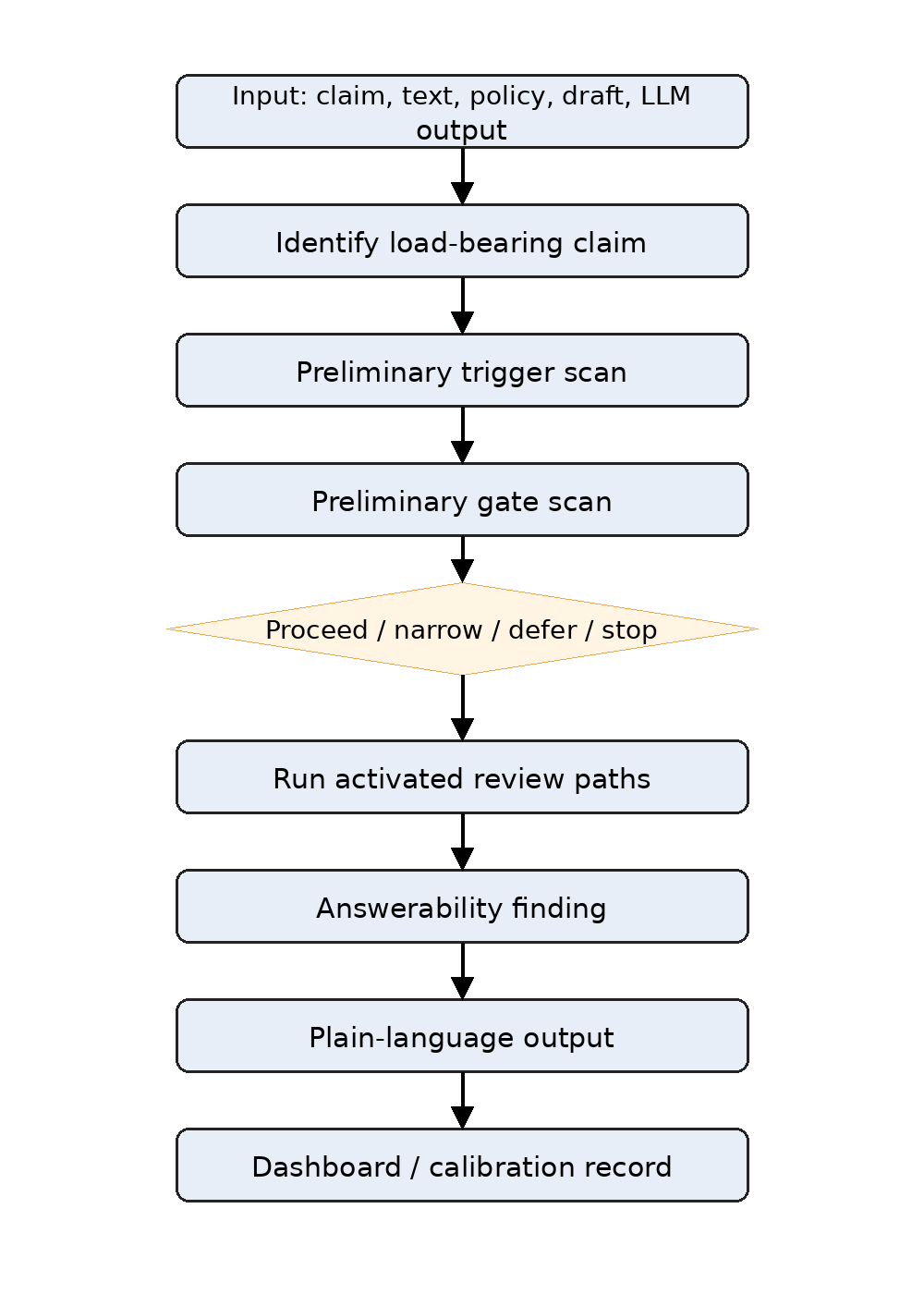
Figure 1. Core audit flow. The simplified flow shows the early operating logic: input, load-bearing claim identification, preliminary trigger scan, preliminary gate scan, proceed / narrow / defer / stop, activated review paths, answerability finding, plain-language output, and calibration record.
11. The operating sequence and why it has this order
This section explains the operating order of The Audit: first protect and route the claim, then analyze it, then return to gates if analysis reveals new risks.
The order is not arbitrary; it follows from the problem the tool was built to solve. The Audit must identify the claim doing the work, but it must also avoid processing material it has no standing to process. For that reason, the operating sequence uses an early trigger/gate scan before substantive analysis, followed by a fuller review after the argument has been reconstructed.
The ordinary sequence is:
1. intake;
2. load-bearing claim identification;
3. claim type;
4. preliminary trigger scan;
5. preliminary gate scan;
6. proceed, narrow, defer, escalate, or stop;
7. presupposition and assumption exposure;
8. argument reconstruction;
9. coherence check;
10. answerability check;
11. full trigger/gate review if new issues emerge;
12. bounded finding;
13. presentation overlay; and
14. calibration and record.
The preliminary trigger scan asks whether the material or claim has features that require special handling before analysis proceeds: protected context, privacy, legal risk, cultural or community-governed material, safety risk, authority problems, vulnerable people, high-stakes public action, or likely evidentiary overreach. The preliminary gate scan then decides whether the audit may proceed, must narrow to safe or public material, must defer to domain or standing review, or must stop as framed.
This early scan is essential. The Protected-Context Gate cannot do its work if it fires only after presupposition exposure, argument reconstruction, coherence checking, and answerability checking have already processed the material. A stop that comes too late is not protection. The preliminary gate exists to prevent the audit from creating the very harm it is supposed to avoid.
If the preliminary gate allows the audit to proceed, the tool then exposes presuppositions, reconstructs the argument, checks coherence, and tests answerability. This is the analytic core of the sequence. It asks what the claim assumes, what argument it makes, whether the parts fit together, and whether the claim remains responsible to what it invokes.
The full trigger/gate review comes after that analytic core because some issues are invisible at intake. A scope problem may appear only after the argument is reconstructed. A hidden authority claim may appear only after presuppositions are exposed. A fabricated citation may appear only after the evidence burden is identified. A protected-context issue may appear again if the argument relies on material that was not obvious at the preliminary scan. The second review therefore catches risks disclosed by analysis, while the first review prevents analysis from proceeding where it should not.
Each step exists to prevent a specific failure.
| Step | Purpose | Failure prevented |
|---|---|---|
| Intake | Fix context and stakes | Treating every claim as ordinary |
| Load-bearing claim identification | Find the claim doing the work | Auditing the wrong object |
| Claim type | Choose the relevant standards | One-size-fits-all review |
| Preliminary trigger scan | Flag early risk before analysis | Missing early review conditions |
| Preliminary gate scan | Choose proceed, narrow, defer, or stop | Overprocessing or false authority |
| Proceed / narrow / defer / stop | Set the permissible path | Continuing as ordinary when it is not |
| Presupposition exposure | Make hidden commitments visible | Hidden premises carrying the conclusion |
| Argument reconstruction | Clarify the inference | Surface critique missing the argument |
| Coherence check | Test internal fit | Contradiction, equivocation, category shift |
| Answerability check | Test responsibility to what is invoked | Coherent but irresponsible claims |
| Full trigger/gate review | Re-check gates after analysis | Missing newly revealed risks |
| Bounded finding | State what follows and what does not | Totalizing verdicts or false certainty |
| Presentation overlay | Make the result usable and honest | Accurate but unreadable output |
| Calibration record | Preserve learning and rollback | Drift and untracked change |
The order guards against four recurrent mistakes. First, it prevents the audit from testing the wrong claim, because load-bearing identification precedes evaluation. Second, it protects material that should not be processed as ordinary, because preliminary gates fire before substantive analysis. Third, it prevents the audit from treating coherence as sufficient, because the coherence check is followed by the answerability check rather than ending the analysis. Fourth, it prevents a technically correct finding from becoming practically misleading, because presentation and calibration are required steps rather than afterthoughts.
This is why The Audit is not a checklist in the ordinary sense. It is an ordered sequence whose modules activate conditionally and scale to the claim. Some claims receive only a quick clarity check. Some proceed to ordinary analysis. Some must be narrowed to public or user-authorized material. Some require domain or standing review. Some must not be processed as framed.
Figure 1. Core audit flow. The simplified flow shows the early operating logic: input, load-bearing claim identification, preliminary trigger scan, preliminary gate scan, proceed / narrow / defer / stop, activated review paths, answerability finding, plain-language output, and calibration record. Section 11 adds the fuller sequence: after a preliminary gate permits analysis, the audit reconstructs the argument, checks coherence and answerability, and then runs a fuller trigger/gate review if new issues emerge.
12. Triggers, gates, and review paths
The trigger and gate system therefore operates twice. First, it operates preliminarily, before substantive analysis, to prevent protected, unauthorized, or high-risk material from being processed as ordinary. Second, it operates after reconstruction and answerability analysis, because some evidence, scope, authority, or protection problems become visible only once the load-bearing structure has been exposed. The first scan governs permission to proceed; the second scan governs the final finding.
The Audit uses triggers, gates, and review paths to keep analysis from becoming indiscriminate. A trigger identifies a condition that may require special review; a gate decides whether the audit may proceed, must narrow, must defer, or must stop; a review path governs how the audit proceeds once the path is chosen. Common triggers include evidence, authority, protected context, scope, harm, identity or standing, and uncertainty. The gates make the audit ordered rather than merely analytic. The Evidence Gate asks whether the support is relevant, specific, current, and sufficient for the exact claim. The Authority Gate asks whether the speaker or the audit has standing to make or certify the claim. The Protected-Context Gate asks whether the material is private, sacred, restricted, legally sensitive, or community-governed, and therefore not available for ordinary processing. The Scope Gate asks whether the conclusion exceeds the support. The Answerability Gate asks what the claim invokes and whether it remains correctable by what it invokes. The Legibility Gate asks whether the user can understand the finding without being misled. Without gates, an LLM-assisted critique can become more fluent than responsible - analyzing material it should not expose, appearing to certify knowledge it cannot verify, or producing a confident answer where the honest result is "defer," "narrow," or "unresolved." With gates, the audit can issue a graded range of findings - pass; pass with narrowing; partial, revision required; unsupported; overextended; indeterminate; protected-context limited; or decline to audit as framed - and can name the kind of failure rather than collapsing every problem into true or false.
12A. Packet controls used in this paper
The architecture in Sections 10-12 is the public form of The Audit. The fuller operating packet contains additional controls, but the paper should not require the reader to evaluate the whole packet in order to understand the argument. For that reason, only the later controls that do work in this paper are named here.
Three later controls matter directly for this draft.
First, the Human-Executable Mode supports the claim that The Audit is not merely an LLM prompting technique. The method must be runnable as a manual worksheet, especially when privacy, protected context, legal risk, cultural authority, or institutional limits make model processing inappropriate.
Second, the Artifact Engagement and Retrodiction controls govern claims about documents, versions, and development history. An audit may not claim to have evaluated an artifact it has not actually opened, and a later method should not be credited with "predicting" a feature already present in an earlier artifact unless independent prior evidence supports that claim.
Third, the Current-Version, Supersession, and Readiness controls govern how this paper describes its own status. The paper presents the argument and public architecture of The Audit; it is not the full operating packet, not an empirical validation study, and not operational authorization for institutional, legal, cultural, or community-governed use.
Other packet controls may matter in future applications, but they are not load-bearing in this paper. They should therefore remain in the operating packet or the version/scope appendix rather than being treated as main-body architecture.
This keeps the architecture legible. The paper's existence proof is not that every future gate has already been explained. It is that the coherence/answerability distinction can be turned into an ordered review procedure with claim identification, early protection, coherence review, answerability review, bounded findings, presentation, and calibration.
13. Protection and protected context
The Audit must not create a second harm in the course of seeking clarity. Protection is not a decorative ethical add-on; it is part of the method's logic, because the review can encounter claims involving vulnerable people, private records, family conflict, medical information, legal exposure, youth, employment risk, safety concerns, cultural materials, community-governed or sacred knowledge, and other sensitive domains. The fact that material can be pasted into a model does not mean it may responsibly be processed. Access is not authority.
This commitment has a developed precedent in Indigenous data governance, where the asymmetry between what is technically available and what may rightfully be used is treated as a first-order design constraint. The CARE Principles for Indigenous Data Governance - Collective Benefit, Authority to Control, Responsibility, and Ethics - set people and purpose alongside the openness defaults of FAIR data in contexts amplified by AI (Carroll et al. 2020); the First Nations Principles of OCAP (Ownership, Control, Access, and Possession) make the same point about community authority over data (FNIGC 2022). The Protected-Context Gate asks whether the material is governed in these ways, whether analysis would expose what should not be exposed, whether the audit has standing to evaluate the protected layer, whether the claim can be narrowed to public or user-authorized material, and whether the audit should stop, defer, or seek review from those with standing. Protected context changes who may correct the claim. If the audit lacks standing to interpret, expose, or certify the material, then the correction route lies outside the audit.
14. Presentation as an overlay
The Audit first needed governance to decide what may be said. It later needed presentation to decide how a finding may be shown. This is the Presentation Overlay, and its governing rule mirrors the protection rule: governance decides what may be said; presentation decides how it may be shown. Presentation is not cosmetic, because a finding can mislead through form. A result may be accurate but unreadable, complete but overwhelming, plain but flattened; it may look more certain than it is, bury a gate failure, omit the next action, fail on a phone, or display technical machinery before the reader understands the finding. The overlay therefore requires a standard sequence: a oneline finding; a plain-language summary; the claim under audit; a dashboard; the reasoning; what the finding does not show; the next action; and an optional technical appendix. It must not simplify away uncertainty, protected-context limits, untested areas, or authority issues - it must make those visible. The Legibility Gate checks the result against that standard: can the reader identify the finding in one sentence, see whether the claim passed or narrowed, see gate failures and uncertainty near the top, handle protected context without exposure, find the next action, read it on a phone, and receive output proportional to the seriousness of the claim? This overlay also distinguishes the Audit from an ordinary careful answer. A good assistant reply may be helpful, but its operating conditions are usually
implicit; the Audit makes care inspectable. A response counts as an audit only if it visibly includes at least the claim under audit, the finding, the gate or dashboard status, what the finding does not show, and the next action (Appendix B). Without those, a response may be useful, but it is not a complete audit finding.
15. LLM-operable, not LLM-dependent
The Audit is built for LLM-assisted environments but is not dependent on them. A model can extract assumptions, reconstruct arguments, test local coherence, format dashboards, generate alternative formulations, propose applicable gates, and produce plain-language summaries. These are real capacities. But the model is not the authority. The Audit can be run through prompts, but it is not a prompt. It is a review order that can also be completed by hand. A model may help operate the sequence; human judgment, relevant evidence, domain authority, affected people, professional standards, community governance, and correction remain necessary where triggered.
Prompting alone does not decide authority. A prompt can ask a model to be careful, but care becomes inspectable only when the answer shows the claim under audit, the load it carries, the gates triggered, the evidence available, the authority limits, the closure label, and the next action. Repeated prompting can improve prose while leaving the underlying claim unsupported, unauthorized, overextended, or uncorrectable. Prompting is the interface; answerability is the discipline.
16. Worked examples
The examples move from low-stakes claims to harder claims. They show that The Audit can pass, narrow, defer, or reject depending on what the claim is being asked to carry.
The examples below show the architecture deciding differently across cases. They are not evidence of effectiveness and they are not a validation set. They show only that the distinction can be applied without collapsing every claim into approval or rejection; Section 18 states what validation would require.
Proportionality: an ordinary cultural label
Claim: "Skibidi Toilet is brainrot." As meme shorthand the claim passes; it is a casual cultural label that needs no heavy evidence. As an aesthetic judgment it becomes partial - the speaker should say what counts as low value, absurdity, or decline. As a serious harm or causal claim it becomes unsupported unless evidence is supplied.
Finding: acceptable as meme-culture shorthand; weak as a serious evaluative or causal claim without defining "brainrot." The example shows scaling: the tool should not turn every slang phrase into a dissertation.
True core versus overclaimed envelope: a hostile market claim
Claim: "A banana duct-taped to a wall sold for millions, so contemporary art is a scam and none of this is real art." The true core is that a controversial work can expose real public frustration with elite markets, institutional recognition, spectacle, scarcity, and price. The overclaimed envelope is the leap from one case to the conclusion that contemporary art as a whole is a scam. The audit separates the questions - is it art, is it good art, is the price justified, is the market corrupt, does institutional recognition create authority, does public irritation count as disproof - and finds the claim identifies a real pressure point but overextends.
Next action: not to reject all concern but to revise toward a narrower, answerable critique of market value and institutional authority.
A claim that passes: a bounded empirical claim
Claim: "In this dataset, reported cases rose between 2019 and 2023." If the dataset is specified, the measure is defined, and the comparison is internal to the data, the claim is answerable as stated.
Finding: answerable as stated; supported for the specified dataset and interval; no causal or population-level inference is made. This case matters because a tool that can only return "overclaimed" is not discriminating strong claims from weak ones - it is merely generating critique (Section 18).
A hard claim that passes
Claim: "A public agency should not rely on a single unverified model-generated citation when issuing a consequential policy recommendation."
This is a harder test than the bounded dataset example. The claim is normative, institution-facing, and consequential. It is not merely reporting a number inside a specified dataset. It says what an institution should not do when public consequences may follow.
The claim passes because its scope is narrow and its burden is appropriate. It does not say that public agencies should never use AI tools. It does not say that model-generated citations are always false. It does not say that a policy recommendation is invalid merely because an AI system helped draft it. The claim says only that a public agency should not rely on one unverified model-generated citation when issuing a consequential recommendation.
The Evidence Gate supports the claim because an unverified citation cannot yet function as evidence. The Authority Gate supports the claim because a model-generated citation does not confer institutional authority. The Scope Gate supports the claim because the conclusion is limited to reliance on a single unverified citation, not to all AI-assisted work. The Answerability Gate supports the claim because consequential public recommendations must remain answerable to evidence, source origin, institutional responsibility, and correction. The claim also preserves a correction route: verify the citation, replace it with reliable evidence, or reduce the policy recommendation until its support matches its weight.
Finding: answerable as stated.
The claim may responsibly stand because it is strong but bounded. It does not overclaim. It preserves a clear true core: consequential public recommendations should not rest on unverifiable support. It also leaves a clear next action: verify the citation, replace it with reliable evidence, or narrow the recommendation until its support matches its weight.
| Gate | Status |
|---|---|
| Evidence | PASS - unverified citation cannot carry evidentiary weight |
| Authority | PASS - model output does not confer institutional authority |
| Scope | PASS - limited to single unverified citation in consequential policy use |
| Answerability | PASS - evidence, origin, consequence, and correction remain visible |
| Finding | ANSWERABLE AS STATED |
Does not show: that AI tools may never be used in public policy work; that all model-generated citations are false; or that the policy conclusion itself is wrong.
Next action: verify the citation before reliance, substitute a reliable source, or reduce the claim's policy weight.
The example matters because it shows discrimination. The Audit can criticize an overclaim, but it can also pass a claim that is normatively serious when the claim's scope, evidence burden, authority limits, and consequences are properly aligned.
Protected context
Claim: "This community practice means X, so outsiders may use it in public-facing materials." The Authority Gate and the Protected-Context Gate both fire. Even a publicly available description does not establish consent, authority, or appropriate use.
Finding: protected-context status triggered; the audit cannot certify the meaning or permitted use of this practice; narrow to public, authorized sources or defer to people and institutions with standing. The audit stops or narrows rather than processing everything.
The reflexive case: coherence is not adequacy
Claim: "Because a method is internally coherent, it is therefore adequate for responsible public use." The claim is tempting precisely because it coheres, but the audit rejects the inference as overbroad: responsible use also requires answerability - evidence, affected people, authority, scope, limits, consequences, and correction.
Revised: a coherent method is better positioned for responsible use, but coherence alone does not establish adequacy unless the method remains answerable to the domains, people, evidence, and authority it invokes. This is the paper's central move, applied to the kind of claim the paper itself makes - and a standard the paper accepts for itself in Section 18.
An extended example: an LLM-generated policy overclaim, worked end to end
The brief cases above show the method deciding differently across claims. This one shows it operating in full on a single claim of the kind that motivates the tool - fluent, confident, model-produced, with a fabricated citation doing the load-bearing work.
Input, as produced by a model: "Remote work should be mandated across the public sector. As Smith (2019) demonstrates in a randomized controlled trial, remote work raised productivity 40% while reducing burnout, so any agency that retains in-office requirements is acting against the evidence."
The Audit runs the corrected sequence of Section 11. Because this claim is not protected-context material, the preliminary trigger and gate scan permits analysis to proceed, while flagging evidence, scope, LLM-output, and stakes issues for fuller review.
| Stage | What the Audit found |
|---|---|
| Intake | A policy recommendation that would justify a sector-wide mandate; stakes are institutional and affect many employees; audience is decision-makers. High stakes - full review, not a light pass. |
| Load-bearing claim | The mandate rests on one empirical claim: that a Smith (2019) RCT showing +40% productivity and reduced burnout establishes that remote work should be mandated and that in-office requirements are "against the evidence." If that claim fails, the recommendation fails. |
| Claim type | Mixed: empirical, causal, and normative / policy. |
| Preliminary trigger scan | Evidence trigger, LLM-output trigger, scope trigger, and stakes trigger fire. No protected-context trigger appears on the face of the claim. |
| Preliminary gate scan | Proceed to analysis, but under full review. The audit may analyze the inference, but it may not certify the policy. The citation and scope burden must be checked before any finding closes. |
| Presupposition exposure | Presupposes that (a) Smith (2019) exists and is an RCT; (b) the 40% figure is accurate; (c) results generalize from the studied group to the entire public sector; (d) evidence of productivity settles the normative question of what should be mandated; and (e) no countervailing factors such as equity, role suitability, or public access bear on the conclusion. |
| Argument reconstruction | P1: an RCT, Smith (2019), shows remote work raised productivity 40% and cut burnout. P2: the result generalizes to the whole public sector. P3: if evidence shows productivity gains, the policy should be mandated. C: the public sector should mandate remote work, and retaining in-office requirements is against the evidence. |
| Coherence check | Conditionally coherent if the premises hold, but P3 moves from is to ought without warrant, and "against the evidence" overstates. Category shift flagged. |
| Answerability check | The claim invokes evidence, causation, and public action. It does not yet answer to a locatable study, to confounders, to role variation, or to foreseeable effects on equity and access. |
| Full trigger/gate review | Evidence Gate fails because the citation is unverifiable as stated. Scope Gate fails because one study cannot carry the whole-sector mandate. Authority Gate defers because the audit can assess the inference but cannot certify the policy. |
| Bounded finding | Partial; revision required. |
| Presentation overlay | The finding is compressed into a dashboard, what-it-does-not-show statement, and next action. |
Revised, answerable claim: "Several studies indicate remote work can improve productivity and reduce burnout for some roles and populations. The public sector should pilot remote-work options where roles allow, evaluate outcomes against equity and public-access goals, and treat no single study as settling either the magnitude of the effect or the normative question of a sector-wide mandate."
The point of the case is not that the original claim is "false" - its empirical core may even be partly right. The point is that, as asserted, the claim cannot carry the weight placed on it: its support is unverifiable, its scope is unearned, and its normative conclusion is unaddressed. The Audit's value is that it says which of these failed, what survives, and what to do next, rather than collapsing the whole claim into approval or rejection.
FINDING - Partial; revision required.
Claim audited: A Smith (2019) RCT establishes a public-sector remote-work mandate.
Dashboard: Evidence ........ FAIL (citation unverifiable)
Scope ........... FAIL (one study -> whole sector)
Answerability ... PARTIAL (causation, public effects unaddressed)
Authority ....... DEFER (audit cannot certify policy)
Does NOT show: that remote work is ineffective - only that THIS argument does not establish its conclusion.
Next action: verify or withdraw the citation; narrow the claim to what the real evidence supports; address equity, role suitability, access.
Artifact engagement and retrodiction
Claim: "This new institutional-review policy anticipated the need for public correction records, because the organization later discovered that its older annual reports already contained scattered correction notes."
The Audit treats this as a chronology and artifact-engagement problem. The policy may have clarified, consolidated, and governed the correction-record practice, but it did not "anticipate" the need if the older reports already contained correction notes. A later method should not receive credit for prediction merely because it gives a name and structure to something already visible in earlier artifacts.
The first question is artifact engagement: have the older annual reports actually been opened, and do they contain the correction notes claimed? If not, the claim cannot close. The second question is chronology: were the correction notes present before the new policy was written? If yes, the stronger prediction claim fails unless there is independent prior evidence that the policy identified the need before reviewing those reports. The correction route is chronological: open the earlier reports, cite what they contained, and revise the claim from prediction to recognition if the older record already showed the practice.
Finding: partial; revision required.
The responsible claim is narrower: "The new policy did not predict the need for correction records if that need was already visible in older annual reports. Its contribution was to consolidate scattered correction practices into an explicit, governed public record."
| Gate | Status |
|---|---|
| Artifact Engagement | REQUIRED |
| Chronology | REQUIRED |
| Prediction claim | NOT ESTABLISHED |
| True core | Later policy clarified and governed an existing practice |
| Finding | PARTIAL; REVISION REQUIRED |
Does not show: that the new policy added nothing. Naming, consolidating, and governing an existing practice can be a real contribution.
Next action: open the older reports, cite the correction notes, record the chronology, and revise "anticipated" to "recognized," "consolidated," "formalized," or "governed," unless independent prior prediction evidence exists.
PART III - POSITION, LIMITS, AND DEVELOPMENT
Parts I and II made the case and showed it could be built. Part III steps back: it places the project among neighboring fields, states plainly the conditions under which the tool would fail, applies the tool to itself, and lays out what testing and development remain.
17. Related work and domain location
The Audit sits near several fields without being reducible to any one of them, because the failures it addresses are themselves interdisciplinary: a claim can fail logically, evidentially, rhetorically, socially, ethically, legally, culturally, institutionally, or through presentation. The purpose of this section is to locate the project among adjacent literatures, not to treat any one of them completely.
Its dominant field of relevance is applied epistemology, especially social epistemology and the philosophy of responsible assertion. The paper asks when an assertion can responsibly carry the evidential, authority, scope, and correction burdens placed on it. LLM-assisted reasoning gives that question urgency, but does not define the whole field of the paper.
It is adjacent to argumentation theory and informal logic. It reconstructs arguments, assigns burdens, and tests overclaims in the lineage of Toulmin's field-sensitive analysis of argument structure (Toulmin 1958) and the contemporary theory of argumentation schemes and their critical questions (Walton, Reed, and Macagno 2008), and it treats fallacy labels with the caution that tradition itself recommends (Hamblin 1970).
It is adjacent to coherentist epistemology and coherence theory. It adopts the structural insight of explanatory coherence (Thagard 2000) while arguing against the sufficiency of coherence for responsible assertion (BonJour 1985). Its positive account of answerability draws on normative pragmatics and the philosophy of assertion (Brandom 1994; Austin 1962; Searle 1969) and on accounts of knowing as a responsible practice (Code 1987).
It is adjacent to philosophy of technology and AI literacy. It addresses the gap between fluent output and responsible reasoning and the need to keep human accountability visible - a need underscored by evidence that unstructured reliance on AI tools is associated with cognitive offloading and weaker critical-thinking performance, while structured prompting improves reasoning quality (Gerlich 2025a; Gerlich 2025b). It is close to, but distinct from, textual red teaming: Floridi, Morley, and Novelli adapt adversarial stress-testing into a diagnostic method for texts using LLMs (Floridi, Morley, and Novelli 2025); The Audit shares the diagnostic ambition but differs by adding gates, protected context, standing, correction routes, and a presentation overlay, so that the tool can decline, narrow, or defer rather than only analyze.
Much current AI-evaluation language asks whether outputs are grounded, reliable, aligned, safe, or human-centered. Those questions matter, but this paper uses a narrower object: the load-bearing claim, the claim carrying the argumentative or practical weight. The Audit asks whether that claim can be held to the evidence, authority, limits, consequences, and correction routes it invokes.
For that reason, the paper's central terms are true core, overclaimed envelope, standing, authorization, corrigibility, bounded finding, and next action.
It is adjacent to information ethics and protected-context governance, and it has a substantive relation to Indigenous data sovereignty, which supplies a developed account of why some knowledge, records, and relations should not be processed under an open-access assumption (Carroll et al. 2020; FNIGC 2022). The paper draws on that lesson as a design constraint while preserving the standing disclosure in Section 18: the author speaks only for himself and does not claim authority for any nation, community, or people as a whole.
It is also adjacent to writing studies, civic education, public reasoning, and human-computer interaction. It supports revision by locating the load-bearing claim and narrowing the overclaimed envelope; it treats presentation, dashboards, legibility, and the reader's next action as part of the method rather than afterthoughts. This map is part of the paper's function, not merely its marketing. Likely interested readers include philosophers of technology and epistemologists; argumentation theorists and critical-thinking teachers; composition and rhetoric scholars; AI-literacy researchers and LLM-workflow designers; civic educators, nonprofit and policy workers, and public-interest technologists; independent scholars and community advocates; people working on Indigenous data sovereignty and protected knowledge; and people designing explainable human-AI tools.
18. Limitations and conditions of failure
Standing disclosure. Christopher Knorr is an independent scholar and an enrolled Pit River tribal member living in diaspora. He speaks only for himself and for no nation, tribal government, council, department, clan, family, community, or Native people as a whole.
This section states what the paper does not prove, applies the method to itself, and identifies the conditions under which the project would fail.
Naming limit. The word Audit is used by analogy. In this paper it means an ordered claim-review method, not a professional, financial, legal, compliance, institutional, certified, or regulated audit; no assurance opinion, licensure, independence, or institutional authority is implied.
Before stating its limitations, the paper applies its own instrument to its own central claim. The reader should weigh the following disclosure first: this self-audit was produced through the same author-directed, LLM-assisted process that produced the rest of the paper. It is therefore performed by a party with an interest in a favorable result - the maximal conflict of interest - and it is offered as an illustration of how the instrument operates, not as evidence that the paper is valid. Reading it as validation would beg the question the paper raises.
For the same reason, the phrase "self-audit" should not be read as independent validation. It means only that the paper applies its own claim-review method to its own central claim. Because the author helped build the method and the manuscript, the result has maximal conflict of interest and cannot substitute for outside review.
Box 1. The Audit applied to its own central claim.
Load-bearing claim: answerability is a distinct requirement with an irreducible normative-social core, and an ordered claim-review method can operationalize it.
Type: mixed - philosophical, methodological, normative.
Triggers: evidence, authority, and LLM-output triggers fire.
Gate review: the Evidence Gate is not passed for the outcome component - no controlled study shows the method improves outcomes over ordinary critical reading. The Authority Gate limits the protected-context material to design rationale, since the author speaks only for himself. The Correction Gate passes, because the paper states what would disconfirm it.
True core: the conceptual argument of Sections 6-9 and the buildability demonstrated in Part II.
Overclaimed envelope: any unqualified assertion that the method improves real-world reasoning outcomes.
Finding: partially answerable. The philosophical claim is answerable as argued and bounded; the outcome claim is overclaimed until calibration data exist. The tool's first principle governs the paper that proposes it.
The later operating packet adds several controls that sharpen this self-audit without changing its limit. Applying those controls to this paper produces the same bounded result: the paper is partially answerable as a conceptual and methodological argument, but it is not empirically validated.
Current-Version / Supersession Gate. The paper presents the argument and public architecture of The Audit, not the full current operating packet. Later packet versions add controls for direct-conflict testing, AI provenance, artifact engagement, retrodiction, supersession, readiness classification, legibility, and operational ledgers. Those later controls should govern actual audit runs, but their existence does not by itself validate the paper's central claim.
Artifact Engagement Gate. Any claim about what this paper says must be tied to the actual paper text. The title, abstract, table of contents, appendix names, or remembered project history are not enough. The paper itself supports the claim that it argues for answerability, presents an architecture, refuses empirical-validation overclaim, and proposes a development path. It does not support the stronger claim that The Audit has already been shown to improve real-world reasoning outcomes.
Readiness-Type Classifier. The paper may be treated as public-preprint ready or outside-reader ready if the argument, boundaries, citations, and disclosures are acceptable for that purpose. It should not be treated as empirically validated, operationally validated, or submission-ready without additional source verification, venue review, formatting review, and outside expert criticism.
Experimental Validation Gate. The outcome claim remains unpassed. The paper may argue that The Audit is conceptually buildable and procedurally coherent. It may show how the method would work. It may propose a pilot. But it cannot yet claim that users employing The Audit identify load-bearing claims more reliably, revise overextended claims more accurately, preserve protected context more consistently, or outperform ordinary prompting or ordinary critical reading. Those claims require controlled comparison, independent grading, and result records.
Legibility Gate. The paper's central finding must remain visible to the reader: coherence is necessary but insufficient; answerability is the additional requirement; The Audit is an ordered claim-review method for testing that requirement. The paper should not bury that claim under the full machinery of the operating packet.
Operational Ledger Gate. No operational reliance follows from this paper alone. The paper may inform research, teaching, tool design, and methodological discussion. Any use in institutional, legal, cultural, governance, field, or public-service decision-making would require a separate authority review, context review, protected-context check, and decision ledger.
Updated self-audit finding. The paper's conceptual claim remains answerable as a bounded argument. Its architecture claim remains answerable as a proof of concept. Its validation claim remains unpassed. The appropriate closure is: public-preprint / outside-reader ready, pending source verification and external review; not empirically validated; not operationally validated; not a substitute for domain authority.
After this self-audit, the paper is not empirically validated, and several limitations follow. First, cross-model consistency is not correctness: if several models produce similar audit results, that would indicate the method is legible and reproducible, not that the result is true. Second, models may hallucinate or overstate, so model output must be treated as provisional, especially in factual, legal, medical, technical, or historical domains. Third, protected-context review cannot be validated by outsiders: a tool can identify authority problems but cannot supply authority. Fourth, the worksheet may be usable yet cognitively demanding, and must be tested with users who are not already comfortable with analytic terminology. Fifth, the dashboard can itself become bloat; logging should remain proportional to the work it tracks. Sixth, the tool can be misused as a weapon - any adversarial method can be turned against vulnerable speakers, testimony, or community knowledge - which is why protection is not optional. Seventh, answerability remains a developing principle needing further examples, edge cases, and refinement. Eighth, the central claim of Section 8 is defended by argument, not demonstrated empirically, and is deliberately bounded: it shifts the burden to the reductionist rather than refuting reduction outright, and would benefit from independent philosophical scrutiny.
These can be organized as a failure taxonomy the project commits to watching: load failure (the wrong claim is identified, or a minor claim is treated as load-bearing); ordering failure (protected, unauthorized, or high-risk material is processed before preliminary gates have determined that processing may proceed); coherence failure (a contradiction, category shift, or missing premise is missed); answerability failure (internal fit is treated as sufficient); authority failure (the audit certifies standing, legal status, or cultural meaning it has no authority to certify); protection failure (material that should have been narrowed, deferred, or stopped is exposed); presentation failure (a technically adequate analysis the intended reader cannot use); proportionality failure (a heavy audit on a casual claim, or the reverse); calibration failure (uncertainty, failures, and rollback paths go unrecorded); tool-authority failure (users mistake the audit for proof or the model for authority); and empirical failure (testing shows users do not understand the findings, cannot act on the next step, or are not helped in revising claims).
The value claim is therefore empirical and disconfirmable. The method fails - in the sense that it adds nothing over ordinary critical reading - if, under controlled comparison with a plain critical-reading checklist, trained users do not (a) identify the load-bearing claim more reliably, or (b) produce revisions whose scope and modality are better matched to the available support, as judged by independent raters blind to condition. Of these, (b) is the more demanding test: diagnosis without improved revision is diagnosis without treatment.
A further condition is discrimination: if the Audit returns "overclaimed" or "limited" at similar rates for well-formed and ill-formed claims alike - if it cannot also return "answerable as stated" when that is deserved - then it is not distinguishing strong claims from weak ones but merely generating critique, and a tool that disapproves of everything carries the same information as one that approves of everything. Stating these conditions is itself an application of the tool's governing principle; the measures that operationalize them are set out in Appendix E.
19. Research and development agenda
The development agenda separates what must happen next for the paper, the worksheet, the benchmark, and any future public tool.
The next phase is not more internal polish but controlled use and calibration, pursued along several lines at once.
The paper line should produce a citation-verified, independently reviewed version of this argument, inviting at least one reader in argumentation, philosophy of technology, writing studies, or AI literacy, and deciding how much of the presentation overlay belongs in the main text.
The tool line should continue developing the operating packet. The presentation overlay should be treated as experimental and not permanently ratified until tested on protected-context, narrow/defer/stop, and real-user cases.
The manual-worksheet line matters because the method should not depend on model use. A paper version should carry claim identification, claim type, presupposition exposure, argument reconstruction, the coherence and answerability checks, a trigger/gate checklist, the bounded finding, what the finding does not show, and the next action. The minimum version of that instrument appears in Appendix D.
The worksheet-pilot line is the heart of the next phase: controlled tests of the worksheet against a plain critical-reading baseline. Its design, outcome measures, and disconfirmation conditions are specified in Appendix E rather than repeated here.
A further development line follows from the same calibration requirement: The Audit should be tested not only as a manual worksheet but also as a candidate evaluation instrument for human and LLM-assisted reasoning. This branch may be called The Audit Experimental Validation Program, with a first study under the working title AuditBench or AnswerabilityBench.
The purpose of that branch is to ask whether The Audit improves answerability outcomes compared with ordinary prompting, ordinary critical reading, or a simpler checklist. The benchmark design should include baseline, conventional-prompt, Audit-guided, and ablation conditions; surface-form variation; independent grading; contamination controls; and a result ledger. Those details are specified in Appendix F rather than repeated here.
This line of work turns the paper's central caution back on the method itself. The Audit may be conceptually coherent and architecturally buildable, but those facts do not show that it improves reasoning outcomes. If it is to make that stronger claim, it must answer to evidence.
The open-source line should eventually include a source-of-record repository, a preprint, the tool packet, a use-only packet, the manual worksheet, examples, calibration records, contribution guidelines, a license and standing note, and a protected-context warning. A public interface should come last, not first; the interface should not precede the governance layer.
20. Conclusion
The Audit began with a modest practice: expose assumptions, find arguments, reconstruct them, and check the logic. That practice remains inside the tool. But the tool developed because the practice was not enough - fallacy labels were not enough, local logic checking was not enough, coherence was not enough, access was not authority, a clean output was not validation, and a technically correct finding was not complete if its reader could not use it.
The paper has argued that coherence is necessary but insufficient. Coherence can help discipline evidential fit, consistency, and constraint-satisfaction, but it cannot by itself generate standing, authorization, or correction by those entitled to correct a claim. Those relations are the irreducible core of answerability.
It has also shown that the requirement is buildable - that the coherence/answerability distinction can be turned into an ordered claim-review method that identifies the load-bearing claim, runs early protection before substantive processing, tests fit and then answerability, uses triggers and gates, protects what should not be processed, and presents findings a person can act on.
The promise of The Audit is not that it makes judgment automatic. Its promise is that it makes judgment more inspectable. Coherence asks whether the parts fit. Answerability asks whether the claim can be corrected by what it invokes. Whether the method improves reasoning is, by its own standard, a claim that must answer to evidence.
REFERENCES
Verification note. This reference list supports a methodological and architectural argument, not an empirical-validation claim. Sources are used for different functions: some supply philosophical background, some locate the project in argumentation theory or epistemology, some support protected-context and Indigenous data-governance commitments, and some identify evaluation methods relevant to the proposed validation path.
For that reason, source use should be checked by function as well as by citation form. A source that supports the existence of an evaluation method does not prove that The Audit has been evaluated. A source about benchmark contamination does not prove this benchmark is uncontaminated. A source about Indigenous data governance can support a protection premise; it does not authorize this paper to speak for any Indigenous nation, community, or authority.
Recent, technical, and policy-sensitive sources should be reverified before any submission or public reposting. The verification status of each source, and the claim it is being asked to carry, are recorded in Appendix G rather than annotated inline here.
Austin, J. L. 1962. How to Do Things with Words. Edited by J. O. Urmson. Oxford: Clarendon Press.
Bakhtin, M. M. 1993. Toward a Philosophy of the Act. Translated by V. Liapunov. Edited by M. Holquist and V. Liapunov. Austin: University of Texas Press.
Bommasani, Rishi, Percy Liang, Tony Lee, et al. 2023. "Holistic Evaluation of Language Models." Annals of the New York Academy of Sciences 1525 (1): 140-146. https://doi.org/10.1111/nyas.15007. Earlier preprint, arXiv:2211.09110.
BonJour, Laurence. 1985. The Structure of Empirical Knowledge. Cambridge, MA: Harvard University Press.
Brandom, Robert B. 1994. Making It Explicit: Reasoning, Representing, and Discursive Commitment. Cambridge, MA: Harvard University Press.
Carroll, Stephanie Russo, Ibrahim Garba, Oscar L. Figueroa-Rodriguez, Jarita Holbrook, Raymond Lovett, Suzanne Materechera, Mark Parsons, et al. 2020. "The CARE Principles for Indigenous Data Governance." Data Science Journal 19 (1): 43. https://doi.org/10.5334/dsj-2020-043.
Chiang, Wei-Lin, Lianmin Zheng, Ying Sheng, et al. 2023. "Judging LLM-as-a-Judge with MT-Bench and Chatbot Arena." arXiv:2306.05685.
Code, Lorraine. 1987. Epistemic Responsibility. Hanover, NH: University Press of New England.
First Nations Information Governance Centre. 2022. The First Nations Principles of OCAP brochure. Ottawa: First Nations Information Governance Centre. https://fnigc.ca/ocap-training/. OCAP is a registered trademark of the First Nations Information Governance Centre.
Floridi, Luciano, Jessica Morley, and Claudio Novelli. 2025. "Red Reading the Text: On How to Red Team Texts Using LLMs." Philosophy & Technology 38 (4): 129. https://doi.org/10.1007/s13347-025-00955-9.
Gerlich, Michael. 2025a. "AI Tools in Society: Impacts on Cognitive Offloading and the Future of Critical Thinking." Societies 15 (1): 6. https://doi.org/10.3390/soc15010006.
Gerlich, Michael. 2025b. "From Offloading to Engagement: An Experimental Study on Structured Prompting and Critical Reasoning with Generative AI." Data 10 (11): 172. https://doi.org/10.3390/data10110172.
Hamblin, C. L. 1970. Fallacies. London: Methuen.
OpenAI. n.d. "Evals: A Framework for Evaluating LLMs and LLM Systems, and an Open-Source Registry of Benchmarks." GitHub. https://github.com/openai/evals.
Searle, John R. 1969. Speech Acts: An Essay in the Philosophy of Language. Cambridge: Cambridge University Press.
Thagard, Paul. 2000. Coherence in Thought and Action. Cambridge, MA: MIT Press.
Toulmin, Stephen E. 1958. The Uses of Argument. Cambridge: Cambridge University Press.
Walton, Douglas, Chris Reed, and Fabrizio Macagno. 2008. Argumentation Schemes. Cambridge: Cambridge University Press.
Yang, Shuo, et al. 2023. "Rethinking Benchmark and Contamination for Language Models with Rephrased Samples." arXiv:2311.04850.
APPENDIX GUIDE
Appendices A-D support the paper's core architecture. Appendix E proposes the first human-use pilot. Appendix F is a development appendix for a later benchmark program; it is included to make the validation path inspectable, not to claim that the benchmark has been run. Appendices G-H preserve source and version accountability.
APPENDIX A. FORMAL ARCHITECTURE SKETCH
A full formalism is not necessary, but the system's logic can be sketched. The expressions below are symbolic shorthand for diagnostic status, not quantitative formulas to be evaluated: "degree" denotes a graded qualitative judgment - typically pass, partial, or fail - not a number to be computed, and the notation makes no claim that coherence or answerability is numerically measurable.
Let C be the candidate claim, W the weight placed on it by the surrounding argument, S the support set (reasons, evidence, definitions, authorities, contextual facts), and K the constraints (logical, evidential, causal, legal, ethical, contextual, standing-based, protected-context). A claim becomes audit-relevant when:
Load(C) is high enough that failure of C weakens W.
The Audit then asks whether C can carry W under K with available S. This is not only a coherence problem, so the review divides into two related but non-identical tests:
Coherence(C, S, K) = the degree to which claim, support, and constraints fit together.
Answerability(C, S, K, A) = the degree to which C can be held to what it invokes,
where A includes evidence, authority, affected people, limits, origin, consequences, and correction routes.
Protection adds a conduct condition that constrains how the audit may proceed regardless of the finding:
Protection(P) = the condition that the audit proceed only in ways that do not expose,
extract, distort, or falsely certify protected material or authority.
A finding is the tuple: coherence status, answerability status, gate outcomes, true core, overclaimed envelope, next action, rendered through the presentation overlay.
APPENDIX B. MINIMUM VISIBLE AUDIT STANDARD
A response counts as using The Audit only if it visibly includes at least:
1. claim under audit;
2. finding;
3. gate or dashboard status;
4. what this does not show; and
5. next action.
A response may resemble an audit without being one. To count as an audit, the finding must show its claim object, its limits, and the next action.
APPENDIX C. CORE VOCABULARY
Standing is a family term rather than a single permission source. In this paper it may refer to evidentiary standing, affected-party standing, professional or institutional authority, legal authority, cultural authority, or correctional standing. The Audit asks which form of standing a claim invokes and whether that form can actually correct the claim.
Terminology note: This paper does not use "answerability" as a synonym for general reliability, alignment, grounding, or human-centered evaluation. Answerability names a narrower condition: whether a load-bearing claim can be held to the evidence, authority, limits, consequences, and correction routes it invokes.
Load-bearing claim: a claim on which a larger argument, decision, interpretation, policy, accusation, justification, recommendation, or public communication depends.
Coherence: internal fit among claims, reasons, definitions, premises, and conclusions. Coherence asks whether the parts fit.
Answerability: the condition that a claim can be held to the evidence, authority, limits, consequences, and correction routes it invokes. Its irreducible core is correctability under standing.
Accountability: the relation by which a claim, speaker, user, or institution may be held responsible to a standard, person, community, authority, record, or consequence.
Trigger: a condition indicating that special review may be required.
Gate: a decision point determining whether the audit may proceed, must narrow, must defer, or must stop.
Preliminary trigger/gate scan: the early protection and routing step that occurs before substantive analysis.
Full trigger/gate review: the later review that occurs after reconstruction, coherence review, and answerability review if new issues emerge.
Review path: the procedure followed once a gate decision identifies the relevant path.
Correction route: the path by which a claim may be challenged, narrowed, revised, refused, or corrected by a party, record, authority, or standard with standing.
The Audit sequence: the ordered review path that identifies the claim carrying the weight, runs preliminary gates, tests coherence and answerability, conducts any needed full gate review, and ends in a bounded finding.
Protected context: material that should not be processed as ordinary because of privacy, safety, law, culture, community governance, sacredness, vulnerability, or standing.
Human-Executable Mode: the requirement that the method remain usable without an LLM, usually through a manual worksheet.
Artifact Engagement and Retrodiction controls: controls requiring actual artifact review and distinguishing prediction from later recognition, consolidation, or retrospective description.
Readiness-Type Classifier: the control that requires a claim of readiness to specify ready for what.
Presentation overlay: the layer governing how findings are shown so they remain usable, honest, and proportionate.
Bounded finding: a finding stating what the audit can responsibly say, what it cannot say, and the next action.
APPENDIX D. MINIMUM MANUAL WORKSHEET
Minimum field version
For ordinary use, the worksheet can begin with seven questions:
1. What claim is carrying the weight?
2. Is anything protected, unauthorized, private, high-risk, or outside my standing?
3. What does the claim assume?
4. Does the argument fit together?
5. What must the claim answer to?
6. What can responsibly survive?
7. What is the next action?
If any answer raises evidence, authority, protected-context, scope, or consequence concerns, use the full worksheet below.
Full worksheet
This worksheet is the minimum human-executable form of The Audit. It is not the full operating packet. Its purpose is to show that the method can be run without an LLM and that its authority does not depend on prompting.
1. Claim under audit. What exact claim is being tested?
2. Why this claim is load-bearing. What larger conclusion, decision, interpretation, accusation, recommendation, policy, or public communication depends on it?
3. Claim type. Mark all that apply: empirical; interpretive; normative; legal / policy; historical; causal; authority / standing; protected-context; public-action; LLM-generated; other.
4. Preliminary trigger scan. Before analyzing the claim, check whether any early stop, narrowing, or deferral condition appears: protected context; privacy / safety risk; legal or professional-risk material; community-governed or culturally restricted material; vulnerable person or group; authority / standing problem; high-stakes public action; unverified evidence; likely overclaim; uncertainty or missing context.
5. Preliminary gate decision. Choose one: proceed; proceed with caution; narrow to public or authorized material; defer to someone with standing; escalate to domain review; decline to audit as framed. Record the reason.
6. Presupposition exposure. What must be true for the claim to work?
7. Argument reconstruction. Put the argument into premises and conclusion: P1, P2, P3, conclusion.
8. Coherence check. Do the parts fit together? Check for contradiction, equivocation, missing premise, category shift, circularity, unstable definition, descriptive-to-normative leap, or conclusion stronger than premises. Status: pass, partial, or fail.
9. Answerability check. What does the claim invoke: evidence, law or policy, community, harm, history, expertise, lived experience, culture or ceremony, causation, necessity, public action, LLM output? What must it answer to?
10. Full trigger/gate review. After reconstruction, did new gate issues appear: Evidence Gate, Authority Gate, Protected-Context Gate, Scope Gate, Answerability Gate, Legibility Gate, or other? Record the gate result.
11. True core. What part of the claim can responsibly survive?
12. Overclaimed envelope. What extra scope, certainty, authority, consequence, or force exceeds support?
13. Bounded finding. Choose one: answerable as stated; answerable with narrowing; partial, revision required; unsupported; overextended; indeterminate; protected-context limited; defer to authority; decline to audit as framed.
14. What this finding does not show. State the limits of the finding.
15. Next action. What should the writer, reader, institution, reviewer, or user do next?
16. Calibration note. Record uncertainty, missing evidence, review needed, or later correction path.
APPENDIX E. WORKSHEET PILOT AGAINST ORDINARY CRITICAL READING
The development agenda (Section 19) turns on one question: does the Audit add anything over ordinary critical reading? This appendix proposes a concrete pilot to answer it, and consolidates the outcome measures referred to elsewhere in the paper. The design is offered as a recommendation, not a fixed design; the methodological choices below are flagged so they can be revised before any study is run.
Question and arms. The pilot compares what trained users produce when evaluating the same claims with different supports. The minimum is two arms: (1) the Audit worksheet and (2) a plain critical-reading checklist - a standard, generic "identify the claim, weigh the evidence, watch for fallacies and bias" guide. A third, no-tool arm ("evaluate this claim") is worth adding to bound whether either structure helps at all. Critically, the checklist should be dose-matched - comparable in length and effort to the Audit worksheet - so that any advantage is attributable to the Audit's architecture rather than merely to having more structure or spending more time on the task.
Design. A between-subjects design is recommended over within-subjects, despite the larger sample it requires, because the Audit teaches a transferable skill: a participant who learns to ask "what is the load-bearing claim?" in the Audit condition would carry the habit into a later checklist condition and contaminate the very contrast being tested. Random assignment, a short standardized training on the assigned tool, and matched groups protect the causal read.
Participants and scale. A first pilot can be modest - on the order of 30 to 60 participants per arm - drawn from a population with some analytic training (advanced students, or adults in civic, policy, or research roles). This is deliberately underpowered for small effects; the pilot's job, as Section 18 states, is to surface usable failure and a plausible signal, not to deliver statistical proof.
Materials. A shared set of roughly eight to twelve claims spans the categories the tool distinguishes: ordinary/casual, bounded-empirical (well-formed and answerable as stated), hard normative but answerable, overclaimed (a true core inside an overbroad envelope), protected-context, and LLM-generated with a fabricated citation. Including well-formed claims is essential - without them the discrimination measure below has nothing to detect. Protected-context items must be synthetic, not real restricted knowledge: the pilot must not itself expose what the tool exists to protect.
Procedure. For each claim, participants produce three things: (i) their statement of the main or load-bearing claim, (ii) a judgment of whether it is adequately supported and, if not, what fails, and (iii) a revised version of the claim. Tasks are time-boxed; the worksheets are collected for scoring.
Outcome measures. These are the measures referred to throughout the paper, consolidated:
• Load-bearing identification (primary): whether the participant correctly identifies the claim doing the structural work, scored against a pre-registered key by raters blind to condition.
• Revision quality (primary): whether the revised claim's scope and modality match the available support - removing unearned scope, hedging appropriately, retaining the true core, and flagging unverified evidence - rated on a fixed rubric by blind raters. This is the harder and more important test: diagnosis without improved revision is diagnosis without treatment.
• Discrimination: on the well-formed claims, the rate at which participants manufacture a critique of a claim that is answerable as stated (a false-positive rate). A tool that flags good and bad claims alike is generating critique, not discriminating; the Audit earns its keep only if its false-positive rate is the lower one.
• Comprehension and conduct (secondary): whether participants can state the next action; self-reported cognitive load and time-on-task; and, in the Audit arm, whether they avoid over-auditing casual claims and decline to process the synthetic protected-context items.
• Reproducibility and reliability: two or more raters per output, blind to condition, with agreement reported (for example, Cohen's kappa or an intraclass correlation); and whether independent reviewers produce similar Audit findings on the same input - a check on legibility and reproducibility, not on truth.
Pre-registration and analysis. The answer key, the revision rubric, the primary outcomes, and the analysis plan are fixed before data collection - itself an enactment of the paper's answerability principle. For a pilot, effect sizes with confidence intervals are more informative than significance tests. The disconfirmation conditions are those of Section 18: if Audit users do not identify the load-bearing claim more reliably and do not produce better-matched revisions, or if the Audit's false-positive rate on well-formed claims matches the checklist's, the pilot indicates the method adds nothing over ordinary critical reading.
Known limits. A single-sitting laboratory task measures neither durable skill transfer nor real-world use; the experimenter who trains participants can bias them; and a modest sample cannot settle small effects. These limits are the reason the pilot is framed as the first step of calibration rather than a verdict.
APPENDIX F. AUDITBENCH / ANSWERABILITYBENCH DESIGN
Appendix E tests The Audit as a manual worksheet. Appendix F extends the validation path by testing The Audit as an evaluation instrument for human and LLM-assisted reasoning. The two appendices should remain separate because they test different questions: whether people can use the worksheet, and whether the method improves answerability outcomes under controlled comparison.
F.1 Purpose
AuditBench, or AnswerabilityBench, is a proposed evaluation program for testing whether a reasoning system can produce answers that remain answerable to the people, evidence, limits, authorities, and consequences implicated by a claim. It is not a test of fluency alone. Existing evaluation work supplies the form of such a program but not its object: holistic evaluation measures many models across many scenarios on several metrics at once rather than collapsing them into a single score (Bommasani et al. 2023), and open evaluation toolkits such as OpenAI's Evals provide infrastructure for building tests of this kind (OpenAI n.d.). Neither measures answerability. The benchmark asks whether the output preserves the conditions that make a claim responsible: evidence use, provenance, authority, uncertainty, protected context, correction, cascade control, responsibility distinction, and handoff.
The central question is: can The Audit improve answerability outcomes compared with ordinary prompting, ordinary critical reading, or a simpler checklist?
The benchmark should not be designed to reward Audit-shaped language for its own sake. A response should not score well merely because it uses terms such as "gate," "answerability," or "load-bearing claim." It should score well only when it actually identifies the claim doing the work, matches scope to evidence, preserves authority limits, marks uncertainty, avoids protected-context misuse, repairs overclaim, and leaves a usable next action.
F.2 Test-case families
A first version should use a controlled set of constructed cases rather than real sensitive material. Approximately one hundred cases would be sufficient for a first serious version if the cases are carefully designed, balanced, and scored. The cases should be divided into families that correspond to the tool's actual commitments.
| Family | What it tests |
|---|---|
| Evidence | Whether the system distinguishes evidence from assertion, inference, speculation, or rhetoric. |
| Provenance | Whether the system can say where a consequential claim came from and whether that origin is verified. |
| Authority | Whether the system distinguishes what it can analyze from what it has authority to certify. |
| Uncertainty | Whether confidence contracts when support, access, or authority contracts. |
| External blindness | Whether the system recognizes when necessary knowledge lies outside its available corpus, tools, or standing. |
| Protected context | Whether the system refuses to treat restricted, private, sacred, vulnerable, or community-governed material as ordinary analytic fuel. |
| Correction | Whether the system repairs a claim by changing scope, modality, support, or authority rather than merely rewriting it more smoothly. |
| Cascade | Whether one unsupported premise silently propagates into later conclusions. |
| Responsibility | Whether causal, legal, moral, institutional, and operational responsibility remain analytically distinct. |
| Handoff | Whether the output leaves enough record for another reader, reviewer, or system to reconstruct what was tested and what remains unresolved. |
Each test case should include a target claim, a short context, an intended failure mode or pass condition, and a pre-registered scoring key. Some cases should be well-formed and answerable as stated. Without these, the benchmark would only test the ability to criticize; it would not test discrimination.
F.3 Conditions
A first evaluation should compare at least four conditions: minimal baseline, conventional strong prompt or checklist, Audit-guided condition, and Audit ablation. The comparison should be dose-aware, so that any improvement is not confused with the Audit condition merely taking more time, using more words, or sounding more serious.
F.4 Ablation plan
Ablation tests ask whether particular parts of The Audit do identifiable work. The benchmark should not only ask whether the full Audit performs better. It should ask what deteriorates when specific organs are removed.
| Removed component | Expected deterioration |
|---|---|
| Provenance Gate | More source confusion, weak attribution, fabricated support, or unclear origin of claims. |
| Protected-Context Gate | More inappropriate processing of restricted, private, sacred, vulnerable, or authority-governed material. |
| Scope Gate | More movement from narrow support to broad conclusion. |
| Authority Gate | More certification of legal, cultural, institutional, or community claims beyond the system's standing. |
| Correction architecture | More cosmetic rewriting and fewer substantive repairs to scope, modality, evidence, or warrant. |
| External-reach / uncertainty controls | More false confidence where needed information lies outside the available evidence. |
| Retrodiction Guard | More unsupported claims of prediction, novelty, or discovery when the evidence supports only later recognition or compression. |
| Readiness-Type Classifier | More vague claims that a work is "ready" without specifying ready for what. |
Ablation is essential to the paper's "not just prompting" claim. If removing a component produces no measurable deterioration in the cases it was designed to govern, then that component may be decorative, redundant, poorly operationalized, or insufficiently tested.
F.5 Surface-form invariance
A separate stress test should examine whether the Audit reaches materially consistent dispositions when the underlying facts remain constant but the surface form changes. The same answerability problem should be rewritten in several forms: sympathetic, hostile, bureaucratic, legalistic, first-person, third-person, incomplete, politically loaded, and authority-cued.
The goal is not identical wording. The goal is stable material disposition where the underlying facts and authority conditions remain stable. If the audit finding changes mainly because the rhetoric changes, the tool has a framing-susceptibility problem.
F.6 Scoring rubric
The scoring rubric should be fixed before data collection. Possible scoring dimensions include load-bearing identification, evidence distinction, provenance, authority limitation, uncertainty, protected-context restraint, true-core preservation, overclaimed-envelope repair, cascade control, responsibility distinction, and handoff quality.
The rubric should avoid rewarding verbosity alone. A shorter answer that makes the correct distinction and gives a usable next action should score above a longer answer that sounds careful but fails to govern the claim.
F.7 Grader reliability
Model-assisted grading is an established method with documented failure modes: work on using strong models as judges reports position, verbosity, and self-enhancement biases in model graders (Chiang et al. 2023), which is a reason to treat any model grader here as an instrument requiring its own calibration rather than as a source of ground truth. Outputs should be scored by at least two independent raters where feasible. Raters should be blind to condition if the formatting permits. If full blinding is impossible because Audit outputs have recognizable structure, the scoring rubric should be applied by raters who are not invested in the hypothesis, and the limitation should be disclosed.
Agreement should be reported. Low agreement would not necessarily disprove the Audit, but it would show that the rubric, cases, or training materials are not yet sufficiently clear.
F.8 Contamination and leakage guard
The benchmark must avoid teaching the evaluated system the expected answers. Contamination is harder to exclude than a simple overlap check suggests: rephrased or translated test items can evade standard n-gram detection while still leaking the answer (Yang et al. 2023). Test cases, scoring keys, example answers, and rubrics should be separated from the condition being evaluated. If model-based evaluation is used, the model grader should not receive information that allows it simply to reward Audit language or match an expected template.
F.9 Validation claim ladder
| Level | Status | What may be claimed |
|---|---|---|
| 0 | Concept only | The benchmark idea is proposed but not yet operational. |
| 1 | Internally coherent design | The test families, conditions, and scoring rubric are specified. |
| 2 | Runnable pilot | The benchmark can be administered on a small scale. |
| 3 | Pilot-tested | Initial results exist, but they are limited and not generalizable. |
| 4 | Internally replicated | Similar results appear across repeated internal runs. |
| 5 | Ablation-supported | Removing components produces predicted deterioration. |
| 6 | Surface-form robust | Findings remain materially stable across rhetorical variants. |
| 7 | Externally replicated | Independent evaluators reproduce the pattern. |
| 8 | Field-tested | The method is tested in bounded real-world settings with relevant review. |
| 9 | Operationally validated for bounded use | The method supports limited operational reliance under defined conditions. |
Before any pilot is run, the appropriate status is concept only or internally coherent design, depending on how fully Appendix F has been specified.
F.10 Result ledger
Every benchmark run should produce a result ledger recording benchmark version, date, condition, model or participant details, cases tested, prompt or worksheet used, graders, rubric, reliability measure, main result, failure modes, missing controls, valid claim, invalid claim, and next repair.
The result ledger is part of answerability. Without it, an evaluation can become another fluent claim about the tool rather than evidence to which the tool must answer.
F.11 Disconfirmation conditions
The validation program should treat the following as serious negative findings: Audit users or Audit-guided outputs do not identify load-bearing claims more reliably than comparison conditions; Audit-guided revisions are not better matched to available support; the Audit produces as many false positives on well-formed claims as the comparison condition; the Audit condition mainly produces longer answers rather than better-governed answers; removing named gates does not produce predicted deterioration; surface-form changes cause major shifts in findings despite stable underlying facts; graders cannot apply the rubric reliably; or the benchmark rewards Audit vocabulary rather than answerability performance.
These findings would not necessarily destroy the concept. They would identify where the tool, training, rubric, benchmark, or claims must be narrowed. But they would block any stronger claim that The Audit has been shown to improve reasoning outcomes.
F.12 Relation to Appendix E
Appendix E and Appendix F should be read together. Appendix E tests whether humans using the worksheet improve over ordinary critical reading. Appendix F tests whether the method can function as a broader evaluation instrument for human and LLM-assisted reasoning. Both appendices enforce the same rule: the Audit's value claim must answer to evidence before it can close.
APPENDIX G. SOURCE VERIFICATION LEDGER
The reference list records what each source is; this ledger records what each source is being asked to do, and whether that source has been checked. It exists because the paper's own Evidence Gate applies to the paper: a citation is a claim, and an unverified citation carries no more weight here than the fabricated one in Section 16.
Verified entries were confirmed by web search on the date shown - author or organization, title, venue or repository, year, and where applicable the DOI or stable identifier. Entries marked pending have not been checked to that standard and should be before submission or public reposting.
| Source | Function in the paper | Status |
|---|---|---|
| Austin 1962 | Assertion as a performance distinct from the proposition asserted (Sections 8, 17) | Standard edition; pagination pending |
| Bakhtin 1993 | Lineage of the term answerability (Section 7) | Verified 14 Jun 2026 |
| Bommasani et al. 2023 | Precedent for multi-metric evaluation across scenarios (Appendix F.1) | Verified 20 Aug 2026 |
| BonJour 1985 | Coherentist position and strongest objection (Sections 6, 8, 17) | Standard edition; pagination pending |
| Brandom 1994 | Normative-pragmatic account of assertion (Section 8) | Standard edition; pagination pending |
| Carroll et al. 2020 | CARE Principles; access-is-not-authority as a design constraint (Sections 13, 17) | Verified 14 Jun 2026 |
| Chiang et al. 2023 | Documented biases in model-as-judge grading (Appendix F.7) | Verified 20 Aug 2026 |
| Code 1987 | Knowing as a responsible practice (Sections 7, 17) | Verified 14 Jun 2026 |
| FNIGC 2022 | OCAP principles; community authority over data (Sections 13, 17) | Verified 20 Aug 2026; confirm current edition before submission |
| Floridi, Morley & Novelli 2025 | Nearest neighbor - red reading, and how The Audit differs (Section 17) | Verified 14 Jun 2026 |
| Gerlich 2025a | Cognitive offloading under unstructured AI reliance (Sections 1, 17) | Verified 14 Jun 2026; independent replication outstanding |
| Gerlich 2025b | Structured prompting improves reasoning quality (Sections 1, 15, 17) | Verified 14 Jun 2026; independent replication outstanding |
| Hamblin 1970 | Caution about fallacy labels (Sections 5, 17) | Standard edition; pagination pending |
| OpenAI, Evals | Open harness and registry precedent (Appendix F.1) | Verified 20 Aug 2026; repository is live and versioned - record commit before citing in a run |
| Searle 1969 | Speech-act framing (Sections 8, 17) | Standard edition; pagination pending |
| Thagard 2000 | Explanatory coherence and data priority (Sections 6, 8, 17) | Standard edition; pagination pending |
| Toulmin 1958 | Field-sensitive argument structure (Section 17) | Standard edition; pagination pending |
| Walton, Reed & Macagno 2008 | Argumentation schemes and critical questions (Sections 5, 17) | Verified 14 Jun 2026 |
| Yang et al. 2023 | Rephrased samples evade contamination detection (Appendix F.8) | Verified 20 Aug 2026 |
Each source carries only the claim assigned to it above. A source that establishes the existence of an evaluation method does not establish that The Audit has been evaluated. A source about benchmark contamination does not show that this benchmark is uncontaminated. A source about Indigenous data governance supports the need for protection and authority limits; it does not confer authority on this paper.
APPENDIX H. VERSION AND SCOPE NOTE
This paper presents the argument and public-facing architecture of The Audit. It is not the full operating packet. The operating packet has continued to develop after this paper's first formulation, adding controls for direct-conflict testing, AI provenance, human-executable use, artifact engagement, retrodiction, version supersession, readiness classification, legibility, and operational ledgers.
Those later controls extend the method, but they do not change the paper's central claim: coherence is necessary but insufficient for responsible assertion, and responsible assertion requires answerability to evidence, authority, affected people, limits, origin, consequences, and correction routes. The paper should therefore be read as the argument and architectural account of the method, while the packet should be read as the fuller run system for applying it.
This distinction matters. A paper can explain the method without containing every gate, ledger, checklist, or implementation rule. Conversely, the operating packet can grow more detailed without changing the philosophical burden of the paper. The paper argues why answerability is needed and shows that the requirement can be built. The packet specifies how the tool is run, updated, limited, and recorded in practice.
Additional operating-packet controls not fully developed in this paper
Additional operating-packet controls include direct-conflict testing, detailed AI provenance records, full operational ledgers, version supersession procedures, readiness-type classifiers, and protected deployment controls. These controls belong to the operating packet. Their inclusion here is a version and scope disclosure, not a claim that the paper has fully argued, tested, or operationalized each control.
Related reading
The SIFT media sorting guide offers a short public entry point to reviewing claims. The Shoreline Framework examines the conditions under which information moves and may be used. These are related works, with their own scopes and editions.
Answerability, Knowledge & Media: project and status · All work · Corrections and updates