The System Model of Art: A Relational Threshold Theory of Art-Entry
A theory of art-entry that separates art-status from interpretation, quality, legitimacy, ownership, and access. The paper asks what expressive framing, form, and encounter make possible—and what they do not authorize.
Working paper v1.6 — Corrected presentation edition
Abstract
This paper proposes the System Model of Art as a relational threshold theory of art-entry. It begins from a recurring problem in aesthetics: the question of whether something is art is often conflated with questions about meaning, quality, moral legitimacy, institutional recognition, authorship, ownership, and access. The model argues that something enters an art-system when it is expressively framed beyond bare function, mediated through form, and made capable of encounter. These three conditions establish minimum art-status; they do not determine interpretation, artistic value, ethical legitimacy, public availability, or legal authorship.
The model's contribution is architectural rather than single-criterion. It separates qualification, interpretation, and evaluation into distinct layers: expressive framing, form, and encounterability establish the minimum threshold; context, temporality, agency/mediation, and recursive encounter deepen the art-system; evaluation judges the work without deciding whether it is art. Its most distinctive move is to make a theory of art-entry also govern the consequences of its own classificatory act: art-status is classification, not authority, and the model builds the limits of classification into the account itself. Expressive surplus functions as the model's anti-overbreadth device, but not as a mechanical decision procedure: in contested cases it disciplines the dispute by requiring the alleged surplus to be salient, anchored, and capable of guiding encounter beyond ordinary function. The distinction between procedural and outcome intent explains chance, collaborative, generative, and AI-assisted cases. The ethical rules - qualification is not exoneration, recognition is not entitlement, classification is not authority - block invalid inferences from art-status to approval, entitlement, appropriation, or redemption. The result is a threshold account designed to handle contemporary boundary cases such as AI output, found objects, private works, harmful art, and restricted or community-governed forms without collapsing into either institutional gatekeeping or the claim that everything is already art.
I. Scope Statement
The System Model of Art is a relational threshold theory of art-entry. It addresses the conditions under which an object, act, process, event, or output enters an art-system within human or human-involved systems of meaning. Its central question is not what art is in every possible ontological order, but when and how something becomes available for art-status through expressive framing, mediation through form, and encounterability.
This scope is deliberately limited. The model does not purport to settle whether animals, ecosystems, spirits, ancestors, or more-than-human agencies create art within their own orders of being, relation, or meaning. Those questions are philosophically important and are not dismissed. They require inquiries into nonhuman agency, ontology, consciousness, relation, and metaphysics that exceed the purpose of
this paper. The narrower claim made here is that something enters a human or human-involved art-system when the threshold relations of expressive framing, form, and encounterability are minimally satisfied.
Nor does human-involved art-status imply unrestricted access, ownership, reproduction, display, or interpretation. A work may be art within a restricted, sacred, familial, ceremonial, or community-governed system while remaining ethically or politically unavailable to outsiders. The model therefore separates the classificatory question of art-entry from questions of authority, legitimacy, and entitlement.
This scope statement matters because much confusion in art theory arises from attempts to settle too many questions in a single definitional move: the metaphysics of creativity, the ontology of aesthetic value, the sociology of institutions, the epistemology of interpretation, the ethics of appropriation, and the politics of access. The System Model addresses the threshold question of art-entry, draws on adjacent questions where relevant, and leaves them analytically distinct where the model cannot or should not resolve them.
II. Argument in Brief
The paper begins from a recurring problem in theories of art: the question “Is this art?” is often conflated with different questions about meaning, quality, moral legitimacy, institutional recognition, authorship, ownership, and access. The System Model of Art separates these questions by treating art-status as entry into a relational art-system rather than as an intrinsic property of objects alone or a status conferred solely by institutions.
The model argues that something enters an art-system when three threshold conditions are minimally satisfied: expressive framing beyond bare function, mediation through form, and encounterability. These conditions are jointly sufficient for minimum art-status within the model, but they are not sufficient for artistic excellence, ethical legitimacy, institutional recognition, legal authorship, public access, ownership, or canonization. They establish that something has entered an art-system; they do not settle everything that may later be asked about it.
Once the threshold is crossed, four system deepeners—context, temporality, agency/mediation, and recursive encounter—explain how an art-system becomes richer, more durable, more contested, or more socially powerful. These deepeners shape interpretation and meaning. They do not function as additional gatekeeping conditions.
Evaluation belongs to a third layer. A work may be technically weak, ethically harmful, politically dangerous, appropriative, institutionally rejected, or aesthetically unsuccessful and still qualify as art. Conversely, recognizing something as art does not create a right to access, reproduce, display, circulate, own, or interpret it without authority.
The model therefore rejects two opposing failures: institutional gatekeeping, in which art-status depends on authorization by experts or institutions, and nihilistic flattening, in which anything declared art thereby becomes art. Its contribution is not a new single essence of art, but a layered architecture for distinguishing qualification, interpretation, and evaluation while preserving a minimum threshold against overbreadth.
III. Situating the Argument: Literature Review
The following review does not treat prior theories as failed attempts to be discarded. Each identifies a real feature of art: affective transmission, experience, aesthetic attention, institutional recognition, historical interpretation, family resemblance, relational encounter, or machine-mediated production. The System Model’s claim is that these features become unstable when any one of them is made the whole definition of art. The review therefore asks three questions of each position: what insight does it preserve, what question does it conflate, and where should that insight be located within a layered art-system? The argument that follows is not that prior theories are simply wrong, but that their strongest insights are better organized when qualification, interpretation, and evaluation are kept analytically distinct.
A. Tolstoy: Emotional Transmission
In What is Art?, Tolstoy argues that art is the intentional transmission of feeling from artist to audience. The artist sincerely experiences an emotion, gives that emotion form, and the audience is “infected” by it. The theory has real force. It centers communication, affect, and the relation between maker and receiver rather than treating art as a mere object-property.
The difficulty is that Tolstoy makes sincere emotional transmission too central. Much art does not operate by transparent affective infection. Irony, craft, conceptual work, procedural art, inherited forms, collaborative practice, satire, and works designed to frustrate emotional identification are difficult to explain if sincere transmission is made definitional.
Tolstoy correctly identifies affect as one route by which art exceeds bare function, but he mistakes one surplus mode for the threshold itself. The System Model preserves affective transmission as a possible form of expressive surplus without requiring sincere emotional infection as a condition of art-entry.
B. Dewey: Art as Experience
Dewey’s Art as Experience rejects the isolation of art inside museums and emphasizes the continuity between aesthetic experience and ordinary life. Art, for Dewey, is not merely a class of special objects; it is a quality of experience, especially when perception, action, feeling, and meaning become unified.
This insight is deeply compatible with the System Model’s rejection of object-essentialism. Art is relational; it involves encounter; it cannot be reduced to a static property inside a thing. Dewey is strongest when he shows how art can intensify and organize experience.
The problem is threshold. “Consummatory experience” explains powerful aesthetic fulfillment better than it explains minimum art-status. Dewey’s account risks conflating what art ideally does with what makes something art at all. The System Model preserves Dewey’s experiential insight through encounterability and experiential surplus, while separating the quality of experience from the minimum conditions of art-entry.
C. Beardsley: Aesthetic Experience and Instrumental Definition
Beardsley defines art through the intention or capacity to afford aesthetic experience. His account has important advantages. It distinguishes art from mere natural beauty, allows for bad art, and gives aesthetic attention a central role without requiring successful emotional transmission.
But aesthetic experience cannot carry the whole definitional burden. Much modern and contemporary art challenges aesthetic pleasure, frustrates aesthetic harmony, or foregrounds conceptual, political, ritual, or institutional questions. Anti-aesthetic and conceptual works are especially difficult for any theory that makes aesthetic experience the master criterion.
Beardsley rightly emphasizes aesthetic attention, but the System Model denies that aesthetic experience exhausts expressive surplus. Aesthetic experience is one surplus mode among others, not the master criterion by which all art-entry is decided.
D. Dickie: Institutional Theory
Dickie’s institutional theory captures something real: artworld institutions matter. Museums, galleries, critics, art schools, collectors, publishers, markets, archives, and curators do not merely observe art. They organize recognition, access, circulation, value, preservation, and canonization.
The problem is that institutional recognition becomes too close to qualification. If art-status depends on institutional conferral, then private, vernacular, outsider, familial, restricted, ceremonial, Indigenous, or community-governed forms become dependent on validation by institutional structures that may be external or even hostile to them.
Dickie correctly identifies the power of institutions to authorize, circulate, and stabilize art, but institutional recognition is better understood as a contextual deepener than as a definitional condition. Institutions can strengthen an art-system without being the only possible route into art-status.
E. Danto: The Artworld and Historical Theory
Danto’s theory explains why perceptually identical things may differ in art-status. A Brillo box and Warhol’s Brillo Boxes are not distinguished merely by appearance. They are distinguished by their relation to theory, history, interpretation, and artworld context. Danto’s insight is important: context can transfigure the commonplace.
The difficulty is that Danto’s “atmosphere of theory” risks tying art-status to a particular art-historical tradition. Works outside, prior to, or resistant to that tradition may become legible only by retrospective annexation into a Western artworld narrative.
Danto is right that context can transfigure the commonplace, but the System Model denies that art-entry must depend on membership in a specific theoretical artworld. Historical interpretation deepens art-systems; it does not exhaust the threshold of art-entry.
F. Cluster Theory
Cluster theory, especially Gaut’s account, resists the long history of failed single-criterion definitions. Art may involve aesthetic pleasure, expression, skill, complexity, meaning, creativity, art-historical belonging, or intention, but no one feature appears present in all cases. This pluralism is a genuine strength.
The difficulty is that cluster theory weakens the floor. If no feature is required, it becomes difficult to explain why some things fail to be art. The theory becomes better at mapping usage than at explaining non-art.
Cluster theory rightly resists single-criterion definitions, but it lacks a principled floor for explaining non-art. The System Model keeps cluster pluralism while adding a threshold with a non-negotiable floor: expressive framing, medium/form, and encounterability are necessary as minimum relational functions, not as fixed material properties, and the complete absence of mediation through form is a categorical, not a scalar, failure.
G. Relational Aesthetics
Bourriaud’s relational aesthetics captures art that produces forms of sociality: shared situations, participatory encounters, temporary communities, and intersubjective relations. This is an important account of social practice and participatory art.
The difficulty is that relational aesthetics converts one historically specific and valuable kind of art practice into too general a definition. Much art is not relational in Bourriaud’s sense, and many social situations are not art merely because they involve relation.
Relational aesthetics captures a powerful way art-systems can become participatory, social, and situated, but it converts one deepened form of art into too general a definition. The System Model relocates relation into encounterability, agency/mediation, context, and recursive encounter.
H. AI Aesthetics
AI aesthetics exposes the need to distinguish output, creativity, agency, authorship, ownership, and art-status. Computational creativity research has shown that machine systems can be analyzed in terms of novelty, value, surprise, search, style, and generative process. AI-art systems such as CAN and AICAN further show that machine-generated images can enter art discourse and be received as art-like or art-relevant. These developments make AI a genuine pressure case for any theory of art.
The pressure comes from conflation. To ask whether an AI output is art is not the same as asking whether the AI is conscious, whether it has intentions, whether it is creative in the human sense, whether it can be an author, whether the output is copyrightable, or whether the system’s training and deployment are ethical. The System Model separates these questions. For art-entry, the relevant issue is whether an output enters an art-system through expressive framing, medium/form, and encounterability.
The System Model therefore treats AI primarily under agency/mediation and procedural intent. In most current cases, expressive framing is supplied by human or human-involved acts of prompting, selection, rejection, modification, titling, sequencing, presentation, curation, or encounter. The AI’s generative process functions as part of the medium or mediation. This allows AI-assisted works to enter art-systems without requiring the stronger claim that the AI itself is an artist, author, conscious agent, legal rights-holder, or moral subject.
I. Young: Cultural Appropriation and the Limits of Classification
The objection that a theory of art-entry should not concern itself with access, authority, or appropriation has a natural home in one of the most systematic philosophical treatments of these questions, James O. Young’s Cultural Appropriation and the Arts. Young’s inquiry proceeds in two steps: he first fixes what counts as art and as appropriation, and then asks, downstream of that settlement, whether a given act of cultural appropriation is aesthetically successful and whether it is morally objectionable. His conclusions are comparatively permissive: he argues that many instances of cultural appropriation in the arts are not wrong simply because they are appropriative, and that aesthetic success and moral objection are separate, case-sensitive questions rather than ones settled by the fact of appropriation itself. On this picture, art-status is established first, and questions of authority and harm are adjudicated afterward, case by case, as separate moral and aesthetic assessments of work whose art-status is already secure.
The System Model does not dispute Young’s claim that outsider appropriation can yield aesthetically successful art; that is an evaluative question the model deliberately leaves to its evaluation layer. The disagreement is structural and concerns the order of analysis. Young treats authority as an external question asked after classification; the System Model treats the limits of classification as internal to art-entry itself. Recognizing that something has entered an art-system is, on this account, already constrained by what that recognition does not confer: it does not establish that the recognizer has standing to frame, access, reproduce, display, or circulate the work. Where Young begins from the comparative permissibility of appropriation and asks what might defeat it, the model begins from the separation of classification and authority and denies that art-status ever supplies the missing authority in the first place. This does not refute Young’s evaluative conclusions, which operate on a different question. It locates the disagreement precisely: not whether appropriative art can be good art, but whether calling something art has already settled who may treat it as theirs. The model’s answer is that it has not, and that a theory of art-entry must say so as part of specifying what art-entry is.
J. Lopes: The Buck-Passing Theory and the Impasse Objection
The most direct challenge to a project like this one does not come from any single-criterion definition discussed above. It comes from the claim that the search for a general definition of art should be abandoned. In Beyond Art, Dominic McIver Lopes argues that theories of art have reached a dialectical impasse and that the right response is not a better general theory but a redirection of the question. His buck-passing theory holds that a work of art is a work in an art kind: x is a work of art when x is a work of K, where K is an art. On this view, the theory of art proper says relatively little; the substantive work is passed down to theories of painting, music, poetry, sculpture, film, dance, and the other individual arts.
Lopes’s route to this conclusion is what makes his view a serious challenge to the System Model. He presents the definition debate as divided between traditional or aesthetic theories, which locate arthood in a work’s exhibited or appreciative features, and genetic theories, which locate it in provenance, history, or institutional context. The familiar hard cases—Duchamp’s Fountain, Cage’s 4’33”, Warhol’s Brillo Boxes—divide these stances because perceptually similar or materially ordinary objects can be art only if something beyond exhibited features matters. Lopes’s diagnosis is that the disagreement is not merely difficult but structurally circular: each side appeals to different intuitions about the hard cases and different criteria of theoretical success. The debate cannot be settled simply by adding another general criterion if that criterion only repeats the same contest over which intuitions to privilege.
The System Model must answer this objection because it appears, at first glance, to be exactly the kind of general theory Lopes rejects. It seems to fill in the schema x is art = x satisfies three conditions: expressive framing, medium/form, and encounterability. If traditional and genetic theories are locked in an impasse, a referee may ask why a threshold theory built from expressive framing, form, and encounter is not simply another entry in the same stalemate.
The reply is that the System Model does not occupy either side of Lopes’s forced choice. The impasse is generated by the demand to decide whether a hard case is art because of its exhibited or aesthetic features, or because of its provenance, history, and institutional placement. The System Model treats those not as mutually exclusive definitions but as possible sources of expressive framing. A work’s perceptible form may generate expressive surplus; so may a work’s history, placement, reception, use, institutional reframing, or later communal encounter. A genetic fact and a formal or aesthetic fact are not competing answers to the threshold question. They are possible sources of the same threshold requirement: operative expressive surplus, mediated through form and made encounterable.
This is why relocating the dispute to operative surplus is progress rather than the impasse renamed. The deadlock Lopes diagnoses is a contest between two rival sources—exhibited features and provenance —each claiming to confer arthood. Operative surplus is source-neutral: it takes no side on which source supplies the surplus, and so does not enter that contest as a third competitor. Within the full threshold of framing, form, and encounterability, the model instead asks whether any source, or combination of sources, has made surplus meaning salient, anchored, and encounter-guiding—a burden of anchored articulation, not fluency, as Objection 3 makes precise.
A skeptic will press that this neutrality is an evasion rather than a resolution: the anchoring sources the model lists—form, placement, performance, use, context, reception—already contain both of Lopes’s horns, so the model has merely stapled the rival answers together and called the staple neutral. The reply turns on which question is being answered. Lopes’s forced choice is forced only for the question of what grounds arthood—which source is the correct or primary explanation of why a work is art— and that question, demanding a single answer or a privileged order, is what generates the impasse. The threshold question is not that question. It asks only whether operative surplus is present, and presence is indifferent to its source the way a lit room is indifferent to whether the light comes from a window or a lamp: “is it lit?” is not a disguised vote between windows and lamps. The disjunction is therefore not a staple of two rival answers but the observation that one condition can be met by either route. An evasion would be declining to answer a question whose answer the theory owes; the model owes no account of which source grounds arthood, because its thesis is precisely that art-entry requires no privileged grounding source—only operative, anchored surplus, however it arises. What it does owe, and pays, is the anchoring burden of Objection 3: the neutrality is indifferent to source but not to anchoring, so it cannot be discharged by just any source, but only by one that makes the surplus salient, anchored, and encounter-guiding.
This is not a refutation of Lopes. His error theory remains a live competitor: he can still argue that the craving for a general theory is itself the thing to be explained away, and that the proper work belongs to theories of the individual arts. The System Model’s answer is more modest. It keeps a general floor where buck-passing disperses the floor by design. The model’s floor is contestable and judgment-laden; it cannot mechanize every hard case. But it does something buck-passing declines to do: it asks what must be minimally true for anything, across art kinds, to enter an art-system at all. Its wager is that a contestable general floor is more useful than no general floor, because it makes disagreement locatable rather than dissolving the general question.
This point also bears on evaluation. Lopes’s later argument against a distinct category of general artistic value parallels the System Model’s separation of qualification from evaluation, but draws a different conclusion. Lopes dissolves artistic value into the values of the particular arts. The System Model retains evaluation as a general layer while denying that evaluation determines art-status. The two positions therefore share a diagnosis: confusion follows when “is it art?” and “is it good art?” are treated as one question. They disagree, however, about whether anything general survives that separation.
The pattern across these theories is not that each is simply mistaken. Rather, each identifies a real feature of art and then risks giving that feature the wrong structural role. Tolstoy elevates affect; Dewey elevates experience; Beardsley elevates aesthetic attention; Dickie elevates institutional recognition; Danto elevates theoretical-historical interpretation; cluster theory preserves plurality but weakens the floor; relational aesthetics elevates social encounter; AI aesthetics often treats machine creativity or authorship as prior to art-status; buck-passing theories relocate the burden to the individual arts and challenge the general project itself. The System Model’s contribution is to preserve these insights while assigning them different roles within a layered art-system. Expressive framing, medium/form, and encounterability establish art-entry; context, temporality, agency/mediation, and recursive encounter deepen meaning; evaluation judges the work without deciding whether it is art. Lopes makes the challenge sharper: why keep the general question at all? The System Model’s answer is that a judgment-laden floor is still a useful floor when it prevents disputes from collapsing into mere intuition, institutional authority, or evaluative preference.
IV. The Contribution: What This Model Adds
The preceding review is necessary because the System Model does not claim to discover wholly new components of art. Prior theories have already discussed intention, medium, reception, context, experience, time, critique, institutional recognition, interpretation, and artistic value. The model’s contribution is therefore not elemental novelty but structural role assignment: it asks which features are threshold conditions for art-entry, which features deepen or interpret an art-system, which features belong to evaluation, and which ethical constraints govern the consequences of classification.
The primary contribution of the System Model is not simply that it separates qualification, interpretation, and evaluation. That separation is necessary, but it is not the paper’s most distinctive claim. The more distinctive claim is that a theory of art-entry must also govern the consequences of its own classificatory act. To say that something has entered an art-system is not to say that it is good, legitimate, public, ownable, reproducible, accessible, authored in a legal sense, or morally redeemed. Art-status is classification, not authority. The model therefore builds inference-blocking rules into the theory itself: qualification is not exoneration, recognition is not entitlement, classification is not authority, potential art-status is not permission to appropriate, and art-status does not erase harm. This is what most distinguishes the model from prior theories of art. The question “what makes something art?” has been answered in many ways; the question “what does calling something art not license?” is rarely treated as internal to the theory of art-entry at all. The System Model treats it as constitutive: specifying what art-entry is includes specifying what it does not authorize.
This placement is a categorical commitment, not an ethical afterthought. Classification and authority are different kinds of fact: the first is a question about whether a work has entered an art-system; the second is a question about standing, consent, protocol, jurisdiction, and relation. The inference-blocking rules exist precisely to keep these categories from collapsing into one another, so that recognition cannot be read as permission, and classification cannot be read as control. A theory that omitted them would not thereby become more purely aesthetic; it would simply leave the most common and most damaging inferences from art-status unaddressed.
The three-level architecture is the mechanism that makes this possible. By separating threshold, deepener, and evaluation, the model can classify a work without converting that classification into approval, access, ownership, authorship, or value. Existing theories often conflate the qualification question (Has this entered an art-system?), the interpretation question (What does it mean within an art-system?), and the evaluation question (How should it be judged?). The System Model separates them. Level One identifies the minimum threshold of art-entry: expressive framing beyond bare function, mediation through form, and encounterability. Level Two identifies system deepeners: context, temporality, agency/mediation, and recursive encounter. Level Three identifies evaluation: the judgment, preservation, refusal, comparison, restriction, or canonization of works that have already crossed the threshold. Ethical safeguards then govern what may and may not be inferred from classification. The architecture matters because it prevents one kind of question from doing the work of another.
The architecture is productive where classification is easily misused. In harmful-art cases, it allows the model to say that a work may qualify as art without being morally redeemed. In protected-context cases, it allows the model to say that a work may enter an art-system without becoming publicly accessible, reproducible, ownable, or available for outsider interpretation. In AI-assisted cases, it allows the model to distinguish art-entry from authorship, copyrightability, and machine consciousness. The point is not merely to relabel familiar features of art theory, but to block common invalid inferences: from art-status to value, from recognition to entitlement, from expressive force to exoneration, and from machine output to authorship.
A further contribution is expressive surplus as the model’s anti-overbreadth device. Many non-art things—traffic signs, legal briefs, tax forms, functional tools, product designs—are intentional, mediated, designed, and encounterable. If those features alone were sufficient, the model would collapse into the claim that nearly all artifacts are art. Expressive surplus prevents that collapse by requiring meaning beyond bare function: aesthetic, symbolic, affective, ritual, formal, conceptual, imaginative, experiential, or interpretive surplus made salient, anchored, and encounter-guiding through framing and form. This does not eliminate all borderline judgment. It disciplines the judgment by requiring the person claiming art-entry to say what surplus is active, where it is anchored, and how it changes encounter. Surplus disciplines the two scalar conditions, expressive framing and encounterability; the medium/form requirement adds what they cannot—a single categorical floor, since a content given no form at all is excluded as a matter of fact rather than by argument, and that one non-dialectical exclusion is what gives the model genuine modal force over a pure cluster account (see Objection 6).
A further contribution is the distinction between procedural and outcome intent at the level of art-entry. Much intentionalist debate concerns interpretation: whether the artist’s intention should govern the meaning of a work. The System Model introduces a different distinction. For art-entry, procedural intent—intentionally framing, authorizing, selecting, or presenting a process—may be sufficient even where outcome intent is absent or limited. This addresses a recurring pressure in intentionalist debates: art-entry may require framing without requiring full control over outcome.
A secondary extension of the evaluation layer is the model’s account of after-art. Evaluation usually appears as judgment upon art, but judgment can itself become expressive medium. Critique, curation, restoration, parody, commentary, response, and reinterpretation may become second-order art when they are expressively framed, mediated through form, and made capable of encounter. This is not a major independent theory of criticism; it is a consequence of the model’s general threshold. If judgment itself becomes framed, formed, and encounterable, it too may enter an art-system.
These contributions are modest but non-trivial. The System Model does not claim to solve the definition of art once and for all. Its claim is that a role-assignment architecture is more useful than a single-criterion definition for handling contemporary boundary cases: AI output, found objects, private works, restricted ceremonial forms, harmful art, distributed authorship, memes, institutional reframing, and retrospective recognition. The model’s value lies in making disagreements locatable. When a case is disputed, the question becomes clearer: is the dispute about threshold entry, expressive surplus, context, agency, evaluation, ethical legitimacy, authority, or access?
V. Core Definition
A. Terminological Distinction: System Model and Art-System
A terminological distinction governs the model. The System Model of Art names the theory advanced in this paper. An art-system names the relational field in which art-status occurs. The model therefore does not treat art as an intrinsic property of objects alone, nor as a status conferred only by institutions. It treats art-entry as a relational threshold: an object, act, process, event, or output enters an art-system when expressive framing, mediation through form, and encounterability are minimally operative. Context, temporality, agency/mediation, recursive encounter, and evaluation then shape the depth, meaning, force, and judgment of the art-system without replacing the threshold itself.
B. Core Definition
Art is a conditional system in which something is expressively framed beyond bare function, mediated through a form, and made capable of encounter, such that meaning can be interpreted, transformed, returned to, or evaluated across time.
More precisely: something enters an art-system when expressive framing beyond bare function, mediation through form, and encounterability are each present in a non-trivial minimal degree.
C. Seven Commitments of the Definition
This definition entails seven commitments:
-
Art is not an inherent property of objects alone; the same object may be art in one system and not-art in another.
-
Art requires more than function; a thing may be useful and still be art, but use alone is not sufficient.
-
Art does not require beauty; formal excellence, emotional appeal, or aesthetic pleasure may be absent from a qualifying work.
-
Art does not require public recognition; a private or restricted work can qualify if it is formed and encountered under relevant conditions.
-
Art does not require institutional validation; institutions shape reception but do not constitute art-status.
-
Art does not require total control over outcome; chance, improvisation, collaboration, and generative processes can participate in art when expressively framed.
-
Art-status does not imply moral approval; a work may qualify as art and still be harmful, exploitative, or worthy of refusal.
The model’s practical consequence is conditional and asymmetric: not everything is art, but anything capable of entering an art-system can become art under the right threshold relations.
VI. The Three-Level Architecture
Level One: Minimum Art Threshold
The threshold conditions are individually necessary in a non-trivial minimal degree and jointly sufficient only for minimum art-status within the model. “In some degree” does not mean that a merely verbal declaration, accidental form, or hypothetical audience is enough. It means that each condition must be operative enough to explain why an object, act, process, event, or output has entered an art-system. Expressive framing must generate or authorize surplus meaning beyond bare function; medium or form must mediate that surplus into some encounterable configuration; and encounterability must make the work available to reception, witnessing, participation, interpretation, memory, or internal response. These conditions establish art-entry. They do not establish artistic excellence, ethical legitimacy, institutional recognition, cultural authority, legal authorship, ownership, public access, canonization, or preservation.
These three conditions are not of the same kind, and the asymmetry matters. Expressive framing and encounterability are scalar: whether each is present in a non-trivial degree is assessed dialectically, and about these the threshold disciplines judgment rather than replacing it. Medium/form alone admits a categorical floor. A content never given form of any kind—no language, sound, body, image, material arrangement, memory practice, or process—fails the medium condition as a matter of fact rather than interpretation: there is nothing to exhibit, and so nothing to contest. This single non-dialectical exclusion (the unexpressed idea; see adversarial case 6 and Objection 6) is what gives the floor genuine modal force and is what distinguishes the model from a cluster account in which every feature may, in principle, be absent. Above that floor, once some form is present, the question of whether it is sufficiently mediated becomes scalar again.
Something enters an art-system when the following conditions are all present in this non-trivial minimal sense:
-
Expressive Framing — the object, act, process, event, or output is positioned, shaped, selected, authorized, presented, or received as carrying meaning beyond bare function.
-
Medium / Form — it is mediated through some material, bodily, sonic, linguistic, spatial, digital, temporal, or processual form.
-
Encounterability — it can be received, sensed, witnessed, interpreted, remembered, participated in, or internally responded to.
These are the qualifying conditions. They answer: Has this entered an art-system?
Level Two: System Deepeners
Once something crosses the threshold, four deepeners describe how its art-system becomes richer, more complex, or more contested:
-
Context — the cultural, historical, political, ethical, spiritual, technological, economic, ecological, institutional, familial, or communal field shaping the work’s meaning.
-
Temporality — the way time changes the work through repetition, decay, preservation, reinterpretation, memory, rediscovery, or revaluation.
-
Agency / Mediation — the individual, communal, machine, ecological, inherited, ritual, or hybrid processes involved in making, transmitting, and transforming the work.
-
Recursive Encounter — the feedback loop by which the work returns to makers, receivers, communities, critics, or later generations and alters understanding.
These deepeners are not additional gatekeeping conditions. They deepen and explain the art-system once qualification is established. They answer: What does this work mean, and how does its system operate?
Level Three: Evaluation Layer
Evaluation addresses how a work is judged, compared, preserved, restricted, refused, repaired, circulated, or canonized. It may involve technical, ethical, contextual, historical, communal, institutional, recursive, and after-art dimensions. Evaluation is not required for art-status; it is part of the extended life of art-systems. It answers: How should this work be judged?
This architecture prevents three common conflations. It does not allow institutional evaluation to override threshold qualification. It does not allow deep contextual interpretation to substitute for threshold satisfaction. And it does not allow a negative evaluation to retroactively remove art-status.
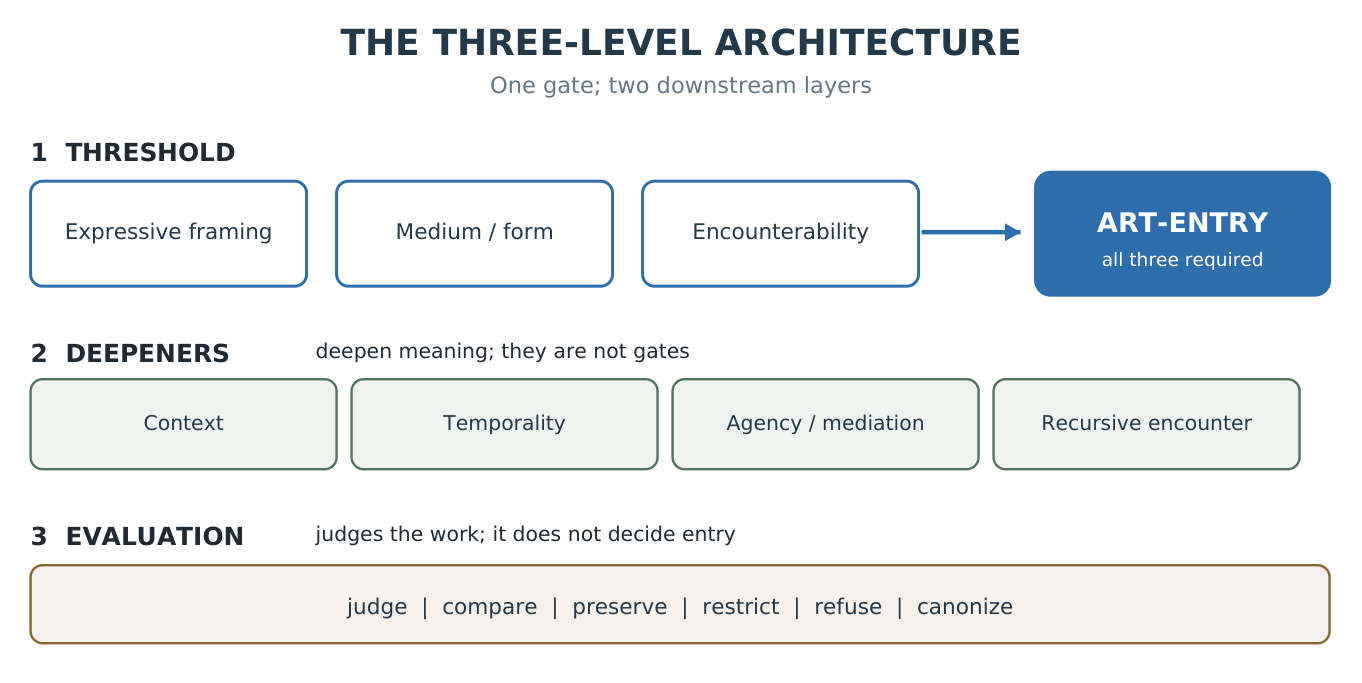
Figure 1. The three-level architecture. Three jointly necessary threshold conditions constitute the single gate of art-entry. Once it is crossed, a work is within the art-system at minimum art-status only—not quality, value, legitimacy, ownership, or public access. Deepeners enrich meaning and evaluation judges the work, but neither is a further gate: a negative evaluation cannot remove art-status. Whether each threshold condition is present in a non-trivial degree is a matter of judgment, not a mechanical switch; the one categorical exception is the complete absence of form, which fails the floor as a matter of fact.
VII. Formal Logic
A. Main Argument
-
Art-status is not an inherent property of objects alone; it emerges through entry into an art-system.
-
Entry into an art-system requires three threshold relations: expressive framing beyond bare function, mediation through form, and encounterability.
-
Each threshold relation must be present in a non-trivial minimal degree: it must be sufficiently salient, anchored, and encounter-guiding to help establish art-entry.
-
Objects, acts, processes, events, or outputs lacking any one of these threshold relations do not meet the model’s minimum conditions for art-status.
-
Objects, acts, processes, events, or outputs satisfying all three threshold relations meet the model’s minimum conditions for art-status.
-
Therefore, not everything is art, but anything capable of entering these threshold relations can become art.
B. Expressive Surplus Argument
-
Many non-art things are intentionally made, formally mediated, and encounterable: traffic signs, legal briefs, tax forms, product packaging, and functional tools.
-
If intentional making, formal mediation, and encounterability were sufficient for art-entry, then nearly all designed and encounterable artifacts would qualify as art.
-
Nearly all designed and encounterable artifacts do not qualify as art.
-
Therefore, art-entry requires more than intentional making, form, and encounterability in the ordinary functional sense.
-
The additional requirement is expressive surplus: meaning generated or authorized by framing that exceeds bare function through aesthetic, symbolic, affective, ritual, formal, conceptual, imaginative, experiential, or interpretive dimensions.
-
Therefore, something enters an art-system only when its framing, form, and encounterability make it available as more than its ordinary use, operation, or informational role.
C. Procedural Intent Argument
-
Some forms of art—chance composition, improvisation, generative processes, open-ended performance, and collaborative work—involve intentional framing without full outcome control.
-
These forms are recognized across artistic practice.
-
A theory requiring outcome intent would exclude them or treat them as defective cases.
-
Procedural intent—intentionally framing, authorizing, selecting, or presenting a process—can suffice for art-entry where expressive surplus, form, and encounterability are present.
-
Therefore, art-entry requires expressive framing somewhere in the system; it does not require total control over outcome.
D. Private Art Argument
-
Art requires encounterability, not necessarily public reception.
-
An artist can encounter their own work as maker, receiver, editor, witness, or remembering subject.
-
A private work can be formed through a medium and encountered by its maker.
-
Therefore, private work can qualify as art.
E. Bad Art Argument
-
Qualification asks whether something meets the minimum conditions for art-entry.
-
Evaluation asks whether the art is good, harmful, strong, weak, significant, or trivial.
-
Something can meet qualifying conditions while being evaluated negatively.
-
Therefore, bad art is still art. Qualification and evaluation are formally distinct.
F. Ethical Safeguard Arguments
Qualification is not exoneration
-
Art-entry requires satisfaction of the threshold conditions: expressive framing beyond bare function, mediation through form, and encounterability.
-
A work may satisfy these threshold conditions while producing harm, exploitation, manipulation, appropriation, degradation, propaganda, or violence.
-
Satisfying threshold conditions establishes minimum art-status only; it does not establish moral approval.
-
Therefore, qualification is not exoneration: harmful art may qualify as art, but its art-status does not excuse, redeem, or protect it from ethical critique.
Recognition is not entitlement
-
Some works may enter art-systems under restricted, sacred, familial, ceremonial, or community-governed conditions.
-
Recognizing that such a work functions as art does not establish authority to access, reproduce, display, interpret, own, sell, digitize, remix, train on, or circulate it.
-
Authority over access and circulation depends on ethical, legal, communal, cultural, political, and protocol-governed considerations that are not settled by art-status alone.
-
Therefore, recognition is not entitlement: art-status does not create rights of access, reproduction, interpretation, circulation, or ownership.
Potential art-status is not permission to appropriate
-
A person or institution may be capable of expressively framing an object, story, image, ceremony, archive, or artifact.
-
The capability to frame something as art does not by itself establish standing or authority to do so.
-
Therefore, potential art-status is not permission to appropriate.
Art-status does not erase harm
-
Some harmful works are expressively framed, formally mediated, and encounterable.
-
Expressive force may intensify a work’s harm rather than redeem it.
-
Therefore, art-status does not erase harm; ethical evaluation remains necessary after qualification.
VIII. Minimum Art Threshold: Full Specification
1. Expressive Framing
Expressive framing is the act by which something is positioned, shaped, selected, arranged, performed, presented, authorized, or received as carrying meaning beyond bare function. It is the initiating condition of art-entry.
The model introduces expressive surplus as the content that expressive framing must generate or authorize. Expressive surplus is the additional meaning that appears when an object, act, process, event, or output exceeds its bare function and becomes available for aesthetic, symbolic, affective, ritual, formal, conceptual, imaginative, experiential, or interpretive encounter. It is not mere decoration, intention, complexity, design, emotional response, or institutional placement. It is the dimension of meaning by which the thing becomes more than its ordinary use, operation, or informational role within a given art-system.
Expressive surplus requires a distinction between function, design, and expression. A thing has function when it performs an ordinary use or task. It has design when its form is intentionally shaped to perform that task effectively, elegantly, persuasively, or beautifully. It has expressive surplus when it is framed or encountered as carrying meaning beyond that task. Function and design may support expressive surplus, but they do not by themselves establish it. A well-designed tool remains a tool unless its form, use, placement, performance, or reception generates surplus meaning beyond ordinary utility.
A surplus is operative when it is made salient within the work’s framing, anchored in some feature of form, placement, performance, use, context, or reception, and capable of guiding encounter beyond ordinary function. This does not mean that every viewer must notice the same surplus or interpret it in the same way. Nor does it mean that borderline cases disappear. It means that the claim of art-entry carries a burden: the surplus must be locatable in the relation between framing, form, and encounter, rather than merely available as an interpretation someone could invent after the fact. Operative surplus is therefore not a mechanical test. It is a burden-shifting criterion: whoever claims that something has entered an art-system must be able to say what surplus is active, where it is anchored, and how it changes the conditions of encounter.
The following modes are diagnostic rather than exhaustive. They identify recurring ways surplus meaning appears: aesthetic surplus, when form, composition, rhythm, proportion, surface, sound, or sensory quality becomes meaningful; symbolic surplus, when something carries conventional, cultural, political, spiritual, or associative meaning beyond literal denotation; affective surplus, when the work engages, organizes, transmits, withholds, or complicates feeling; ritual surplus, when the work enacts, marks, repeats, or transforms shared practice; formal surplus, when structure, constraint, sequence, pattern, or relation generates meaning; conceptual surplus, when the work foregrounds an idea, question, proposition, or category problem; imaginative surplus, when the work opens counterfactual, fictional, speculative, remembered, or possible worlds; experiential surplus, when the work alters the quality, duration, or intensity of attention; and interpretive surplus, when the work sustains multiple, layered, contested, or recursive meanings. The list is not closed; its purpose is to prevent expressive surplus from becoming either too narrow or too permissive.
Mere declaration does not by itself establish expressive surplus. A declaration can initiate expressive framing, but only when it changes the object’s art-system by generating, authorizing, or activating surplus meaning. To say “this is art” is not enough. The declaration must make a difference in how the object, act, process, event, or output is encountered, interpreted, situated, performed, remembered, or contested.
A key distinction governs intent within expressive framing: procedural intent intentionally frames or authorizes a process without requiring control over its final outcome; outcome intent intends a specific final result. Art-entry requires expressive framing somewhere in the art-system, but it does not require total control over outcome. This distinction allows chance composition, improvisation, collaborative practice, generative systems, and AI-assisted work to enter art-systems when the process is expressively framed, selected, presented, or encountered.
Expressive framing need not be supplied by the original maker. A later receiver, community, curator, tradition, or descendant may supply or transform the framing. This accommodates found art, outsider art, inherited vernacular forms, and works that acquire artistic status over time. But retroactive framing is not costless. It must still generate surplus meaning; it cannot be a purely verbal annexation. In protected, sacred, familial, or community-governed contexts, the fact that a later viewer can frame something expressively does not mean that the viewer has authority to access, display, reproduce, own, or interpret it. Potential surplus does not establish entitlement.
2. Medium / Form
Art requires that expression be mediated through some form: material, bodily, sonic, linguistic, spatial, temporal, digital, performative, or processual. The medium is not a neutral carrier. It shapes what kinds of meaning can appear. A poem and a carving do not generate meaning in the same way even when they address similar themes.
Technique belongs to this component: the way a medium is handled, shaped, performed, constrained, or allowed to operate. Technical excellence is not a qualifying condition. Weak or crude technique affects evaluation, not art-entry.
Medium/form also separates art-entry from unexpressed thought. A person may imagine a powerful poem, image, song, ceremony, or performance, but until it is mediated through some form—language, sound, body, image, memory practice, material arrangement, or process—it has not yet entered an art-system.
3. Encounterability
Art requires encounterability: the capacity to be received, sensed, witnessed, interpreted, participated in, used, inhabited, remembered, or internally responded to.
Encounterability does not require public access. The receiver may be an audience, a community, a future generation, a critic, an authorized ceremonial participant, or the artist as their own first receiver. Private art qualifies when formed and encountered by the maker. Restricted art qualifies when encountered within authorized conditions. Unexpressed thought does not qualify—not because private experience cannot matter, but because an unformed, unmediated experience has not yet become an encounterable work.
Encounter may be active or passive. Active encounter includes interpretation, participation, response, or co-creation. Passive encounter includes receiving, absorbing, witnessing, or remembering. Both can qualify.
Restricted and Authorized Encounter
Encounterability does not mean public availability. A work may be encounterable only within authorized, familial, ceremonial, sacred, communal, or protocol-governed conditions. Such restriction does not negate art-status. It changes who may encounter the work, under what authority, and according to what obligations.
Authorized encounter is sufficient for encounterability; public encounter is not required. A private poem may be encountered by its maker. A family image may be encountered within familial relation. A ceremonial song may be encountered by authorized participants. A community-governed object may be encountered under protocol. In each case, the work may enter an art-system without becoming publicly accessible.
This distinction prevents a common error: treating art-status as a claim of public availability. To say that a restricted work enters an art-system is not to say that outsiders may access, reproduce, interpret, display, digitize, archive, train on, sell, remix, or circulate it. Encounterability names the possibility of encounter within the relevant relation; it does not create entitlement to encounter.
The model therefore distinguishes three questions: whether the work has entered an art-system, who has authority to permit encounter, and what protocols govern access, interpretation, reproduction, and circulation. Art theory may help clarify the first question. It does not settle the second or third by itself.
IX. System Deepeners
4. Context
Context is the field of meaning that shapes how a work is made, perceived, interpreted, restricted, valued, transmitted, transformed, or contested. It includes personal, familial, cultural, historical, political, ethical, spiritual, technological, economic, ecological, institutional, linguistic, ceremonial, and platform dimensions.
Institutional recognition belongs within context. Institutions can powerfully shape an art-system by expanding audience, conferring prestige, preserving works, organizing archives, producing markets, generating criticism, and stabilizing canons. But institutional recognition is not definitionally necessary. A work can enter an art-system without museum recognition, market value, critical approval, or institutional authorization.
5. Temporality
Art exists in time and is transformed by it. This includes creation time, performance duration, repetition, memory, material decay, preservation, destruction, rediscovery, historical revaluation, and obsolescence. A work may fade, be misremembered, become sacred, become offensive, become newly urgent, or acquire force it did not initially carry.
Temporality is a deepener rather than a threshold condition. A new work need not survive time to enter an art-system. But time often deepens the art-system by adding layers of memory, return, reinterpretation, care, loss, or dispute.
6. Agency / Mediation
Art may be produced through individual, collective, technological, ecological, inherited, ritual, or distributed processes. The relevant question is not whether every part of the process is human, but whether the output has entered an art-system through expressive framing, medium/form, and encounterability.
Machine mediation, communal authorship, ritual repetition, ecological processes incorporated through framing, and inherited forms can all deepen an art-system. They do not automatically create one. Agency and mediation matter because they shape how a work is made, transmitted, credited, contested, or governed.
7. Recursive Encounter
Recursive encounter is the feedback loop through which a work returns to a maker, receiver, community, critic, or later generation and changes understanding, judgment, memory, or action. It may occur during making, as when an artist revises after seeing or hearing the work. It may occur after making, as when a community reinterprets a song, image, story, or monument. It may occur beyond the artist’s involvement, as later generations reframe an artifact or critique a canon.
Recursive encounter is not required for art-entry, but it is one of the ways art-systems become durable, contested, and alive.
X. AI, Authorship, and Machine Mediation
AI-assisted art is a pressure case for the System Model because it separates questions that are often conflated: output, creativity, agency, authorship, ownership, art-status, and moral responsibility. The model does not need to decide whether current AI systems are conscious, intentional, or creative in the full human sense before determining whether an AI-involved output can enter an art-system. The threshold question is narrower: has the output been expressively framed beyond bare function, mediated through form, and made capable of encounter?
This distinction matters because an AI system may participate in the production of an image, sound, text, design, performance element, or other output without being the artist, author, legal rights-holder, or moral subject of the work. The AI may function as a tool, medium, process, constraint system, generative collaborator, or machine mediator depending on the case. These roles differ in attribution and evaluation, but they do not by themselves settle art-status.
The System Model treats most current AI-assisted art as procedurally framed. A human or human-involved agent may prompt, constrain, select, reject, revise, title, sequence, contextualize, exhibit, or otherwise present an output. These acts may supply expressive framing even where the human does not control every feature of the generated result. This is why outcome intent is not required for art-entry. Chance composition, improvisation, photography, printmaking, algorithmic art, and generative systems already show that art can involve procedures whose final results are not fully controlled. AI intensifies this issue but does not create it from nothing.
Prompting alone, however, should not be treated as automatically sufficient. A prompt becomes art-relevant when it functions as part of expressive framing: when it constrains, directs, authorizes, selects, or situates a generative process so that the resulting output becomes available for surplus encounter. A casual prompt that produces an unselected and unpresented image is a weak case. A deliberate process involving iterative prompting, selection among outputs, revision, compositing, titling, sequencing, exhibition, or contextual framing is a stronger case. The model therefore distinguishes mere generation from art-entry.
It is fair to ask for a principled cut: what quantum of selection or curation tips a weak case into a qualifying one? The honest answer is that there is no quantum, and the model should not invent one. A numerical threshold of prompts, edits, or selections would be exactly the mechanical rule the rest of the account rejects, and it would falsely imply that art-entry is decided by counting activity. The cut is principled in a different way. AI sufficiency is a question about the two scalar conditions—whether human or human-involved framing has made surplus operative and anchored, and whether the output is genuinely encounterable—not about the categorical floor, which a generated image clears the moment it exists as form. The line is therefore qualitative: what must be true is that some framing act makes surplus salient, anchored in the output’s form, placement, sequence, or context, and capable of guiding encounter beyond the bare fact that a prompt was typed. A single well-anchored act of selection, composition, or presentation can satisfy this; a thousand idle prompts that no one selects, presents, or encounters do not, because nothing has been anchored. This is the same burden of anchored articulation that governs every contested case above the floor (Objection 3), applied to the AI case rather than suspended for it. Institutions and courts find the line hard because they want a bright, countable rule for authorship and copyright; the model’s question is narrower and prior to theirs—it concerns art-entry, not authorship—and on that question the absence of a quantum is accuracy, not evasion: where surplus is operative is a matter of anchored judgment, not arithmetic.
This also separates art-status from authorship. An AI-assisted output may qualify as art without settling whether the human prompter, editor, curator, model designer, dataset laborers, institution, or machine should receive authorial credit. Authorship is an attribution question; copyrightability is a legal question; responsibility is an ethical question; art-entry is a threshold question. These questions often interact, but they are not identical.
Copyrightability is not art-status, but copyright debates help clarify where human expressive contribution, selection, modification, and authorship are being located. A legal regime may decide protectability differently from an aesthetic theory’s classification of art-entry. The System Model therefore uses legal authorship questions only as analogies or adjacent distinctions, not as controlling criteria for art-status. A later U.S. Copyright Office report on generative AI training concerns the separate issue of training on copyrighted works and fair use; that question may matter ethically and legally, but it is orthogonal to the threshold question of art-entry.
Fully autonomous AI output presents a different case. If a machine system generates outputs that are not selected, framed, presented, encountered, archived, or otherwise situated within any human or human-involved art-system, then the expressive framing condition is not met. The output may be visually complex or statistically novel, but it has not yet entered an art-system under this model. If a later person, community, institution, or tradition selects and frames that output, it may then enter an art-system through retroactive framing, provided that the framing generates operative expressive surplus. As with any retroactive framing, that the output thereby enters an art-system does not license access to or authority over protected material; where the framing would breach protocol, consent, or relation, the entry confers nothing and the framing may itself be a wrong (see the Protected-Context Rules).
The model therefore avoids two opposing errors. It does not deny art-status to AI-assisted work merely because a machine participated in its production. But it also does not grant art-status to every machine output merely because it is image-like, surprising, or technically complex. The relevant question remains structural: where is expressive framing supplied, how is the output mediated through form, and under what conditions is it encountered?
XI. Evaluation Layer
A. Evaluation After Qualification
Evaluation addresses how a work should be judged, compared, valued, criticized, defended, preserved, restricted, refused, repaired, or remembered. It may consider expressive force, technical command, originality, ethical complexity, cultural resonance, emotional power, historical importance, participatory force, temporal durability, recursive depth, and transformative effect.
Evaluation is formally separated from qualification. A negative evaluation does not remove art-status, and qualification does not require positive evaluation.
B. Criteria of Evaluation
A work is not simply “greater” in the abstract. It may be stronger or weaker with respect to different criteria: expressive surplus; medium or technique; encounterability; contextual density; ethical force; originality; cultural resonance; historical importance; emotional power; durability; risk; recursive depth; and transformative effect.
This permits cross-criteria judgments. A work may be technically strong but ethically corrupt; emotionally powerful but formally thin; conceptually sharp but experientially inert; deeply communal but materially ephemeral; aesthetically beautiful but politically manipulative. Such multidimensional assessments are the norm in serious criticism.
The model avoids authoritarian ranking by requiring criteria. It avoids empty relativism by allowing comparison across named axes.
C. After-Art
After-art is a second-order form: critique, curation, restoration, parody, response, commentary, and interpretive reframing may themselves become art when judgment or interpretation becomes expressive medium.
The governing rule is: judgment is not the gatekeeper of art, but judgment can become part of art’s life. A critique is not art merely because it comments on art. A restoration is not art merely because it touches art. But when criticism, curation, restoration, parody, or response is expressively framed, mediated through form, and made capable of encounter, it may itself enter an art-system.
XII. Ethical Safeguards
The System Model separates art-status from moral approval, access, ownership, and legitimacy. This separation is necessary because art-status can otherwise be misused. If art-status is treated as moral approval, harmful works become protected from critique. If recognition is treated as entitlement, restricted or community-governed forms become vulnerable to extraction. The ethical safeguards therefore function as inference-blocking rules: they do not decide whether something has entered an art-system, but they govern what may and may not be inferred from that entry. They are internal to the model because a theory of art-entry must also clarify what its own classificatory act does not authorize.
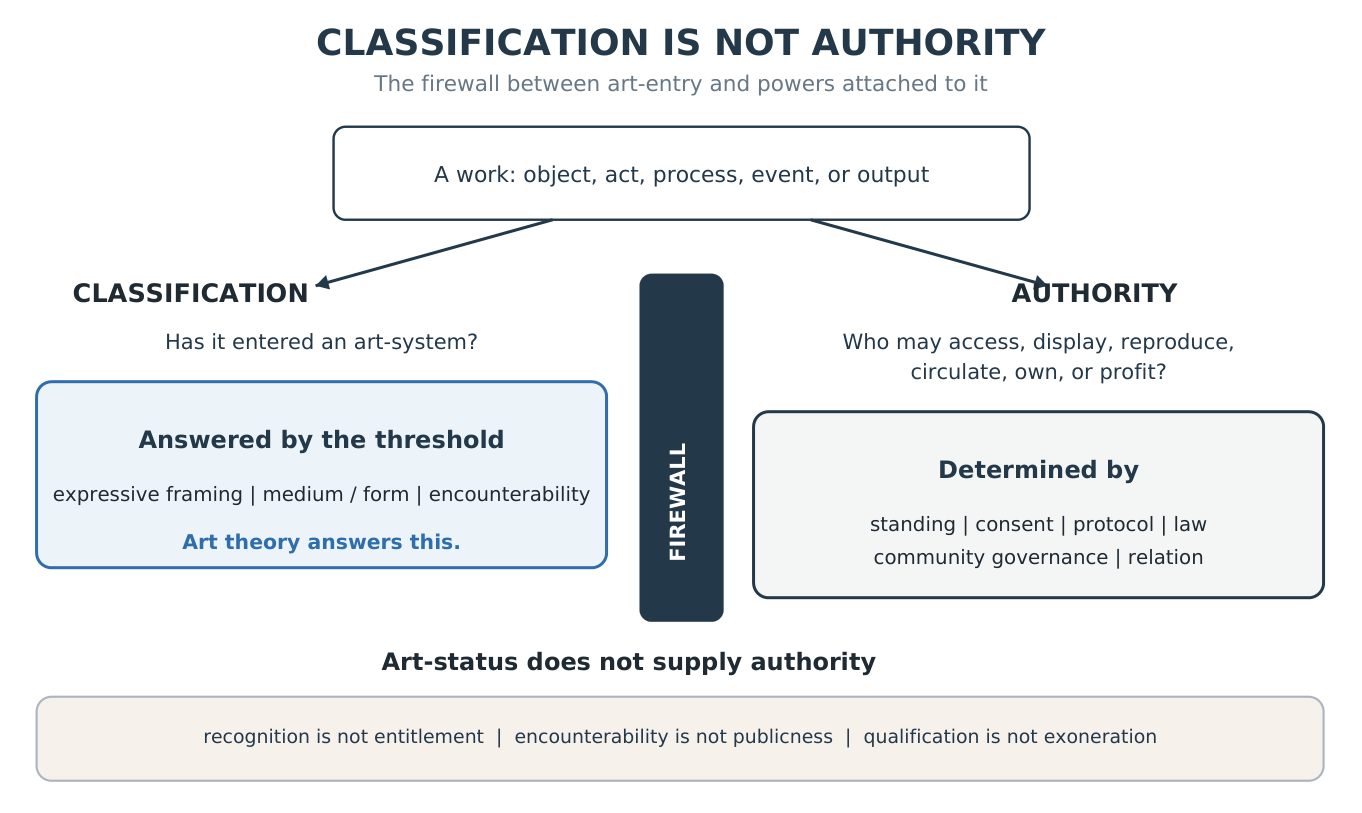
Figure 2. Classification is not authority. A work raises two distinct kinds of question. Classification—has it entered an art-system?—is answered by the threshold and is the domain of art theory. Authority—who may access, display, reproduce, circulate, own, or profit from it?—is determined by standing, consent, protocol, law, community governance, and relation, and is not settled by art theory. The inference-blocking rules below (recognition is not entitlement, encounterability is not publicness, and the rest) are all forms of this one distinction. The model blocks the inference from art-status to authority; it does not adjudicate authority itself.
Qualification is not exoneration. A work may satisfy the threshold conditions of art-entry and still be unethical, exploitative, appropriative, degrading, manipulative, propagandistic, violent, dangerous, or worthy of refusal, restriction, condemnation, contextualization, or repair. Calling something art does not excuse the conditions of its making, the harms of its circulation, the politics of its display, or the uses to which it is put.
Recognition is not entitlement. To recognize that something functions as art does not mean that everyone has a right to access, reproduce, publish, interpret, display, own, sell, remix, digitize, archive, extract, train on, or circulate it. This applies with particular force to sacred, ceremonial, familial, community-governed, restricted, or culturally sensitive forms. A work can enter an art-system under authorized conditions while remaining unavailable to outsiders or governed by protocol.
Classification is not authority. This is the rule the others express: art-status is a classificatory fact, while authority is a separate normative one. To classify something as art is not to establish who may access, display, reproduce, interpret, circulate, own, sell, digitize, train on, or govern it. Authority depends on standing, consent, protocol, law, community governance, relation, or other conditions that art-status alone cannot supply. Recognition is not entitlement and encounterability is not publicness because, more fundamentally, classification is not authority: the act of placing something in an art-system settles a question of kind, not a question of who may do what with it. Art discourse can describe, situate, and interpret; but it cannot confer the standing it does not have, and where a form is restricted, its public, institutional, reproductive, or circulating interpretation may itself require authority that art-status does not supply.
Potential art-status is not permission to appropriate. The fact that something could be expressively framed does not mean that any person or institution has authority to frame it. An outsider may be capable of placing a sacred object, story, image, ceremony, archive, or community artifact into an art-system, but capability does not establish legitimacy. The model therefore distinguishes possible art-entry from rightful authority to frame, display, reproduce, interpret, or circulate.
Art-status does not erase harm. Propaganda, exploitation, spectacle, humiliation, appropriation, and violence can be expressively framed, formally mediated, and powerfully encountered. That does not redeem them. A harmful work may qualify as art and still deserve condemnation, restriction, refusal, counter-speech, contextualization, removal, or repair. Evaluation remains answerable to what the work does to persons, communities, memory, dignity, and relation.
These safeguards do not add a moral gate to the threshold. They preserve the distinction between classification and consequence. The threshold asks whether something has entered an art-system. Ethical evaluation asks what follows from that entry, who is affected, who has authority, what harms are produced, and what forms of refusal, restriction, repair, or accountability may be required.
Protected-Context Rules
-
Restriction does not negate art-status. A work may be art even when access is limited, private, ceremonial, familial, or community-governed.
-
Encounterability does not require publicness. Encounter may occur within authorized relation, private making, familial memory, ceremonial participation, or community protocol.
-
Recognition does not create authority. Recognizing something as art does not give the recognizer standing to access, display, reproduce, interpret, circulate, own, sell, digitize, train on, or archive it.
-
Framing capacity does not establish framing legitimacy. The fact that an outsider can generate expressive surplus around a restricted object, image, story, song, or archive does not mean the outsider has authority to do so.
-
Institutional recognition does not override protocol. A museum, archive, platform, collector, critic, researcher, or AI developer may intensify visibility, circulation, or classification, but institutional power does not by itself establish legitimate access.
-
Ethical evaluation remains active after classification. A restricted work may qualify as art, while a particular display, reproduction, archive, dataset, or interpretation of it remains unethical or illegitimate.
A hard case sharpens what this orthogonality means: what happens when the operative surplus is itself supplied by an outsider’s retroactive framing, and the object is protected? The answer follows directly from the separation of classification and authority, and it is deliberately two-part. Classificatorily, the work may enter an art-system: if the framing genuinely makes surplus operative, anchored, and encounterable, the threshold is met, and whether it is met cannot be made to depend on whether the framing was permitted—because making authority a precondition of classification would reinstate the very collapse the firewall forbids, letting standing decide what counts as art. But the entry confers nothing. It grants the framer no access, display, reproduction, ownership, or interpretive authority; and where the framing breached protocol, consent, or relation, the act of framing is a wrong that art-status neither erases nor excuses. The result that even an unauthorized or appropriative framing can succeed classificatorily is not a concession the model regrets but the firewall stated at its hardest: classification was never the prize, and the protections that matter live entirely on the authority side, left fully intact precisely because classification is refused the power to carry them. A model that instead blocked classification for protected objects would protect them less, not more—it would imply that what authority withholds is the status of art, when what authority withholds is access, use, and control.
Art theory cannot settle every question of authority, but it can refuse to let classification masquerade as authority. Art discourse does not override authority, standing, or protocol.
XIII. Humility Clauses
A. Nature and Human Framing
Within this model, natural phenomena are not art by existing. A sunset, mountain, animal track, river, storm, or bird call may be beautiful, sacred, relational, and meaningful. The model does not deny that. Its narrower claim is classificatory: for purposes of this framework, a natural phenomenon becomes part of a human-involved art-system when it enters an expressive framing relation.
The rule is: nature alone is not art within this model; nature-plus-framing may become art. This accommodates land art, environmental art, found natural material, photography of natural subjects, ritual framing, and ecological works while preserving the threshold requirement.
B. Nonhuman Agency
This model does not settle whether animals, ecosystems, spirits, ancestors, or other more-than-human beings create art within their own ontological orders. That question is philosophically important. It is outside this model’s scope.
The model is methodologically anthropocentric but not metaphysically exclusionary. It analyzes human or human-involved art-systems without denying the possibility of expressive orders beyond them.
C. AI and Machine Outputs
The model does not require AI consciousness, creativity, or sentience as conditions for AI-involved art. The relevant question is whether an output enters an art-system through expressive framing, medium/ form, and encounterability. These questions can be answered without settling all disputed issues in AI philosophy.
At the same time, AI output is not automatically art. Machine generation does not replace expressive framing. Art-entry requires that the output be situated within an art-system through non-trivial framing, form, and encounter.
XIV. The Art Matrix
The Art Matrix is a descriptive and diagnostic aid, not a scoring machine, funding rubric, or substitute for encounter, protocol, or judgment.
| Dimension | Guiding question | Weak presence | Strong presence |
|---|---|---|---|
| Expressive framing | What frames this beyond bare function? | Mostly functional; unclear surplus | Strong aesthetic, symbolic, affective, ritual, conceptual, or interpretive surplus |
| Medium / form | How does it become encounterable? | Thin, incidental, or unformed | Meaningful use of material, language, sound, body, image, code, space, or process |
| Encounterability | Who or what can encounter it? | Barely encounterable or inaccessible without reason | Public, private, communal, internal, restricted, participatory, or deeply receivable |
| Context | What field shapes its meaning? | Generic or weakly situated | Rich personal, cultural, ethical, historical, political, spiritual, or institutional field |
| Temporality | How does time affect it? | Little temporal force | Strong repetition, decay, memory, preservation, reinterpretation, or endurance |
| Agency / mediation | Who or what participates? | Simple or unexamined agency | Complex individual, communal, machine, ecological, ritual, inherited, or hybrid mediation |
| Recursive encounter | How does it return? | Little evidence of return or reinterpretation | Strong feedback loop of making, receiving, judging, revising, or reinterpreting |
| Ethical force | What does it do to people, memory, dignity, or relation? | Unexamined harm or thin ethical awareness | Ethically aware, reparative, protective, truth-bearing, or responsibly provocative |
A work with strong expressive framing but weak technique differs from one with strong technique but little surplus. A work with deep communal context and minimal material form differs from one with dazzling form and shallow context. The matrix helps locate these differences; it does not resolve them.
XV. Adversarial Test Cases
The following cases are pressure tests for the System Model. They are not scoring devices and do not replace judgment. Their function is to locate where a dispute occurs: expressive framing, medium/ form, encounterability, expressive surplus, context, agency/mediation, evaluation, authority, access, or ethical consequence.
Each case distinguishes classification from evaluation. A case may qualify as art and still be weak, harmful, illegitimate, restricted, or ethically compromised. Conversely, a case may be aesthetically pleasing, technically elegant, meaningful, or institutionally displayed and still fail to enter an art-system if the threshold conditions are not met.
1. Tax form in a filing cabinet. A tax form has language, layout, symbols, and possible readers. Under ordinary conditions, however, it is framed as administrative function. Its form serves information-gathering and compliance. It does not ordinarily generate operative expressive surplus beyond bare function. Disposition: Does not qualify under ordinary conditions. Pressure point: Function and design are not enough.
2. Tax form in an installation. A tax form placed in an installation about bureaucracy, labor, citizenship, extraction, surveillance, or state power may be expressively reframed. The same form now becomes encounterable as more than paperwork; its administrative structure becomes symbolic, conceptual, and interpretive material. Disposition: Qualifies if the reframing generates operative expressive surplus. Pressure point: Retroactive or institutional framing can generate art-entry, but only when surplus meaning becomes operative.
3. Traffic sign. A traffic sign is designed, visible, formal, and encounterable. Its ordinary purpose is public instruction and safety. Its design may be elegant or iconic, but its form is usually exhausted by function. Disposition: Usually does not qualify. Pressure point: Design is not identical to expressive surplus.
4. Stop sign in a protest installation. A stop sign used in a protest installation may become a symbol of state authority, blocked movement, refusal, danger, policing, border control, or social interruption. Its ordinary function is not erased, but it is reactivated as expressive material. Disposition: Can qualify. Pressure point: Ordinary function may be transformed by expressive framing.
5. Legal brief praised for beauty. A legal brief may have rhythm, elegance, structure, and rhetorical force. But under ordinary conditions it is framed as advocacy, not as an artwork. It qualifies only if its form, language, institutional role, or performative structure becomes the object of encounter beyond legal function. Disposition: Borderline; qualifies only where expressive surplus exceeds advocacy. Pressure point: Aesthetic quality alone is not enough.
6. Unexpressed idea for a poem. A person imagines a poem but never forms it in language, sound, writing, performance, memory practice, or any other medium. The idea may be meaningful to the person, but it has not yet become mediated form. Disposition: Does not qualify yet. Pressure point: Art-entry requires medium/form, not merely interior intention.
7. Private poem encountered only by its maker. A poem written privately and encountered only by its maker may satisfy the threshold. It has expressive framing, linguistic form, and encounterability through the maker’s own reception, revision, memory, or self-witnessing. Disposition: Qualifies as a minimal art-system. Pressure point: Encounterability does not require public reception.
8. Permanently inaccessible object. Suppose an object is formed with expressive intent but is destroyed before any actual, internal, authorized, or later encounter becomes possible. The intention may have existed, but encounterability has failed. Disposition: Does not clearly qualify; the lost project may later become the object of another art-system. Pressure point: Hypothetical encounterability is not enough.
9. Ceremonial song restricted from outsiders. A ceremonial song may be expressively framed, formally mediated, and encounterable within authorized ceremonial conditions. Restriction from outsiders does not negate art-status. Public access is not required. Disposition: Qualifies within authorized conditions. Pressure point: Encounterability is not publicness; recognition is not entitlement.
10. Sacred object displayed without consent. A sacred or community-governed object may function as art within an authorized system. If displayed by an outsider without consent, the object may still be treated as art by an institution, but the display may be illegitimate. Disposition: May qualify; unauthorized display remains ethically compromised. Pressure point: Classification does not establish authority, standing, or protocol.
11. Racist propaganda poster. A racist propaganda poster may have expressive framing, form, symbolism, affective force, and public encounterability. It can qualify as art. But qualification does not imply moral approval. Disposition: Qualifies, but is ethically condemnable. Pressure point: Qualification is not exoneration.
12. Exploitative spectacle. A performance or image that humiliates, exploits, or endangers persons may be expressively framed and encounterable. Its art-status does not redeem the harm. Indeed, expressive force may intensify the harm. Disposition: May qualify, but remains ethically vulnerable or condemnable. Pressure point: Art-status does not erase harm.
13. Fully autonomous AI image selected by no one. A machine system generates an image without human prompting, selection, presentation, curation, preservation, or encounter. The output may be complex or image-like, but it has not entered a human or human-involved art-system. Disposition: Does not qualify yet. Pressure point: Machine generation is not automatically expressive framing.
14. Prompted AI image, immediately ignored. A person enters a casual prompt, receives an output, and never selects, saves, titles, edits, presents, or encounters it as art. The human involvement is too thin to clearly supply expressive framing. Disposition: Weak or non-qualifying case. Pressure point: Prompting alone is not automatically sufficient.
15. Iterative AI-assisted work. A person uses iterative prompting, selection, editing, compositing, titling, sequencing, and presentation to produce a work. The AI system participates as machine mediation, but expressive framing is supplied through human or human-involved process. Disposition: Qualifies. Pressure point: Outcome control is not required where procedural framing is strong.
16. Ordinary object in a museum. An ordinary chair, tool, or manufactured object placed in a museum does not automatically qualify merely because it is institutionally displayed. But if the display frames the object as a question about design, labor, use, class, history, domesticity, or art itself, expressive surplus may become operative. Disposition: Conditional. Pressure point: Institutional placement is powerful context, not automatic art-entry.
17. Parody or critique of an existing artwork. A parody, critique, restoration, curation, or interpretive response may itself enter an art-system if judgment becomes expressively framed, formally mediated, and encounterable. It is not art merely because it comments on art. Disposition: Can qualify as after-art. Pressure point: Evaluation can become art, but evaluation is not automatically art.
18. Meme with recursive circulation. A meme may be visually simple, anonymous, derivative, or low-status, but it can carry formal repetition, symbolic compression, affective force, communal recognition, remix, and recursive encounter. Its weakness or ephemerality affects evaluation, not necessarily art-entry. Disposition: Can qualify. Pressure point: Low technique or popular circulation does not prevent expressive surplus.
The cases above test the model for consistency: each locates where a dispute falls and distinguishes classification from evaluation. The two cases that follow test it for comparative advantage. Each is a case in which the model returns a different verdict than a major rival theory, and the divergence is where the model does work the rival cannot. They are not claims that the rivals are refuted; they show that the model’s role assignment is not idle relabeling, because it changes what a disputed case yields.
19. Ceremonial object outside the institutional artworld. An object is made and used within a ceremonial tradition that has had no contact with the Western artworld, carrying meaning fixed by that tradition’s own protocols and encountered only by authorized participants. Rival verdict (a Danto-style artworld reading): art-status depends on a relation to art-historical theory and the artworld—an “atmosphere of theory”—so on a narrow reading an object outside that narrative becomes legible as art only when retrospectively taken up into an external art-historical frame. System Model verdict: it constitutes an art-system on its own terms; its ritual and symbolic surplus is operative within its tradition, mediated through its form, and encountered under authorized conditions. It is art without annexation, and later artworld recognition, if it comes, is a deepener rather than the source of art-entry. Disposition: Qualifies, on the tradition’s own terms. Divergence: a narrow artworld reading courts an annexation problem—non-Western and pre-contact forms become art only by external uptake, as though art-status were in the artworld’s gift. A more capacious reading of the artworld can soften this, but the model removes the problem structurally: it lets the object be art within its own order of meaning, and its protocol rules ensure that granting art-status authorizes no outside access or display. It extends art-status more justly and withholds the entitlement that extension is usually taken to imply.
20. Signed blank canvas sold as a transaction. An artist signs a blank primed canvas, sells it at a major fair for a large sum, and is written about by critics—but states plainly that the work has no meaning, that it is “only a transaction,” and nothing in its surface, placement, or presentation is offered as carrying surplus beyond the sale. Rival verdict (institutional or market reading): the full apparatus has engaged—exhibition, sale, criticism, the machinery of canonization—so on a conferral- or market-based reading, status has been conferred and it is art. System Model verdict: the model withholds the automatic yes and forces the question. If genuinely nothing—not the surface, not the placement, not the disclaimer treated as a gesture—makes any surplus operative, what has occurred is institutional placement and a transaction, not art-entry; if instead the disclaimer is itself framed and received as a conceptual surplus about the art market, the model grants entry, but only by locating that surplus explicitly. Disposition: Withholds unless operative surplus can be located. Divergence: this is the floor biting in the direction the model is most often accused of neglecting. Against the worry that the model lets anything become art, the case shows the opposite: full institutional and market endorsement does not suffice without operative surplus. The model refuses to let the artworld vote something into art-status by fiat, and requires the defender to say where the surplus is rather than point at the price.
XVI. Evaluation and Comparison
The model permits evaluation and comparison while requiring criteria to be named. A work is not simply “greater” in the abstract. It may be greater with respect to expressive surplus, medium, technique, encounter, ethical force, originality, cultural resonance, historical importance, emotional power, durability, risk, recursive depth, or transformative effect.
This permits cross-criteria judgments. A work may be technically strong but ethically corrupt; emotionally powerful but formally thin; conceptually sharp but experientially inert; deeply communal but materially ephemeral; aesthetically beautiful but politically manipulative. Such multidimensional assessments are the norm in serious criticism. The model supports them without claiming that any single dimension is universally decisive.
The model avoids authoritarian ranking by requiring criteria; it avoids empty relativism by allowing comparison across named axes. This places the model between the two failures.
XVII. Scope of Applications
The System Model is a general theory. It is not derived from or dependent on any single political, cultural, technological, or educational application. Applications may include art education, criticism, AI-assisted creation, design theory, cultural preservation, public memory, sovereignty frameworks, community archives, protest movements, ceremony and protocol, digital platforms, museum studies, ethics of representation, and public discourse.
One companion application—Art as an Epistemic Tool for Indigenous Sovereignty—may map the model onto cultural memory, counter-archives, governance imagination, and community review. That application depends on the model’s general architecture; the model does not depend on that application. The hierarchy is: core theory first, applied use second. This independence protects both.
The protected-context rules also explain why the model can support, but should not replace, sovereignty-facing work. In cultural heritage, Indigenous data governance, repatriation, and community-archive contexts, the central issue is often not whether an object, story, image, song, or record is meaningful enough to be treated as art. The central issue is who has authority to access, frame, display, reproduce, circulate, interpret, or profit from it. The System Model’s contribution here is deliberately limited: it prevents art-status from being mistaken for that authority. It does not adjudicate the authority question, which depends on standing, consent, protocol, law, community governance, and self-determination that art theory cannot supply. A companion application can develop this connection more fully, relating art-entry to people-rooted authority, protected conditions, protocol, cultural memory, and non-extractive recognition; the present paper claims only that the classification/ authority distinction is the conceptual hinge such work requires, not that the model has been validated in any governance setting.
XVIII. Objections and Replies
The System Model is intended as a relational threshold theory of art-entry, not as a mechanical test that eliminates all borderline judgment. The following objections therefore focus on the model’s most vulnerable points: whether the threshold is too vague, whether expressive surplus is too elastic, whether institutional recognition is underweighted, whether private art is too individualistic, whether the model is merely cluster theory under another name, whether AI cases are being deflated, whether protected-context safeguards have authority, and whether the model’s role-assignment architecture is a genuine contribution rather than a relabeling of familiar disputes.
The replies do not claim that every disputed case can be decided automatically. The model’s aim is more modest: to make disagreement locatable. In a hard case, the question should become clearer: is the dispute about expressive framing, medium/form, encounterability, surplus meaning, context, agency, evaluation, authority, access, or ethical consequence?
Objection 1: Threshold Vagueness
The model says that expressive framing, medium/form, and encounterability must each be present in a “non-trivial minimal degree.” But this phrase may seem too flexible to do real definitional work. If the required degree varies by case, then the model may include or exclude works according to intuition rather than principle. A critic may ask: who decides when expressive framing is non-trivial enough, when a form is sufficiently mediated, or when encounterability is actual rather than merely possible? The threshold risks becoming a vocabulary for judgment rather than a constraint on judgment.
Reply: The objection is serious, and the model should not pretend to remove judgment from boundary cases. But it succeeds only if the threshold is uniform across its three conditions, and it is not. The architecture is better described as one categorical floor and two scalar conditions than as three conditions of the same kind. Expressive framing and, for the most part, encounterability are scalar: each is non-trivial when surplus is salient rather than merely asserted, or when the work can actually be received, witnessed, remembered, interpreted, participated in, or internally responded to under some relevant relation. About these two the objection is largely right. They are not mechanical measurements; they state a burden discharged dialectically—in criticism, contestation, community judgment, institutional argument, or authorized review—and for them the model claims only that disagreement becomes locatable and answerable, not algorithmically decidable.
Medium/form is different in kind, and this is what the objection misses. Its sharpest form is that a necessary condition which can never be shown unsatisfiable except by losing an argument is not really necessary. That charge holds against the two scalar conditions and fails against the floor. A content never given any form—language, sound, body, image, memory practice, material arrangement, or process—fails the medium condition as a matter of fact, not interpretation. There is nothing to litigate, because the party claiming art-entry has nothing to exhibit. The exclusion of the unexpressed idea (§VIII; adversarial case 6) is not the outcome of a contest the model might lose; it is a verdict reached before any contest begins. At least one of the three conditions can be shown unsatisfiable without an argument, and one is enough to defeat the claim that the threshold does no modal work at all.
Two qualifications keep this honest. The categorical force lives at the zero-point of mediation, where there is no form of any kind; as soon as some candidate form is present—a hummed bar, a scrawled line, a rehearsed image—whether it is sufficiently mediated becomes scalar again, and the dialectical burden returns. And one non-dialectical exclusion does not make the general test algorithmic; the model’s overall promise remains the modest one stated above. What the floor secures is narrower and sufficient: the model is scalar but not permissive, because it is anchored by a single condition whose complete absence is dispositive and factually checkable. Why that one condition is enough to separate the model from an unrestricted cluster is taken up under Objection 6.
Objection 2: Overbreadth through Retroactive Framing
If any later receiver, community, curator, or descendant can supply expressive framing to any object, then anything can become art through retrospective reframing. A rock, a piece of debris, a discarded tool—all are available for someone’s framing. This collapses the model back into “everything could be art,” which is the flattening the model claims to avoid.
Reply: The objection conflates could be art with is art. The model’s claim is conditional: something capable of entering an art-system could become art, but it does not become art through possibility alone. Retroactive framing must generate operative expressive surplus, not merely possible interpretation. It must also be mediated through form and made encounterable.
Retroactive framing can explain readymades, found objects, inherited forms, and later recognition, but it is not permission for unlimited annexation. In protected contexts, the fact that an outsider can generate surplus meaning does not establish authority to frame, access, reproduce, display, or interpret. Retroactive framing is possible, but it is not costless.
Objection 3: Circularity and Elasticity in Expressive Surplus
The model defines expressive surplus through aesthetic, symbolic, affective, ritual, formal, conceptual, imaginative, experiential, and interpretive modes. But these modes may seem to track what art already does. A skeptic can ask: how do we know whether expressive surplus is genuinely present without already knowing that the object is art? Worse, almost anything can be interpreted symbolically or conceptually. Does expressive surplus become infinitely elastic?
Reply: The model distinguishes possible interpretation from operative surplus, but this distinction should not be overstated as a mechanical solution. A critic can interpret anything. Expressive surplus is operative only when it is salient in the framing, anchored in form, placement, performance, use, context, or reception, and capable of guiding encounter beyond ordinary function. A legal brief, traffic sign, tax form, uniform, logo, or tool can be interpreted in many ways. It enters an art-system only when framing, form, and encounterability make it available as more than ordinary use, instruction, advocacy, administration, branding, or function.
The modes of surplus are independently intelligible. Symbolic meaning, affective organization, ritual enactment, formal constraint, conceptual questioning, and experiential transformation can be described without first deciding art-status. The disputed question is whether these modes are active in the case at hand. The model does not dissolve that dispute in advance; it locates it. Whoever claims art-entry must say what surplus is active, where it is anchored, and how it changes encounter. The model does not say that anything interpretable is art. It says that art-entry requires surplus meaning made operative through expressive framing, form, and encounter. The burden is not met by fluent interpretation alone: the claimed surplus must be anchored in the work’s form, placement, performance, reception, or authorized context, so that a false or merely inventive articulation can be defeated by showing that nothing in the case supports it.
Objection 4: The Institutional Power Objection
By treating institutional recognition as a contextual deepener rather than a definitional condition, the model may understate institutional power. Being exhibited in a major museum seems to contribute to art-status differently than being displayed in a living room. Institutions do not merely add context; they confer status, authority, and public legibility.
Reply: The model does not deny institutional power. It denies that institutional recognition is the only possible route into art-status. Institutions can powerfully shape recognition, circulation, interpretation, preservation, market value, and canonization. They can deepen an art-system by expanding encounter, stabilizing archives, generating criticism, and creating public memory.
But institutional power should not be confused with definitional necessity. Private, vernacular, outsider, familial, ceremonial, community-governed, and restricted works should not require institutional validation to enter art-systems. The model better captures the dual role institutions often play: they can strongly shape recognition and evaluation without being the sole source of art-status.
Objection 5: Private Art and the Social Dimension
The model permits private art: a work formed through a medium and encountered only by its maker can qualify. But art is typically public, communicative, and social. By allowing private art, the model may individualize art too much and lose what is essential about shared artistic life.
Reply: Art is typically social, but it does not follow that it is essentially public. A private poem qualifies as a threshold case, but it is usually thinner in context, communal encounter, institutional circulation, and recursive public life than a published poem. The model captures that difference through deepeners and evaluation without excluding private art from art-status.
The alternative would make public reception a threshold condition. That would exclude private writing, private performance, intimate ritual work, family-held objects, and works encountered only by their maker. The System Model avoids that exclusion while still explaining why public and communal art-systems are often richer, more durable, and more socially powerful.
Objection 6: Cluster Theory Adequacy
Cluster theory already handles art’s heterogeneity without demanding strict necessary and sufficient conditions. The System Model may look like cluster theory with three preferred cluster features: expressive framing, medium/form, and encounterability.
Reply: The System Model is closer to cluster theory than to rigid essence theory, but it adds a floor that cluster theory, by its structure, cannot supply. The three threshold conditions are necessary as minimum relational functions, not as fixed material properties, and they are jointly sufficient only for minimum art-status—not for value, legitimacy, public access, authorship, ownership, or institutional recognition. The disputed point is whether necessity here does any work a weighted cluster of criterial features does not. It does, and the unexpressed idea (§VIII; adversarial case 6) is where the difference shows.
A cluster account in Gaut’s sense holds that art has a range of criterial features—aesthetic merit, expressiveness, intellectual challenge, skill, and the rest—no one of which is required, whose presence in sufficient weight is enough. Consider, then, a content that would score well on those features— vividly imagined, emotionally charged, conceptually interesting, the sort of thing that would be art if only it were given form—but that is never expressed in any medium whatever. The model rules it out on the medium condition alone, whatever it scores elsewhere, because that condition is necessary. A pure cluster account has no such bar. It can usually reach the right verdict, but only because several of its appreciative features tacitly presuppose a made object; that exclusion is a contingent confluence of feature-absences, not a structural guarantee. Where a feature can be construed as a property of the content rather than the artifact, a cluster view owes art-status to whatever scores high enough on it and has no principled ground for refusing. The model refuses by the structure of necessity itself. Either way the dilemma favors the model: a cluster account either smuggles in a mediation requirement to get the verdict, or it overgenerates without one.
This is what a single non-negotiable condition buys, and it is the precise complement to the reply under Objection 1. There the concession was that two of the three conditions are scalar and dialectical, and the worry was that scalarity collapses the model into a cluster. The answer across both objections is one answer: cluster theory permits every feature to be absent so long as enough others are present, whereas the model permits at most two conditions to be scalar and permits none to be wholly absent. The floor is what disciplines the two scalar conditions rather than leaving them to float, and it is why the model can explain failure cases—bare function, unformed thought, inaccessible formation—that cluster theory can only accommodate one at a time. The model keeps cluster pluralism above the floor and refuses it at the floor.
Objection 7: AI Consciousness and Authorship Deflation
The model claims that AI-assisted outputs can enter art-systems without deciding whether AI systems are conscious, intentional, or creative in the full human sense. But expressive framing appears to require an agent with intentional orientation toward meaning. If current AI systems lack genuine intentionality, then AI-assisted art is simply human art made with a sophisticated tool. The model seems to deflate the AI question rather than answer it. It also risks avoiding the harder question of authorship: if the human does not control the outcome and the machine lacks intention, who, if anyone, is the author?
Reply: The deflation is deliberate but limited. The System Model distinguishes art-entry from authorship. For art-entry, the relevant question is where expressive framing is supplied and whether the output is mediated through form and made capable of encounter. In most current AI-assisted cases, expressive framing is supplied through human or human-involved acts: prompting, constraining, selecting, rejecting, editing, titling, sequencing, presenting, contextualizing, or curating. The AI system participates as machine mediation within the art-system. It may be more complex than a brush, camera, loom, synthesizer, or editing system, but its participation does not by itself settle authorship.
Nor does the model claim that prompts always suffice. A casual prompt producing an unselected output may be too thin to establish art-entry. A sustained process of selection, modification, contextual framing, and encounter is stronger. The model therefore avoids both extremes: it does not deny AI-assisted art because machine mediation is involved, and it does not treat every machine output as art merely because it is novel, image-like, or surprising.
Authorship remains a separate question. Depending on the case, authorial credit may attach to the prompter, editor, curator, programmer, model designer, collaborative group, institution, or no single agent. Copyrightability is a further legal question, and moral responsibility is a further ethical question. These questions matter, but they do not determine the threshold question by themselves. The System Model’s contribution is to keep them from collapsing into one another.
Objection 8: The Appropriation Paradox
The recognition-is-not-entitlement rule says that an outsider who frames a sacred, restricted, familial, or community-governed object as art may be acting illegitimately even if the object genuinely functions as art within its own authorized system. But who decides whether the framing is legitimate? If the rule is too strong, it appears to give communities an absolute veto over interpretation. If it is too weak, it fails to protect against extractive appropriation. The model seems caught between unrestricted outsider framing and total prohibition.
Reply: The rule is neither an absolute veto rule nor a permission rule. It separates classification from authority. The classificatory question asks whether something has entered an art-system through expressive framing, form, and encounterability. The authority question asks who has standing to frame, access, display, reproduce, circulate, own, interpret, or profit from it. The recognition-is-not-entitlement rule answers only the second question negatively: art-status alone does not create entitlement.
What determines legitimate authority is not settled by art theory alone. It may depend on community governance, cultural protocol, treaty relations, property law, intellectual property law, data sovereignty, institutional responsibility, familial relation, consent, and principles of self-determination. The model’s contribution is therefore limited but important: it refuses to let aesthetic or institutional recognition bypass those authority questions.
The model is especially cautious about protected and restricted forms because classification itself can become a mode of capture. To classify something as art may change how institutions, markets, archives, platforms, critics, or AI systems attempt to access and circulate it. The recognition-is-not-entitlement rule blocks that conversion. Art discourse does not override authority, standing, or protocol.
Objection 9: The Role-Assignment Objection
The model claims that its contribution is structural role assignment rather than elemental novelty. But this may seem too modest to count as a genuine theoretical contribution. If prior theories have already discussed intent, medium, reception, context, time, critique, institutional recognition, aesthetic experience, and interpretation, then the System Model may simply relabel familiar materials. A critic may ask: does assigning some elements to “threshold,” others to “deepeners,” and others to “evaluation” actually solve anything, or does it merely reorganize existing disagreements?
Reply: The model’s contribution is modest, but it is not merely cosmetic. Many disputes in art theory arise because a real feature of art is assigned the wrong structural role. Aesthetic experience matters, but if it becomes the threshold, anti-aesthetic, conceptual, ritual, and protest works become difficult to classify. Institutional recognition matters, but if it becomes the threshold, private, vernacular, outsider, familial, and restricted works become dependent on external validation. Context matters, but if theoretical or historical context becomes the threshold, art-status becomes too dependent on specific artworld narratives. Evaluation matters, but if it determines art-status, bad art becomes conceptually unstable. Ethical legitimacy matters, but if it determines art-status, harmful art becomes impossible to classify without moral laundering or denial.
The System Model preserves these features while assigning them different roles. Expressive framing, medium/form, and encounterability establish art-entry. Context, temporality, agency/mediation, and recursive encounter deepen meaning. Evaluation judges, compares, preserves, refuses, or canonizes. Ethical safeguards block invalid inferences from art-status to moral approval, access, ownership, or legitimacy. This role assignment does not eliminate all disagreement, but it makes disagreement locatable. That is the theoretical contribution, and it is exhibited rather than merely asserted: cases 19 and 20 in the adversarial suite are points where the model’s verdict diverges from a major rival’s— granting art-status on a tradition’s own terms where a theory tying arthood to the artworld would require annexation, and withholding it from institutionally and commercially endorsed work that carries no operative surplus. Where the verdicts diverge, the divergence is principled rather than stipulative, which is what separates role assignment from redescription.
The sharpest form of this objection is Lopes’s buck-passing theory, which holds not merely that role-assignment relabels familiar disputes but that no general theory of art can resolve the hard cases at all. If that is right, the System Model’s architecture is not a contribution but another chair at a table that should be abandoned. The reply developed in the literature review is that the model is not seated at that table in the same way: it does not answer hard cases by choosing between exhibited features and provenance, but treats both as possible sources of operative expressive surplus. This does not prove the model superior to buck-passing. Lopes’s error theory remains a live competitor, and the System Model’s floor remains judgment-laden where buck-passing has no general floor to defend. But it does show that role assignment is not idle relabeling. It changes the question a disputed case raises: not simply whether a work is art by its features or by its history, but whether operative surplus is present, where it is anchored, and how it guides encounter. Relocating the disagreement to that point is the contribution.
XIX. Glossary
Art — A conditional system in which something is expressively framed beyond bare function, mediated through a form, and made capable of encounter, such that meaning can be interpreted, transformed, returned to, or evaluated across time.
System Model of Art — The theory advanced in this paper.
Art-System — The relational field in which art-status occurs through expressive framing, medium/ form, and encounterability, and is then deepened, interpreted, transformed, or evaluated through context, temporality, agency/mediation, recursive encounter, and judgment.
Art-Entry — The threshold event by which an object, act, process, event, or output enters an art-system.
Art-Status — The classificatory result of art-entry; not equivalent to artistic value, ethical legitimacy, public access, legal authorship, ownership, or institutional recognition.
Expressive Framing — The act by which something is positioned, shaped, selected, arranged, performed, presented, authorized, or received as carrying meaning beyond bare function.
Expressive Surplus — Aesthetic, symbolic, affective, ritual, formal, conceptual, imaginative, experiential, or interpretive meaning beyond ordinary utility, made operative through framing and encounterable form.
Procedural Intent — Intentional framing or authorization of a process without requiring control over the final outcome.
Outcome Intent — Intention toward a specific final result.
Medium / Form — The material, body, language, sound, code, image, space, movement, silence, object, ritual, or process through which expression becomes encounterable.
Encounterability — The capacity of a work to be received, sensed, witnessed, interpreted, participated in, used, inhabited, remembered, or internally responded to.
Authorized Encounter — Encounter that occurs within a proper relation, permission structure, familial context, ceremonial condition, community protocol, or other legitimate access condition.
Context — The field of meaning that shapes how a work is made, perceived, interpreted, restricted, valued, transmitted, transformed, or contested.
Temporality — The way time changes or may change a work through repetition, memory, decay, preservation, destruction, reinterpretation, or revaluation.
Agency / Mediation — The individual, communal, machine, ecological, inherited, procedural, or hybrid forces involved in making, transmitting, or transforming the work.
Recursive Encounter — The feedback loop by which a work returns to a maker, receiver, community, critic, or later generation and changes understanding, judgment, memory, or action.
Evaluation — The act of judging, comparing, preserving, refusing, repairing, ranking, or interpreting a work according to named criteria.
After-Art — A second-order expressive act—critique, curation, restoration, reinterpretation, parody, response, or commentary—that forms around an existing work and may itself become art.
Authority — The right or standing to permit, restrict, refuse, display, reproduce, circulate, interpret, or govern access.
Standing — The position or relation that makes a person, community, institution, or participant properly situated to frame, interpret, care for, or evaluate a work.
Protocol — The rules, permissions, obligations, restrictions, or relational conditions governing encounter, access, interpretation, reproduction, or circulation.
Qualification is not exoneration — Art-status does not imply moral approval.
Recognition is not entitlement — Recognizing something as art does not create rights of access, reproduction, interpretation, display, circulation, training, or ownership.
Classification is not authority — Art-status is a classificatory fact, not a grant of authority; classifying something as art does not establish who may access, display, reproduce, interpret, circulate, own, or govern it. This is the rule from which recognition-is-not-entitlement and encounterability-is-not-publicness follow.
Potential art-status is not permission to appropriate — The fact that something could enter an art-system does not establish authority to frame, access, reproduce, or circulate it.
Art-status does not erase harm — A harmful work may qualify as art and still require critique, refusal, restriction, repair, or condemnation.
XX. Conclusion
The System Model of Art proposes that something enters an art-system when it is expressively framed beyond bare function, mediated through form, and made capable of encounter. These three conditions establish minimum art-status. They do not decide meaning, value, morality, institutional recognition, authorship, ownership, public access, or authority.
The model’s central contribution is that a theory of art-entry must also govern what its classification does not authorize: art-status is classification, not authority, and the model builds that limit into the account through its inference-blocking rules. The three-level architecture is the structure that secures this. Expressive framing, medium/form, and encounterability establish art-entry. Context, temporality, agency/mediation, and recursive encounter deepen the art-system. Evaluation judges the work without determining whether it is art. Ethical safeguards block invalid inferences from art-status to approval, entitlement, appropriation, or redemption.
The model rejects two opposing failures. It rejects gatekeeping theories that make art-status depend on institutions, experts, public recognition, or specific artworld narratives. It also rejects flattening theories that make everything art by declaration. The middle position is conditional and asymmetric: not everything is art, but anything capable of entering an art-system can become art under the right threshold relations.
This claim is modest. The model does not resolve the definition of art once and for all. It does not settle every dispute about value, interpretation, authorship, ownership, cultural authority, machine creativity, or protected access. Its value lies elsewhere: it makes disagreements locatable. When a case is difficult, the model asks where the difficulty lies. Is the dispute about expressive framing? Medium or form? Encounterability? Surplus meaning? Context? Agency? Evaluation? Harm? Authority? Access?
That diagnostic function is the model’s practical strength. It allows AI-assisted works, found objects, private works, restricted ceremonial forms, memes, harmful works, institutional reframings, and after-art to be analyzed without collapsing classification into approval, recognition into entitlement, or expressive force into redemption.
Qualification is not exoneration. Recognition is not entitlement. Classification is not authority. Potential art-status is not permission to appropriate. Art-status does not erase harm. Judgment is not the gatekeeper of art, but judgment can become part of art’s life.
Appendix A: Version History
v0.9 — System Model established. Seven components: intent, medium/technique, viewer engagement, historical/ethical context, temporality, collaborative/non-human agents, evaluation as art. No formal threshold/deepener distinction.
v1.0 — Publication version. Adds procedural vs. outcome intent clarification and nature-plus-framing boundary for found art and readymades.
v1.2 — Hardened threshold draft. Adds expressive surplus; reorganizes into three-level architecture; adds ethical safeguards; adds humility clauses; adds adversarial test cases; moderates novelty claims.
v1.3 — Academic edition. Adds literature review; sharpens novelty claim; converts informal counterpoint passages into formal objections-and-replies section; tightens scope statement; consolidates manifesto-register sentences into discursive argument.
v1.4 — Hardened zero draft. Compresses abstract; adds Argument in Brief; locks the distinction between System Model and art-system; clarifies threshold logic as individually necessary in non-trivial minimal degree and jointly sufficient only for minimum art-status; hardens expressive surplus; strengthens AI/authorship distinctions; expands ethical safeguards; adds protected-context rules; replaces selected test cases with a standalone adversarial test suite; expands objections and replies; preserves conceptual voice while improving academic rigor.
v1.4.1 — Referee repair draft. Responds to a simulated aesthetics-referee pressure point by replacing the circular “does explanatory work” formulation with a salience/anchoring/encounter-guidance account of operative surplus; narrows the model’s promise from mechanically resolving elasticity to locating and disciplining the dispute; strengthens the contribution section by showing what the architecture buys in harmful-art, protected-context, and AI cases; clarifies that ethical safeguards are internal inference-blocking rules; and demotes after-art from a major independent contribution to a secondary extension of the evaluation layer.
v1.4.2 — Lopes / buck-passing integration draft. Adds Lopes’s buck-passing theory as the live external pressure on the general-definition project; clarifies that the System Model is not a refutation of buck-passing but a rival wager that a contestable general floor is more useful than no general floor; adds a Lopes paragraph to the role-assignment objection; and adds a brief currency note distinguishing copyrightability from generative-AI training questions.
v1.4.3 — Operational repair draft. Adds a source-neutrality clarification to the Lopes reply, explaining why operative surplus is not a third competitor between exhibited features and provenance but a burden of articulation across possible sources; adds a dialectical-burden clarification to the threshold-vagueness objection; and preserves the narrowed v1.4.1 promise that the model makes disputes locatable and answerable rather than algorithmically decidable.
v1.4.4 — Proofread clean draft with anchoring clarification. Applies a conservative proofreading pass to v1.4.3 (correcting grammar, sentence roughness, formatting consistency, and minor wording while preserving the argument and section structure), and adds an anchoring constraint to the expressive-surplus objection (Objection 3), specifying that the articulation burden is not met by fluent interpretation alone but requires surplus anchored in the work’s form, placement, performance, reception, or authorized context, such that a false or merely inventive articulation can be defeated; this constraint is cross-referenced from the Lopes reply so that the source-neutrality move inherits the anchoring constraint rather than restating it.
v1.4.5 — Contribution repositioning pass. Reframes the paper’s primary contribution from the three-level architecture to classification without entitlement: a theory of art-entry must also govern the consequences of its own classificatory act, and the architecture is presented as the enabling structure that makes this possible. Names “classification is not authority” as the umbrella rule from which recognition-is-not-entitlement and encounterability-is-not-publicness descend, and adds it to the ethical safeguards, the glossary, and the conclusion. Adds a literature-review subsection on James O. Young’s Cultural Appropriation and the Arts, distinguishing the model structurally (authority-limits internal to art-entry) rather than topically (the claim is not that art and authority have never been connected, but that the safeguards are placed inside the classificatory act). Adds a bounded sovereignty-facing application note in the Scope of Applications, in a supports-but-does-not-replace register. Lightly adjusts the abstract so the distinctive claim appears earlier. The philosophical core is unchanged; this is a framing correction that carries one small integration (Young).
v1.4.6 — Discriminating cases pass. Adds two cases to the adversarial suite (cases 19 and 20) and a short bridge marking the shift from testing the model for consistency to testing it for comparative advantage. Case 19 (ceremonial object outside the institutional artworld) diverges from Danto: the model grants art-status on the tradition’s own terms where a theory tying arthood to the artworld would require retrospective annexation. Case 20 (signed blank canvas sold as a transaction) shows the model’s floor biting against a market or institutional reading: full endorsement does not establish art-entry without operative surplus. Together the two cases answer the role-assignment objection (Objection 9) by exhibition rather than assertion, showing that the model’s verdicts differ from rivals’ in a principled way. The cases are tested on worked examples only; they demonstrate conceptual discriminating power, not real-world validation. No change to the argument or the safeguards.
v1.4.7 — Objection 9 cross-reference. Adds a cross-reference from the role-assignment objection to cases 19 and 20, so that the claim “role assignment is not idle relabeling” is discharged where the objection is raised rather than only in the case suite: the reply now points to the two cases as the exhibited demonstration that the model’s verdicts diverge from rivals’ in a principled rather than stipulative way. A one-sentence addition; no change to the cases, the argument, or the safeguards.
v1.4.8 — Diagrams pass. Adds two structural figures. Figure 1 (in §VI) renders the three-level architecture, drawn so the threshold is the only gate and so deepeners and evaluation act on a work already within the art-system, with a negative evaluation explicitly unable to remove art-status. Figure 2 (in §XII) renders the classification/authority firewall as two questions about the same work, with the inference from art-status to authority blocked and the model explicitly not adjudicating authority. Each figure carries a caption stating the same hedges as the prose (minimum art-status; non-trivial degree, not a switch; the model does not adjudicate authority). Folds in a one-clause repair to the “classification is not authority” rule, distinguishing art discourse’s interpretive activity from the authority to interpret restricted forms—a latent tension surfaced while constructing Figure 2. No change to the argument; the figures are expository and inherit the paper’s worked-example status.
v1.4.9 — Clean-preprint pass. Three referee-facing wording repairs, no change to the argument or structure. (1) Tempers the Young characterization from “largely permissive” to its accurate case-sensitive form, so the contrast with the model does not rest on a caricature. (2) Attributes the ceremonial-object divergence (case 19) to “a Danto-style artworld reading” on a narrow construal, rather than to Danto without qualification, and notes that a more capacious reading of the artworld can soften the annexation charge while the model removes it structurally. (3) Specifies that the restricted-form interpretation which may require authority is public, institutional, reproductive, or circulating interpretation—not the private act of forming an impression—closing an overreach in the v1.4.8 interpretation clause. Version history retained for the preprint; a journal-submission fork would relocate it to supplementary material.
v1.5 — Public Preprint. The shareable version. The conceptual architecture is stable; the version number advances to mark that the v1.4.x hardening sequence is complete. Two final referee-facing repairs only: “the most systematic philosophical treatment” is softened to “one of the most systematic philosophical treatments” to avoid an unnecessary side dispute, and the two U.S. Copyright Office reports are cited with their exact public-release dates (Part 2, January 29, 2025; Part 3 pre-publication version, May 9, 2025). No change to the argument, the cases, the figures, or the safeguards. The paper’s signature contribution stands as stated throughout: classification is not authority. For a journal submission, fork this version, relocate Appendix A (version history) to supplementary material, and compress the abstract and the adversarial suite to the venue’s length limit; the comprehensive preprint is not compressed in place.
v1.5.1 — Floor/cluster repair (post-referee). Answers the objection that the threshold’s necessity might be epiphenomenal—that if every condition is discharged only “dialectically, in contestation,” necessity does no work a weighted cluster of features does not. The repair recasts the floor as one categorical condition plus two scalar conditions rather than three of the same kind: expressive framing and encounterability are scalar and dialectical, while medium/form admits a categorical floor (a content given no form of any kind fails it as a matter of fact, not interpretation—the unexpressed idea, adversarial case 6). The replies to Objections 1 and 6 are rewritten and cross-locked: the modal rebuttal (one condition can be shown unsatisfiable without an argument) sits in Objection 1, the structural anti-cluster argument (necessity does work a weighted cluster cannot) sits in Objection 6, and each points to the other. The asymmetry is surfaced in §VIII and the §IV contribution as the model’s anti-cluster proof, and the cluster-subsection and Figure 1 caption are aligned so no passage still frames the threshold as uniformly scalar. The Gaut engagement is kept fair: the claim is not that cluster theory miscounts the unmediated case, but that it gets it right only by a contingent confluence of feature-absences rather than by structure. No change to the three-level architecture, the firewall, the cases, or the safeguards; this sharpens the central necessity claim that was already present. (Referee objections on source-neutrality, retroactive framing under protected contexts, and a principled AI cut remain open and are candidates for a subsequent revision.)
v1.6 — Objection-completion revision (post-referee). Answers the three remaining major objections from referee review. Source-neutrality (the Lopes reply): adds the resolution-not-evasion argument— the model answers whether operative surplus is present, not which source grounds arthood, so the anchoring disjunction is one condition satisfiable by either route rather than a staple of Lopes’s two rival answers; the neutrality is indifferent to source but not to anchoring. Retroactive framing under protected contexts (Protected-Context Rules, §XII): resolves the hard case the prior version left ambiguous—an outsider’s unauthorized retroactive framing can succeed classificatorily while conferring no authority and possibly constituting a wrong, because making authority a precondition of classification would reinstate the collapse the firewall forbids and would protect such objects less, not more; the autonomous-AI passage in §X is realigned so that legitimacy is treated as an authority question, not a condition of entry. The AI cut (§X): replaces the demand for a quantum of selection with a qualitative line—AI sufficiency concerns the two scalar conditions (operative, anchored framing; genuine encounterability), not the categorical floor a generated image already clears, so a single well-anchored act can qualify and a thousand idle prompts do not, under the same anchoring burden that governs every contested case above the floor; art-entry is distinguished from the authorship/copyright question where courts want a bright line. The Gaut and Lopes engagements remain fair; no change to the architecture, the firewall, the figures, the cases, or the safeguards.
References
Beardsley, Monroe C. Aesthetics: Problems in the Philosophy of Criticism. Harcourt, Brace, 1958.
Beardsley, Monroe C. “An Aesthetic Definition of Art.” In What Is Art?, edited by Hugh Curtler. Haven, 1983.
Boden, Margaret. The Creative Mind: Myths and Mechanisms. 2nd ed. Routledge, 2004.
Bourriaud, Nicolas. Relational Aesthetics. Les Presses du Réel, 1998.
Danto, Arthur. “The Artworld.” Journal of Philosophy 61, no. 19 (1964): 571–584.
Danto, Arthur. The Transfiguration of the Commonplace. Harvard University Press, 1981.
Danto, Arthur. After the End of Art. Princeton University Press, 1997.
Dewey, John. Art as Experience. Minton, Balch \& Co., 1934.
Dickie, George. Art and the Aesthetic: An Institutional Analysis. Cornell University Press, 1974.
Dickie, George. The Art Circle: A Theory of Art. Haven, 1984.
Elgammal, Ahmed, Bingchen Liu, Mohamed Elhoseiny, and Marian Mazzone. “CAN: Creative Adversarial Networks, Generating ‘Art’ by Learning About Styles and Deviating from Style Norms.” arXiv 1706.07068, 2017.
Floridi, Luciano. “AI as Agency Without Intelligence: On ChatGPT, Large Language Models, and Other Generative Models.” Philosophy \& Technology 36, article 15, 2023.
Gaut, Berys. “‘Art’ as a Cluster Concept.” In Theories of Art Today, edited by Noël Carroll. University of Wisconsin Press, 2000.
Hertzmann, Aaron. “Can Computers Create Art?” Arts 7, no. 2 (2018): 18.
Hirsch, E. D. Validity in Interpretation. Yale University Press, 1967.
Levinson, Jerrold. “Intention and Interpretation: A Last Look.” In Intention and Interpretation, edited by Gary Iseminger. Temple University Press, 1992.
Lopes, Dominic McIver. Beyond Art. Oxford University Press, 2014.
Mazzone, Marian, and Ahmed Elgammal. “Art, Creativity, and the Potential of Artificial Intelligence.” Arts 8, no. 1 (2019): 26.
Tolstoy, Leo. What Is Art? Translated by Aylmer Maude. Thomas Y. Crowell, 1899 [1897].
U.S. Copyright Office. Copyright and Artificial Intelligence, Part 2: Copyrightability. Washington, DC: U.S. Copyright Office, January 29, 2025.
U.S. Copyright Office. Copyright and Artificial Intelligence, Part 3: Generative AI Training. Pre-Publication Version. Washington, DC: U.S. Copyright Office, May 9, 2025.
Wiggins, Geraint A. “A Preliminary Framework for Description, Analysis and Comparison of Creative Systems.” Knowledge-Based Systems 19, no. 7 (2006): 449–458.
Wimsatt, W. K., and Monroe Beardsley. “The Intentional Fallacy.” Sewanee Review 54, no. 3 (1946): 468–488.
Wittgenstein, Ludwig. Philosophical Investigations. Blackwell, 1953.
Young, James O. Cultural Appropriation and the Arts. Wiley-Blackwell, 2008.
Related reading
Art Project 17 is a related art experiment involving AI, framing, authorship, and encounter. The experiment and this working paper remain distinct works.
Art-Status Is Not Legitimacy: project and status · All work · Corrections and updates
Further developments
Art-Status Is Not Legitimacy develops the distinction between making something function as art and having rightful authority to frame it that way. The Aesthetic Encounter and Its Limit turns to reception and the limits of a value-neutral account. Each manuscript carries its own draft status.